The William Madden Family
A glimpse into the early farming life in Brighton, Colorado
Old paper documents and letters from Henderson and Brighton, Colorado were found
in an antique milk can at garage sale in Littleton, Colorado. (Now donated to the Brighton City Musuem)
Photos, stereoviews and documents are from the Parsons Collection
unless otherwise identified.
 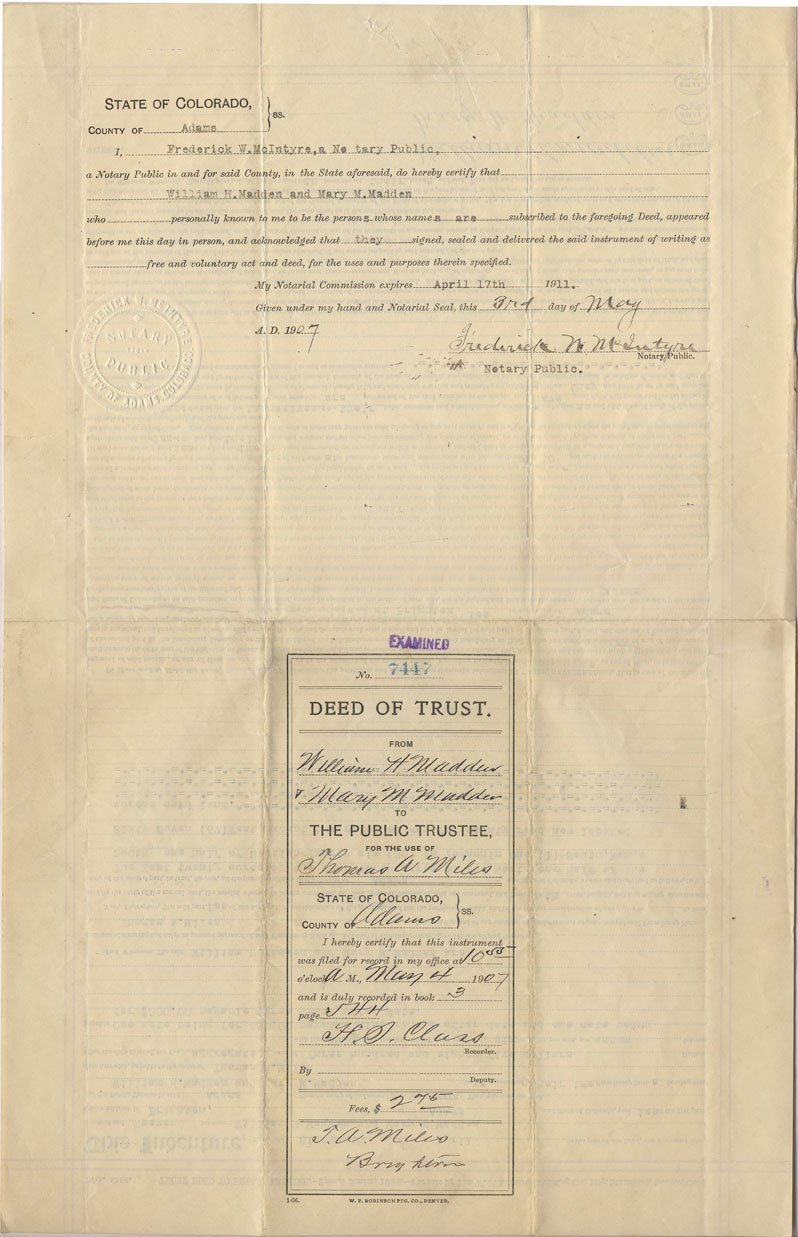
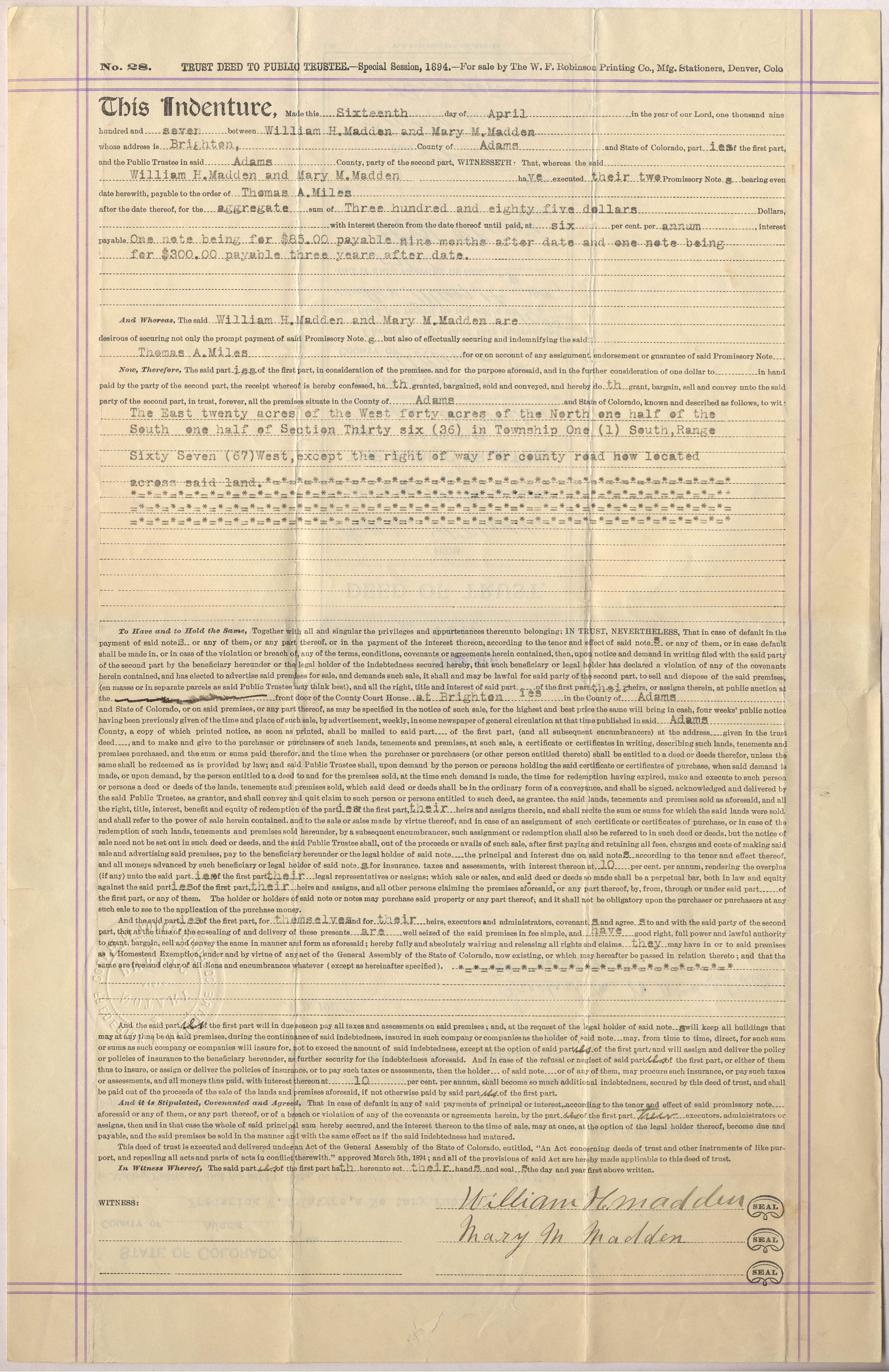
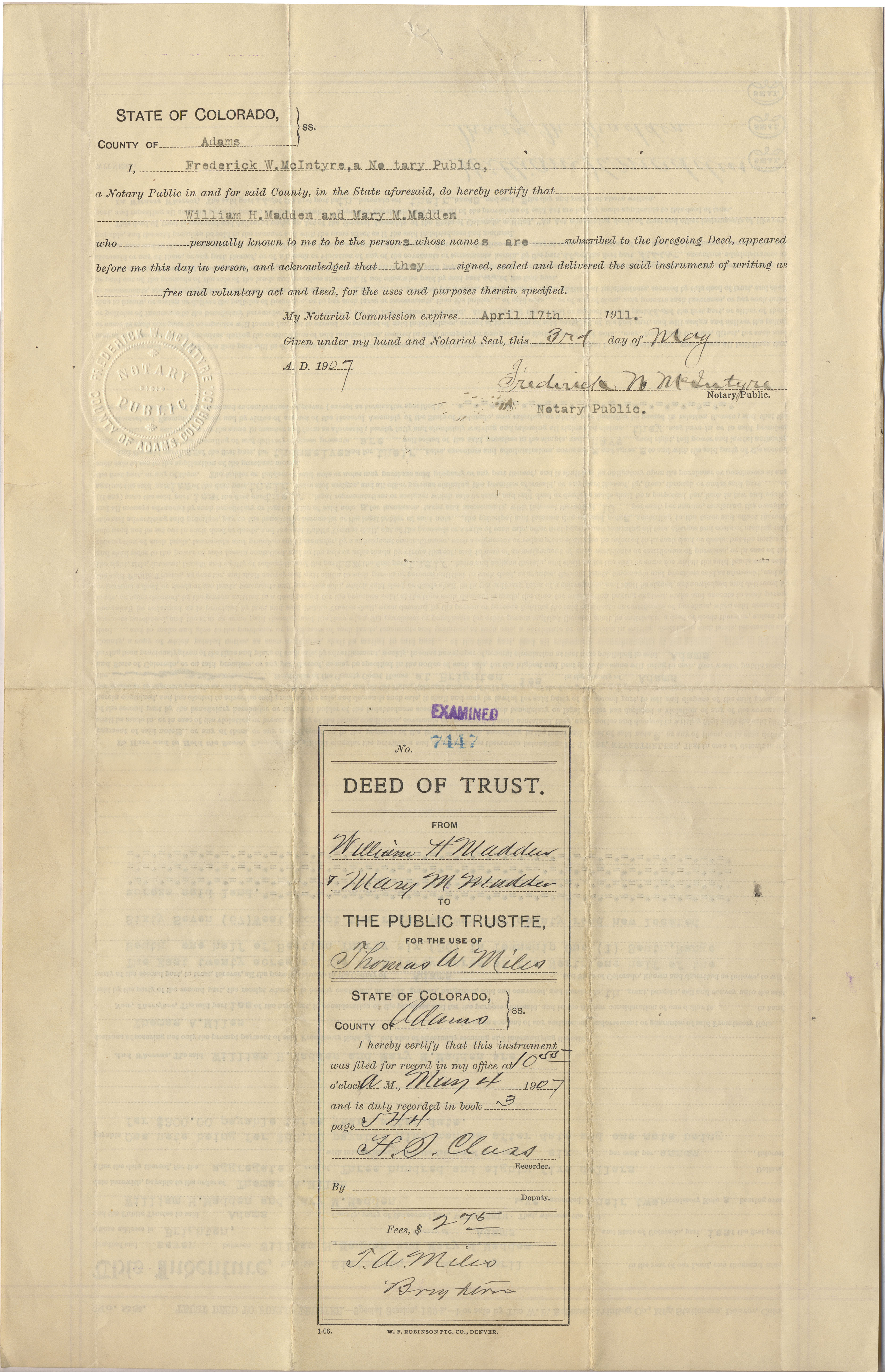
1907 - The Madden's land deed in Adams County for 20 acres in the South Platte River valley east of the rail stop of Henderson, Colorado. |
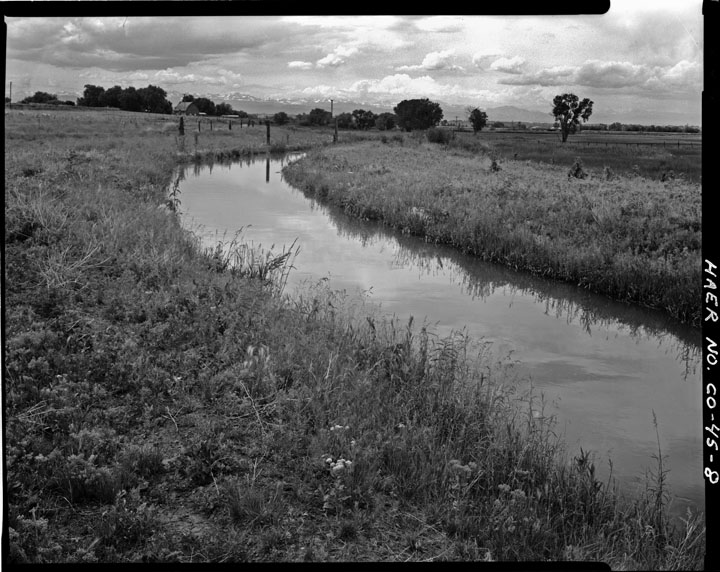
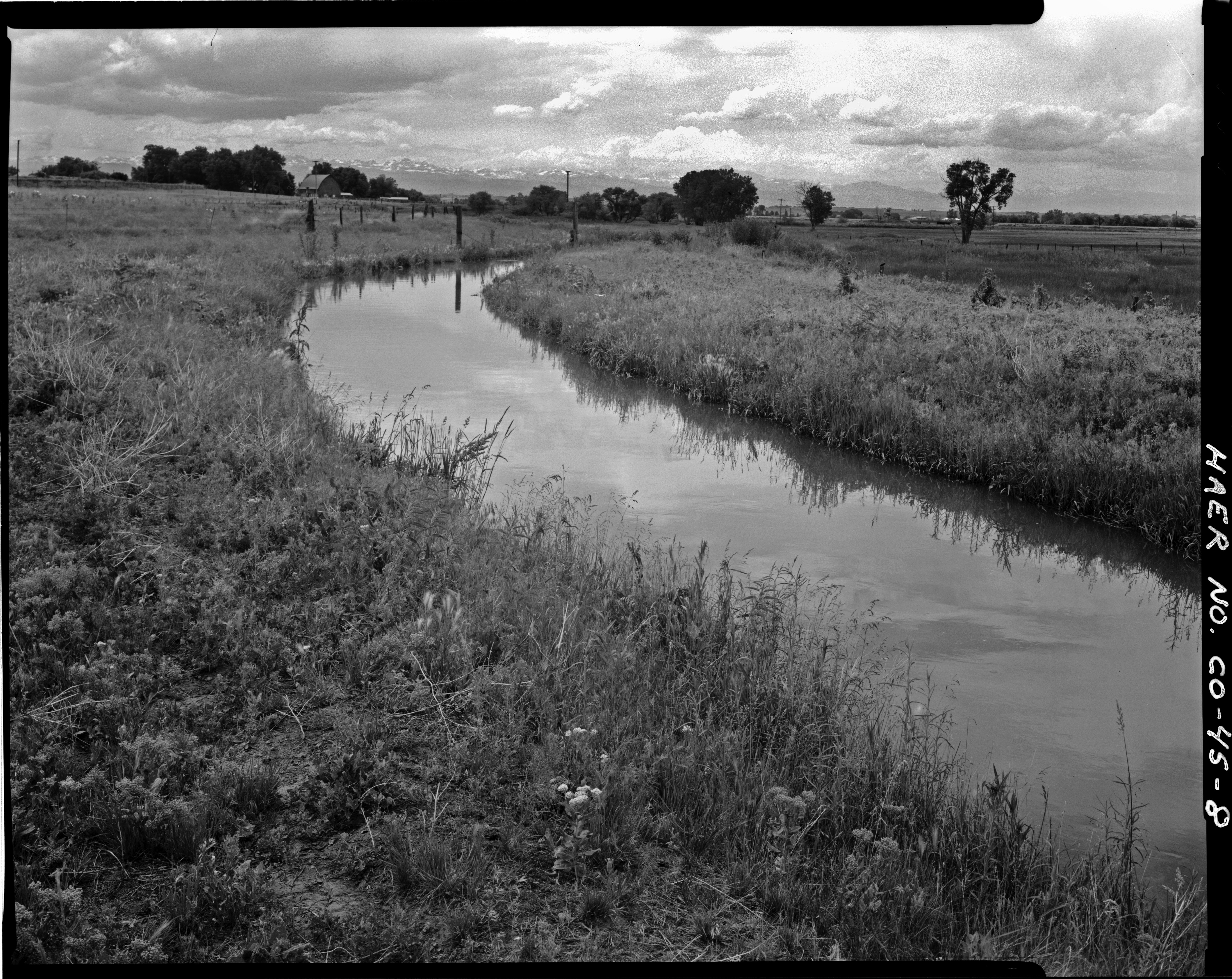
William purchased water rights to the Burlington Ditch and an additional 320 acres of land in 1914 east of the town of Brighton where his land would have looked similar to this. Sitting among shade trees, a barn sits on the horizon line above of the Burlington Ditch with the snow melting on the distant Rocky Mountains. Photo taken in the early 1970s from the Library of Congress. |
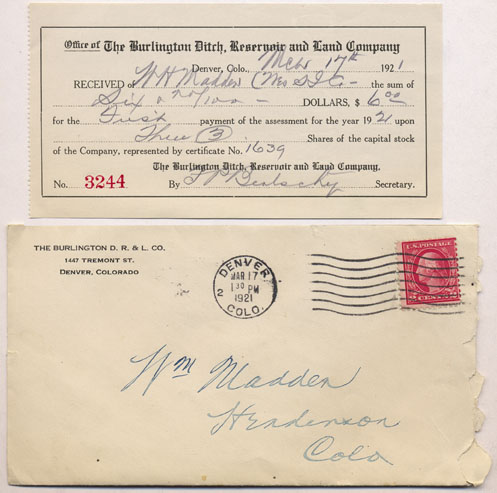
William's 1921 irrigation water payment for three shares of Burlington Ditch Reservoir and Land Co. |
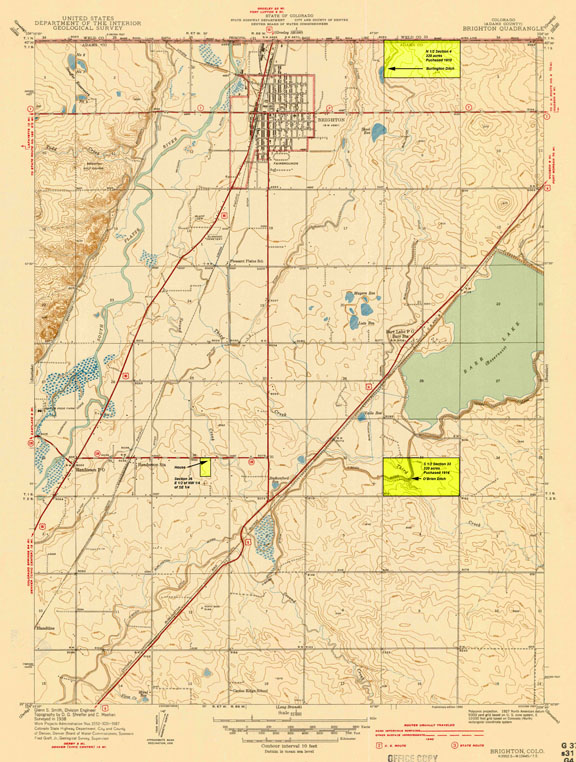
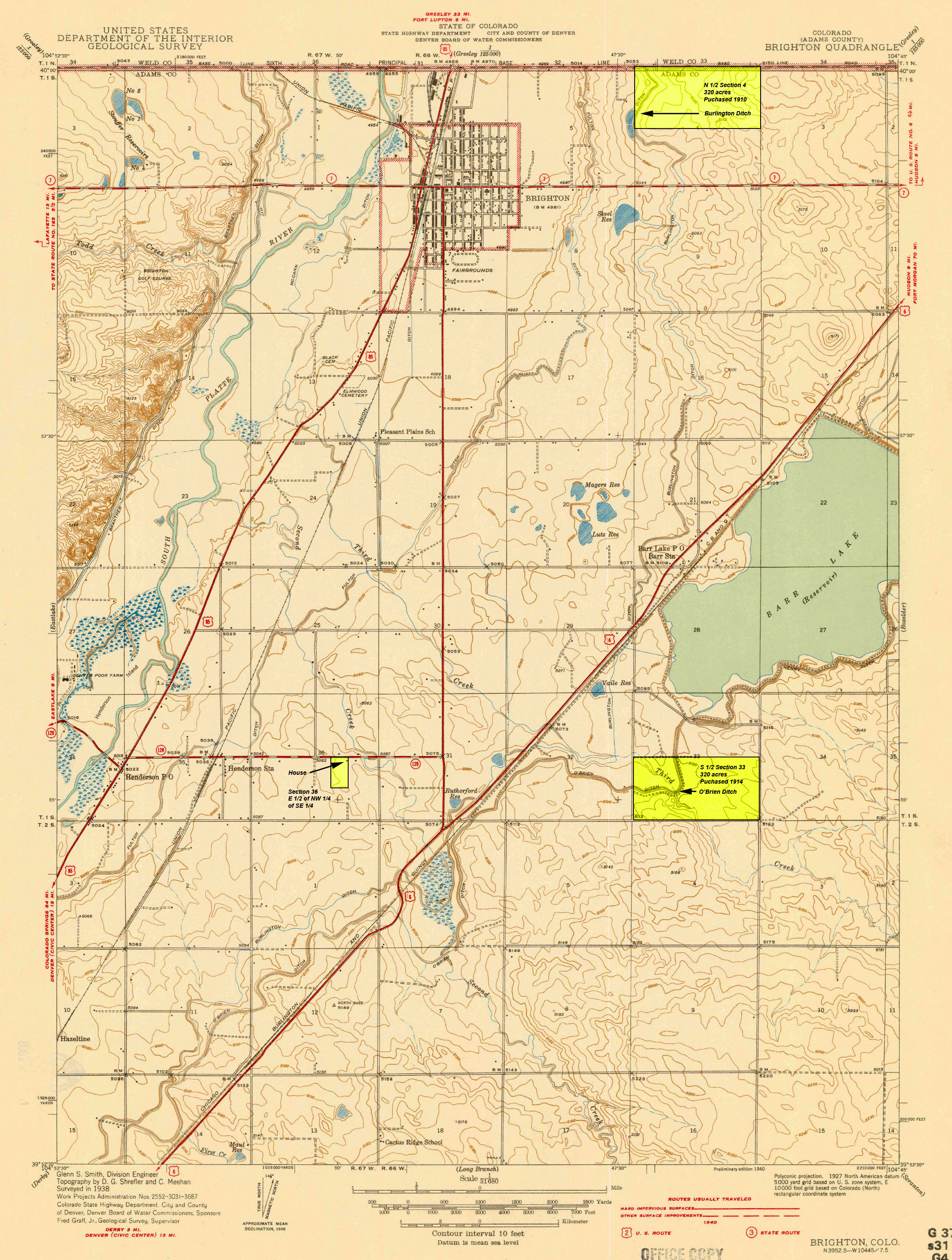
Highlighted locations of the 20 acre plot with an adjacent farm house purchased in 1907 and the 640 acres of agricultural land purchased later in sections 33 and 4 along the Burlington and O'Brien irrigation ditches near Barr Lake.
Today, E-470 cuts through section 33 south of Barr Lake, however much of the land in still agricultural and filled with a large pivot irrigation sprinkler system. A concentrated housing development fills section 4 just off highway 7 and homes with large plots fills his 20 acres along 124th Ave.
The 1940 Brighton Quad from USGS Topoview. |
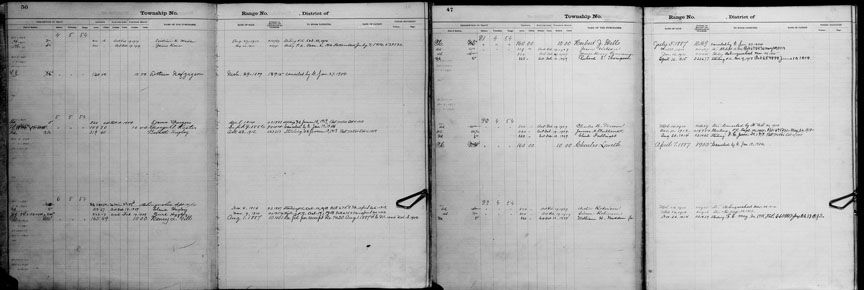
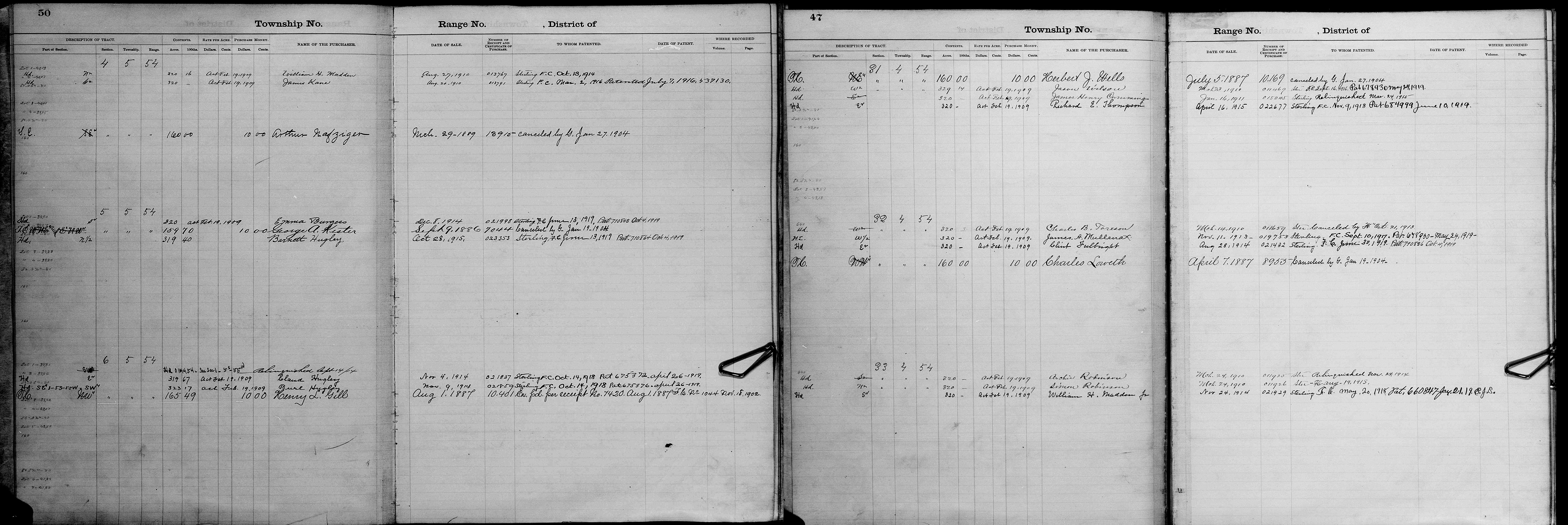
640 acres of land purchased in sections 33 and 4 by William in 1909 and 1914 in Brighton. Records from familysearch.org. |
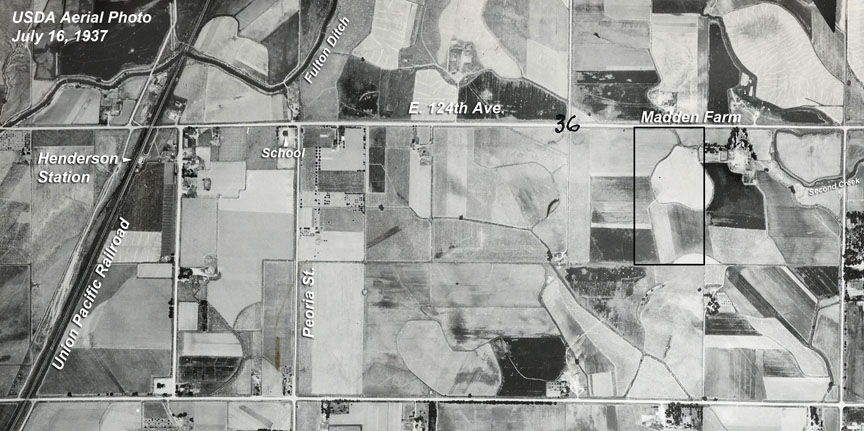
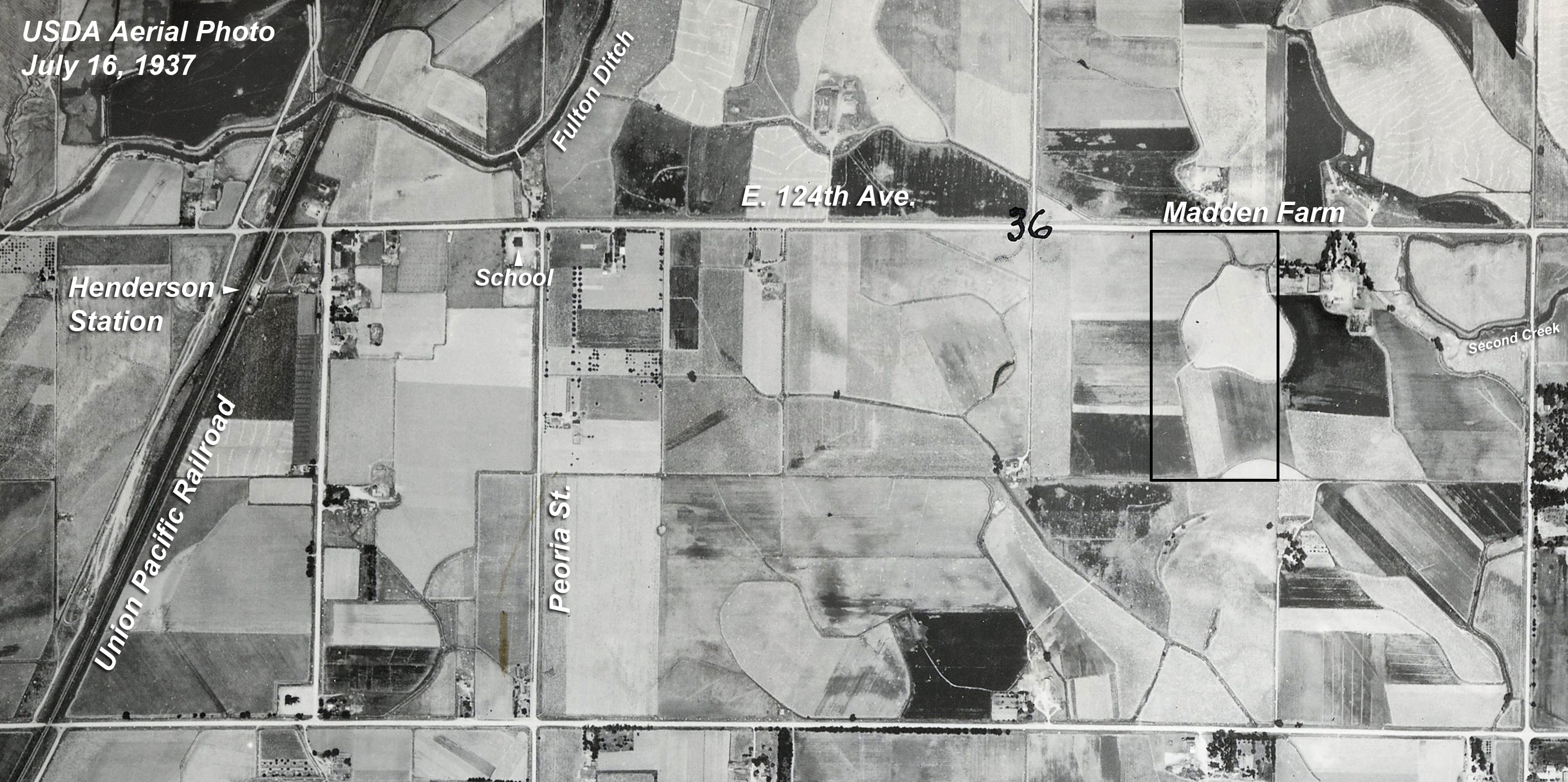
In a 1937 aerial photo, dirt roads and agricultural lands surround Henderson, just south of the town of Brighton. The Union Pacific Railroad runs north and south just a few miles to the west of the farm. Twenty acres of land stand in the E 1/2 of NW 1/4 of SE 1/4 of section 36 Range 67. Agricultural Adjustment Administration photo from the University of Colorado Archives. |
William Madden was born in Illinois in 1858 and moved from Madison Township, Mahaska, Iowa then to the Fort Morgan area in Colorado about 1890. In 1895 he married Mary Bosch (Boesch) originally from Switzerland, in Deuel, near Fort Morgan, Colorado.
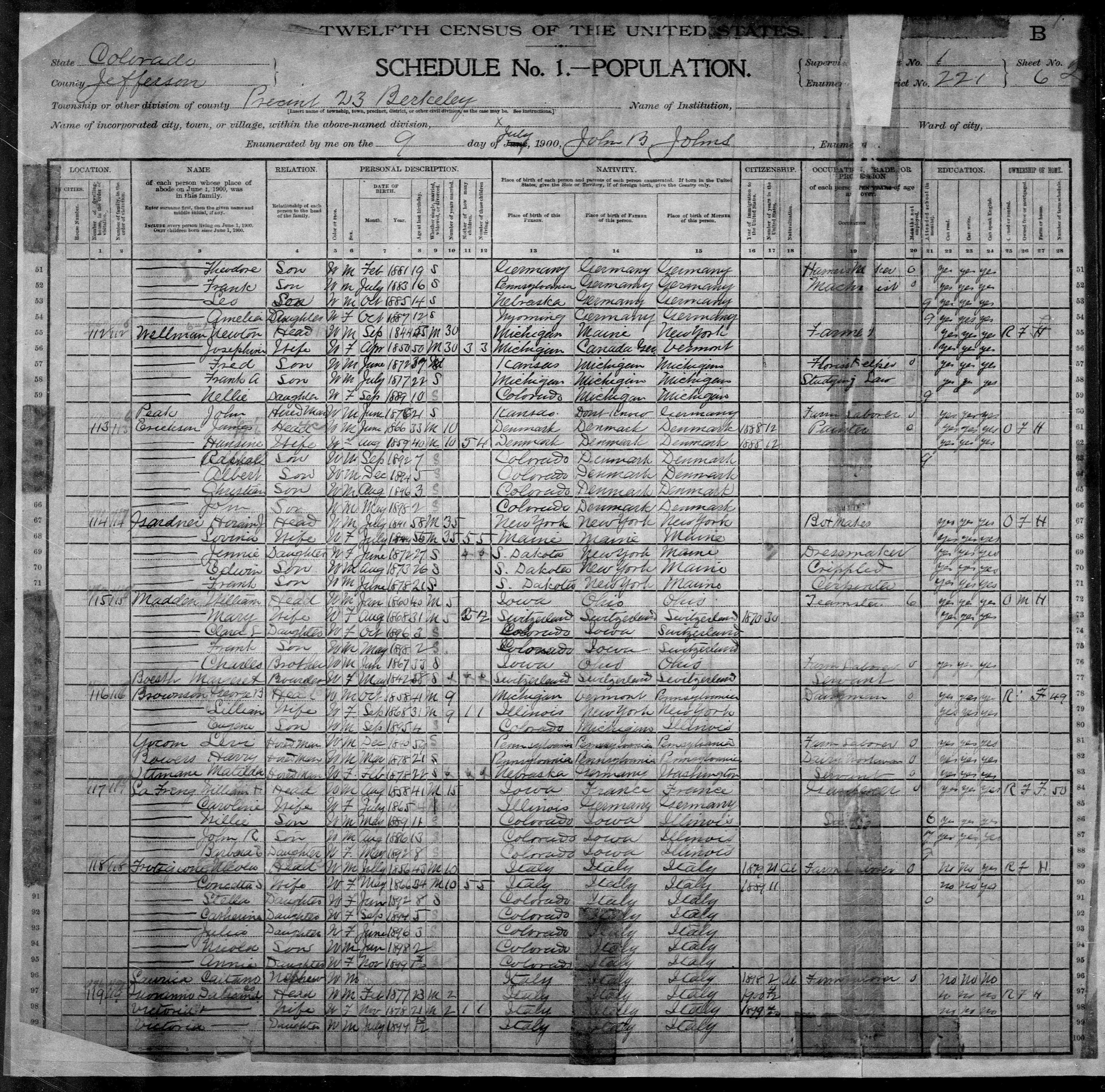
After his marriage, the family, with two kids, Frank, Clara (not to be confused with Clara his sister) as well as William's brother Charles, lived in a home in Jefferson County. According to the 1900 census William worked was a "teamster" for six months where he would have driven a team of horses, mules or oxen hauling goods for long hours and usually low pay.
In the 1890s through the early 1900s, William and his siblings Charles, Clara and Clifford invested in Colorado Front Range homes. William and Charles traded insurance, taxes and payments in a few lots in Alcott, outside of Denver in Jefferson County.
About 1905,
William and his family settled in Henderson, a Union Pacific rail stop south of Brighton in Adams County and in the Platte River Valley. In 1907, he purchased the farm where he would raise chickens, cattle, hogs, have horses and grow a variety of irrigated crops including potatoes, pickles (cucumbers), corn and wheat.
It a bout of hard luck, a severe hip injury late in 1907 laid him up on crutches and eventually he used a cane which greatly hindered his work abilities as he had to depend on his family and hired hands. Next year, his brother Charles, who had just sent family members fresh peaches from the Delta orchards, died of Typhoid in a Grand Junction hospital.
Money was tight and he was always accounting for expenses and profits on any available scrap of paper as various bills would stack up. Money would also go back and forth between him and his brothers that also came west. He worked his farm and paid his taxes as one of his brothers, Charles worked on the Colorado western slope maintaining fruit orchards, pruning trees and picking peaches, apples and cherries in Delta and another, Alpheus worked his mining claims in a treacherous gold mine in Oregon while living alone in a cabin while also sustaining injuries of his own digging a 174 foot tunnel in the mountains.
William traded letters with his brothers and his wife's family in Iowa. He worked as a farmer for the rest of his life, even purchasing another 640 acres of agricultural land in 1909 and 1914. Later in life, he hired workers to harvest and work his crops and eventually, was burried in the Elmwood Cemetery in Brighton in 1938.
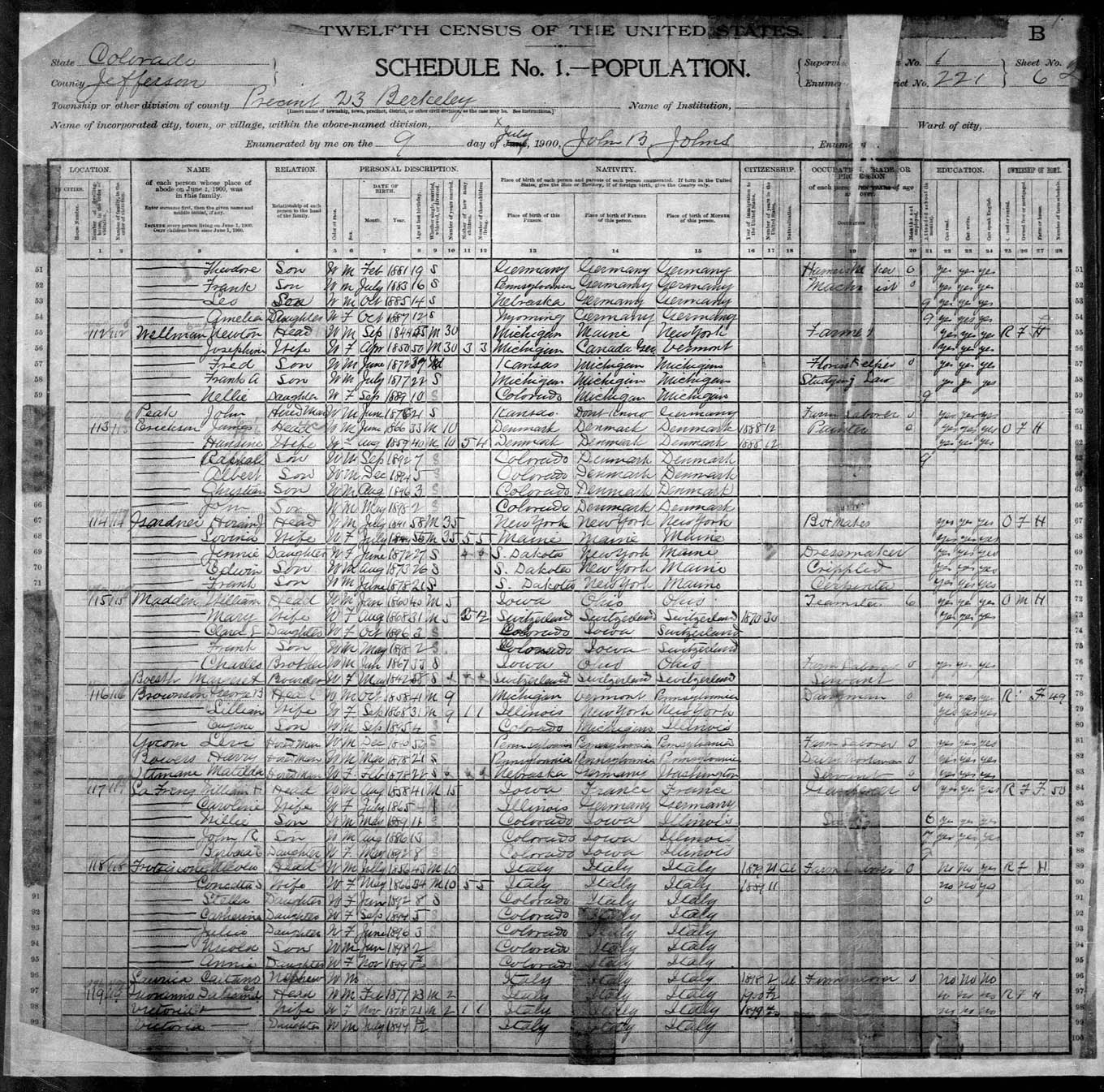
The 1900 Census for Jefferson County shows the Madden Family living in a home they owned and William worked was a "teamster" for six months. The 1910 Colorado Census shows they were living in Adams County on their farm as does the 1920 and 1930 census. Census records from familysearch.org. |
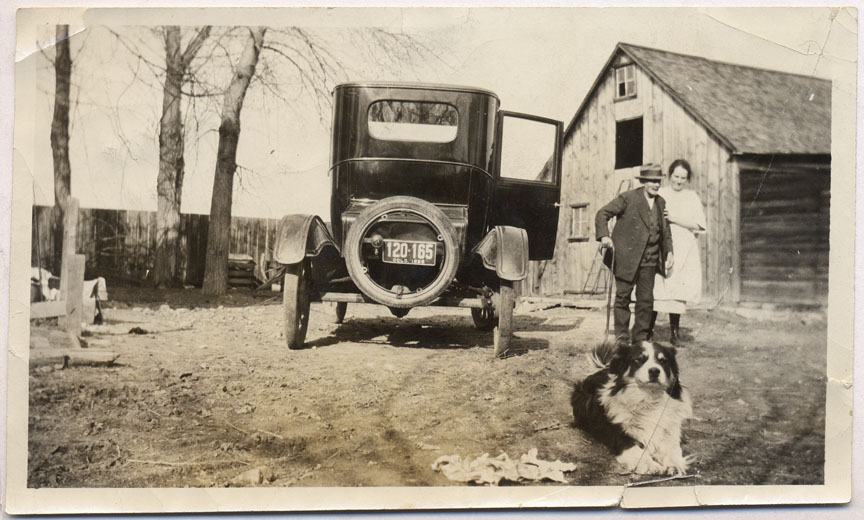
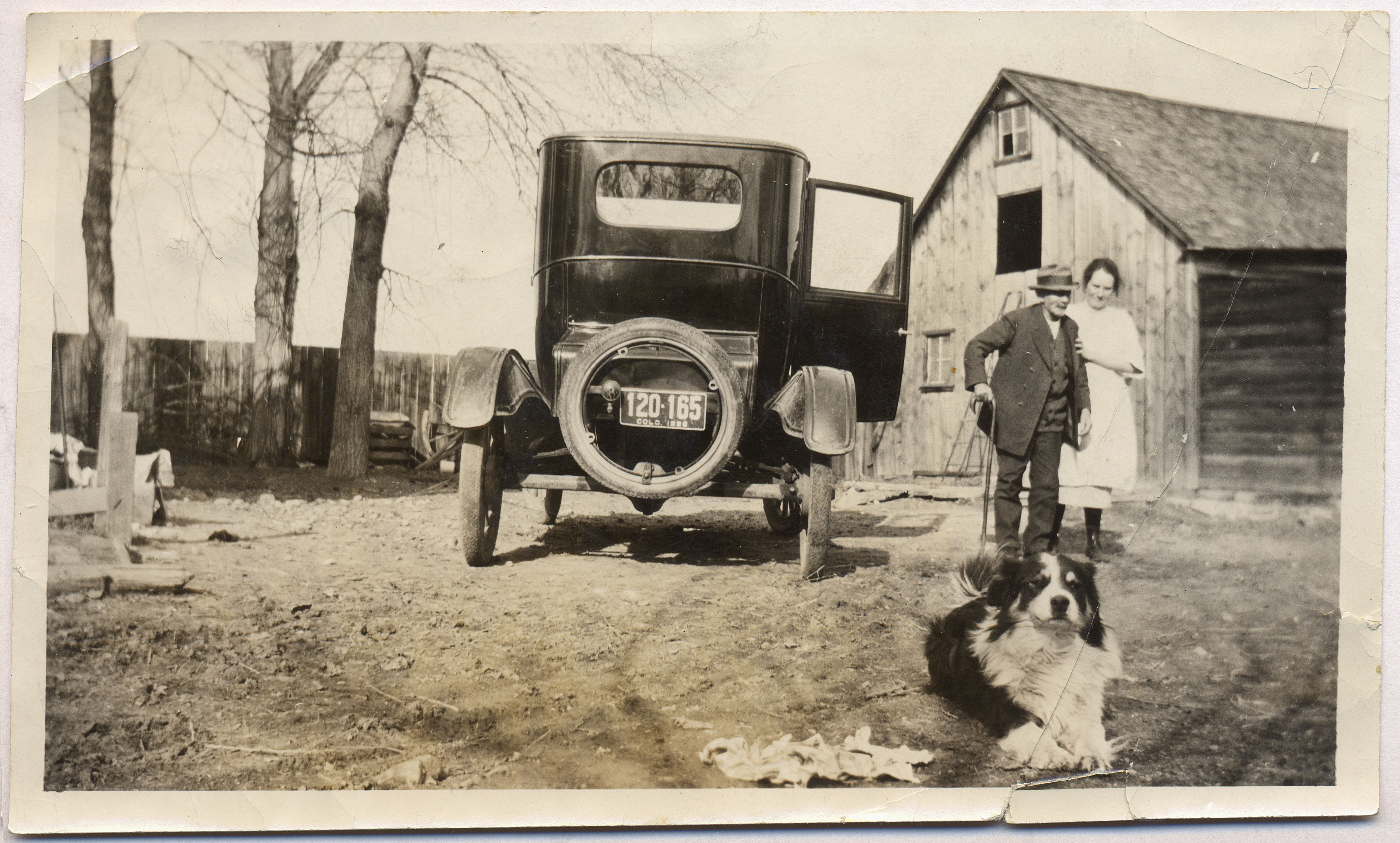
A photo in with the documents was taken about 1926 or 1928 according to the Colorado licence plate, it very well may be William's farm. It is likely William himself walking with the cane after a severe hip injury in 1907 after which he could not walk for a long time. He would have been 68 or 70 years old at the time the photo was taken. He was still using a cane that he mentions in his 1908 letter to his brother after his injury where he had to use crutches and the neighbors had to plant his grain. In a December 1, 1908 letter from his brother, Alpheus wrote "I am sorry that your hip is not well yet. I fear it never will get well, you must not expose your self in the cold weather."
Unfortunately, nothing was written on the back of the photo. The border collie looks ready to herd the cows. |
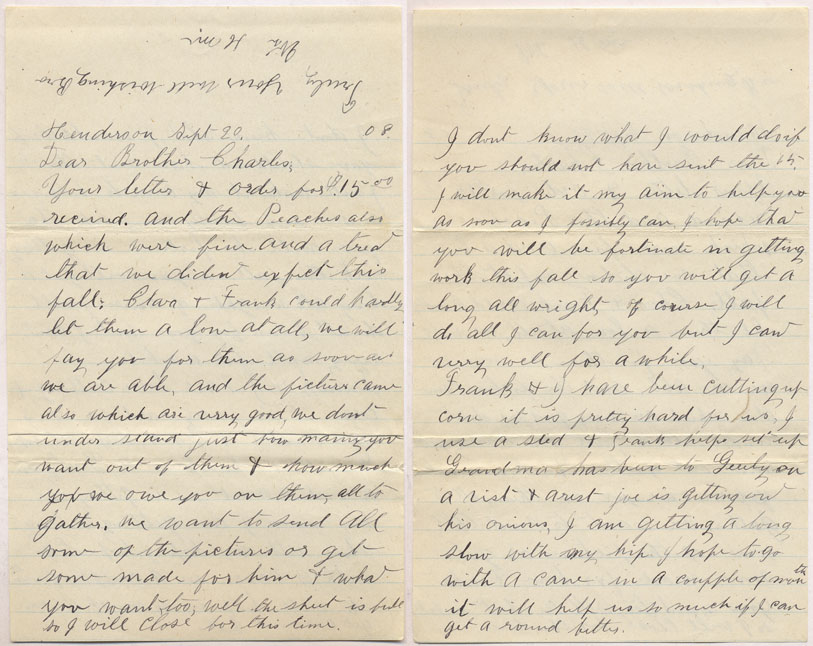
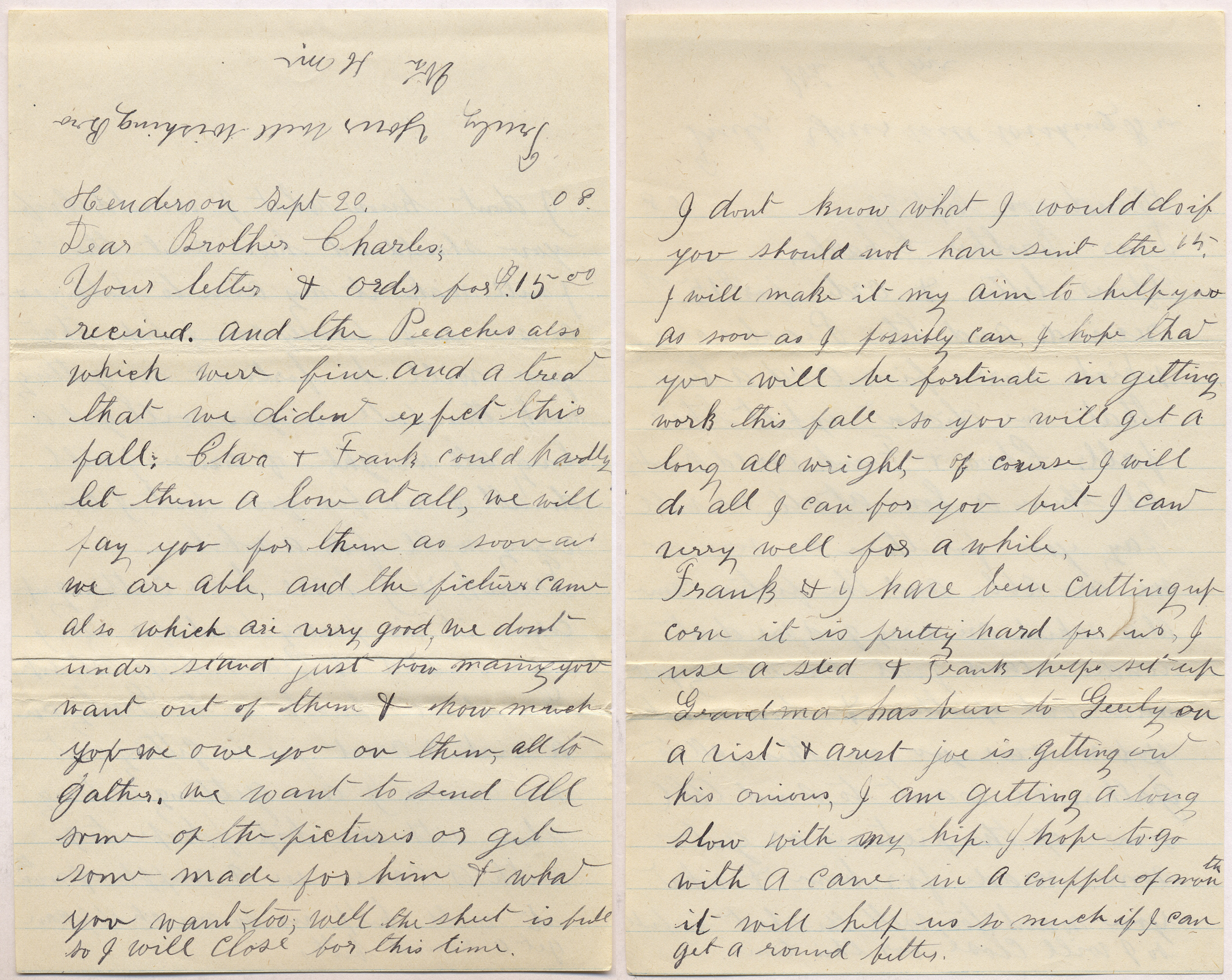
William's September 20, 1908 letter to his brother Charles working in the orchards of Paonia, Colorado. He mentions the peaches Charlie sent and the photos they took when Clara, their sister and her husband visited Colorado. William writes that his son Frank and J (for Joe) had been cutting up corn and William uses a sled. He mentions "I am getting a long slow with my hip I hope to go with a cane in a couple of months it will help us so much if I can get a round better."
Ironically, William's last letter to his brother was sent back to him after Charlie died from Typhoid in a Grand Junction hospital and Hiram, his other brother sent the letter back with others after the funeral in Iowa. |
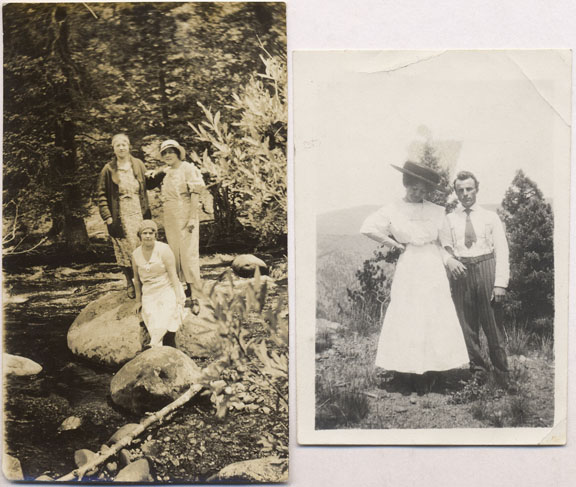
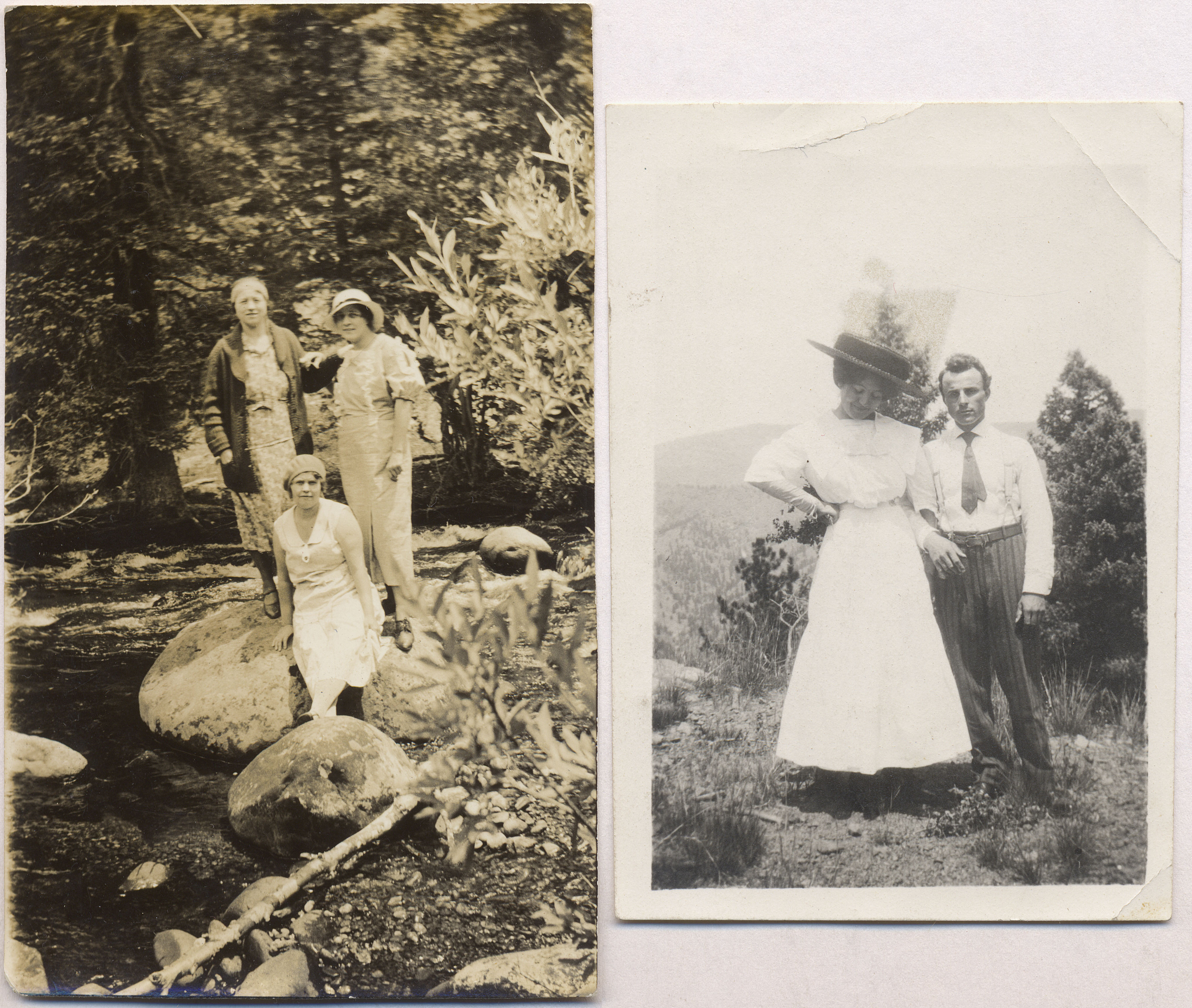
Another pair of unmarked photos with the Madden documents, perhaps taken on a trips to the Front Range Rocky Mountains. William's sister, Clara and her husband Ross Reece made trips to Boulder, Colorado in August of 1908 along with her brother Charlie who was taking the photos and sending some to William according to letters. |
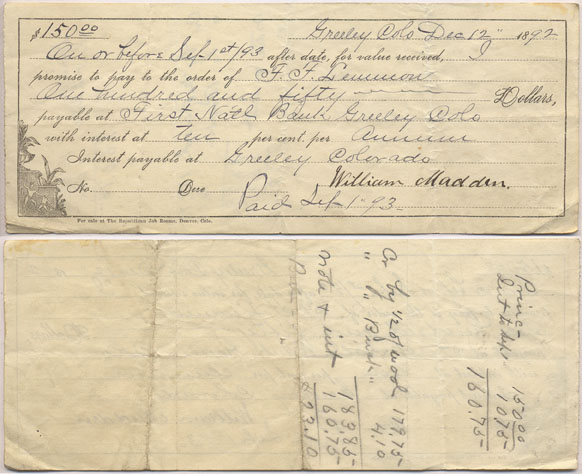
A 1892 balance for $150.00 paid by William Madden on September 1, 1893 at the First National Bank in Greeley, Colorado with calculations on the back. William and his brother Charles along with family in Iowa were investing in Fort Morgan real estate together. |

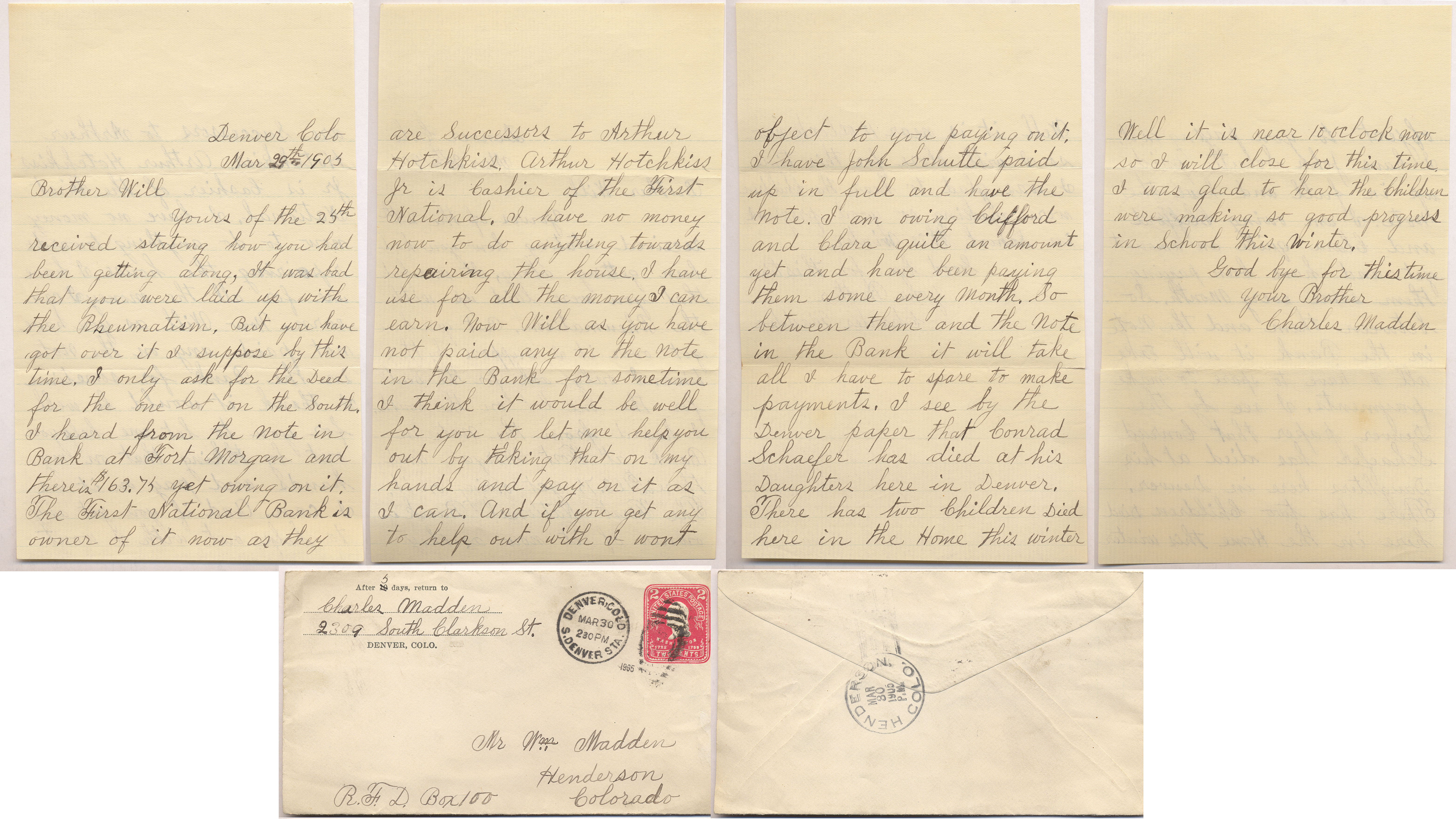
In 1905, Charles wrote William telling him the Fort Morgan property owner (the bank) they were making payments on, was The First National Bank, the same bank listed above. Charles stated he had no money for repairing the house and also owed his siblings Clara and Clifford. William and Charles would also invest in Jefferson County homes in Alcott outside Denver, Colorado. |
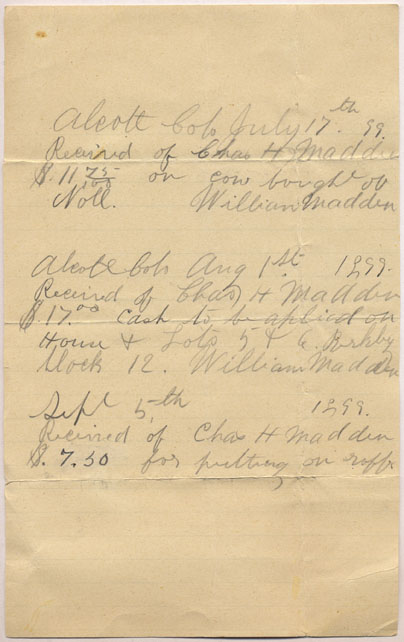 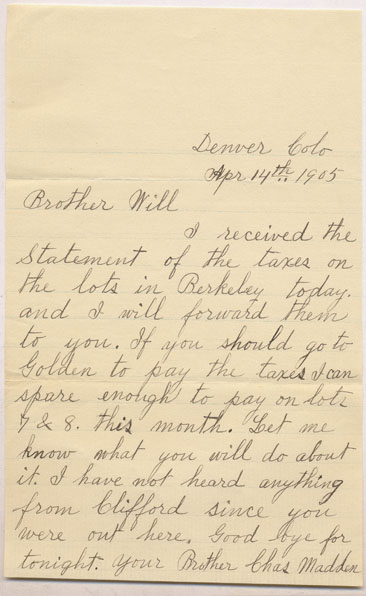 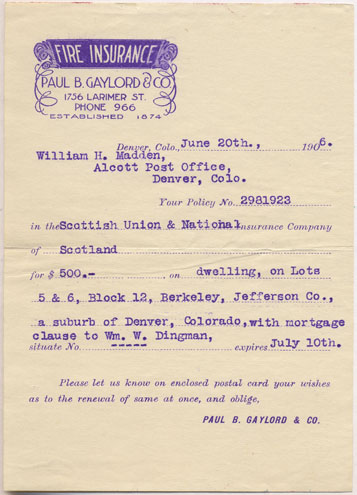
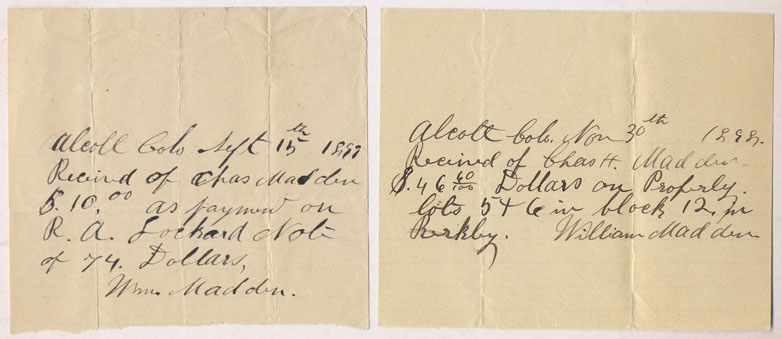
1899 receipts from Charles and his brother William Madden for a cow, house lots 5 & 6 in Berkley and new house roof in Alcott, Colorado, before they moved to Brighton.
Charles and William made an investment together purchasing the Alcott, Berkley homes in Jefferson County. Later in 1905, Charles would write William about paying the taxes in Golden on lots 7 and 8 in Berkley. Who ever had a bit of money at the time would pay on the notes and cover expenses like insurance and repairs. Each brother would document the payments made by the other on scraps of paper.
 |
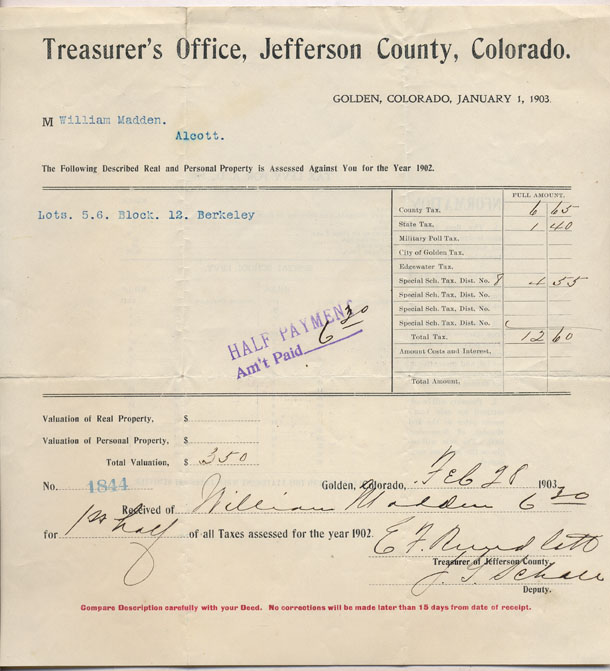
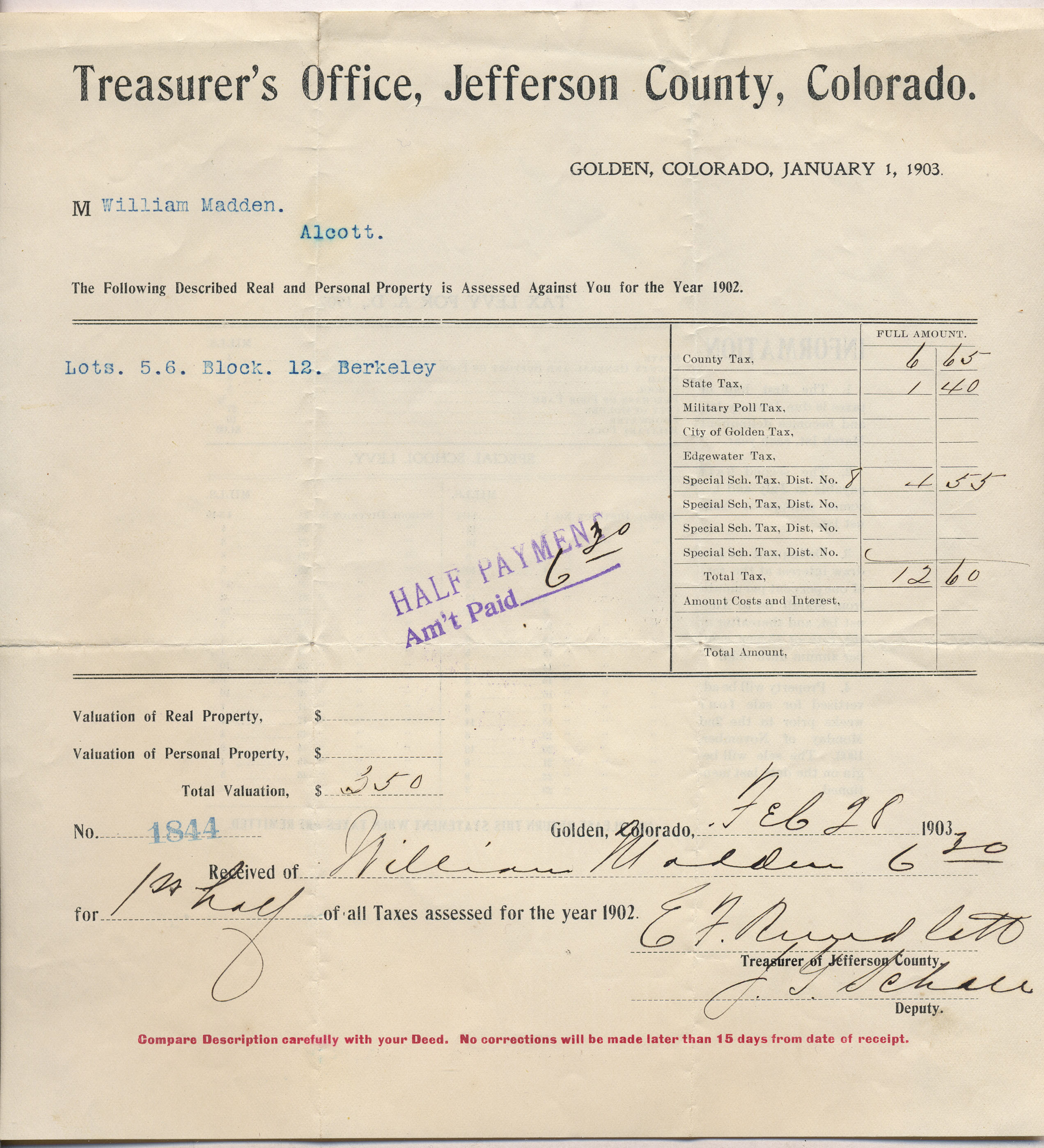
William's taxes for Berkeley lots 5 and 6 in Alcott, Jefferson County in 1903. Soon after he would move to Adams County. |

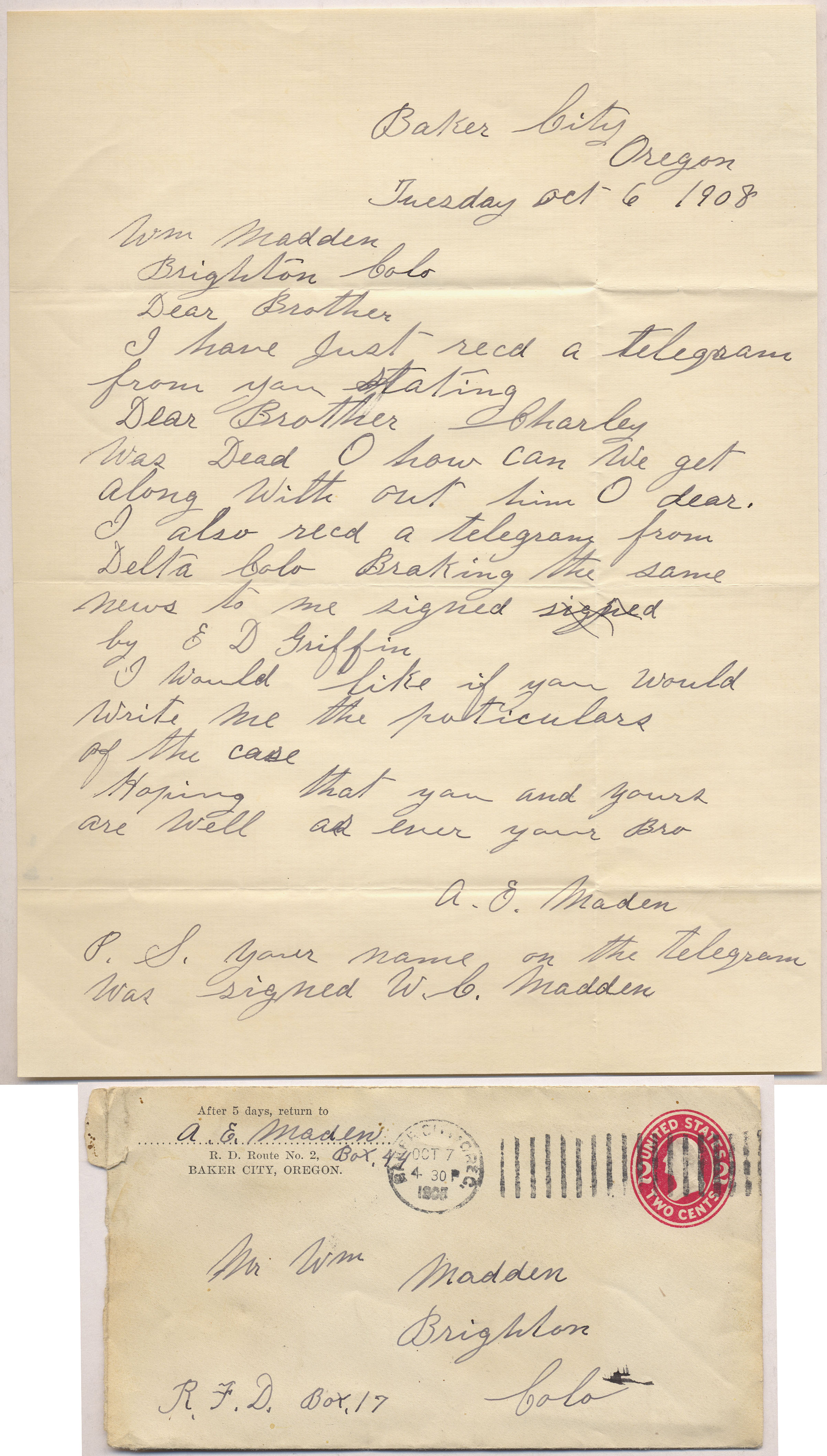
After a sudden death of Charles in 1908 from typhoid, Williams other brother, Alpheus in Oregon, writes an alarmed letter to William. |
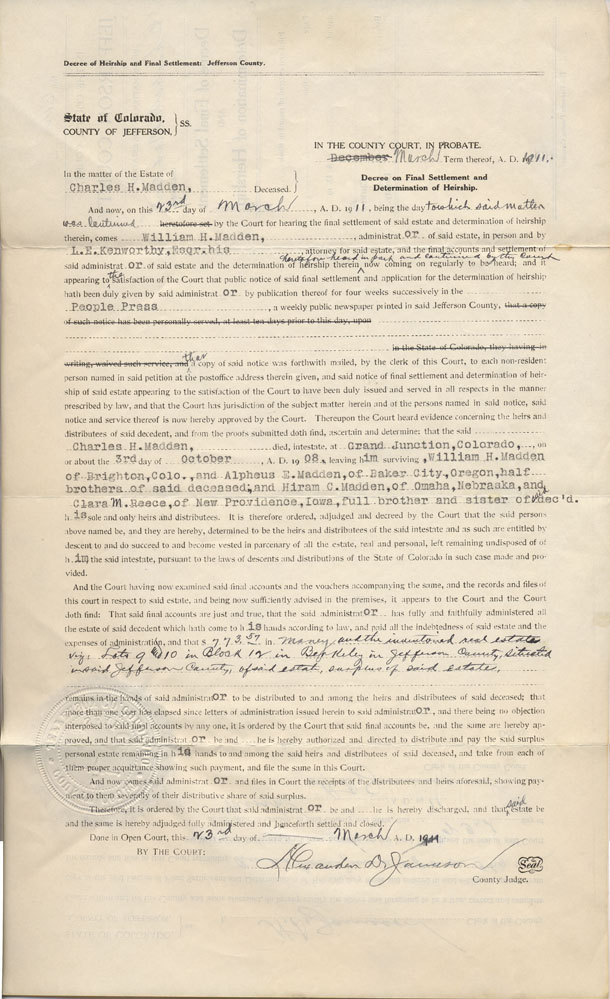
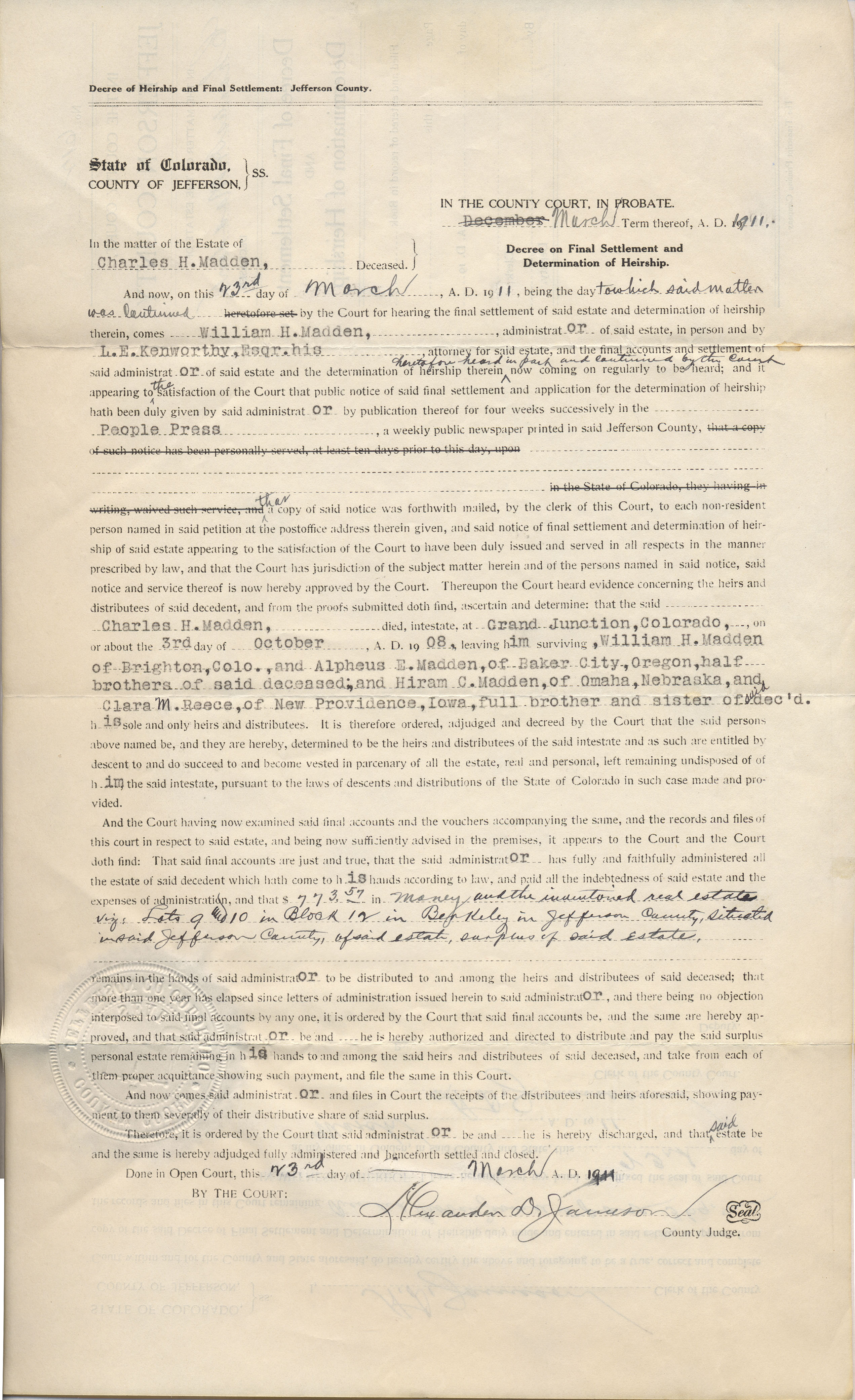
Three years later after Charles death in 1911, William receives a estate settlement from Charles' investments in Berkley lots 9 and 10 from Golden, Colorado in Jefferson County. The document also lists other family members Alpheus, Hiram, and Clara. |
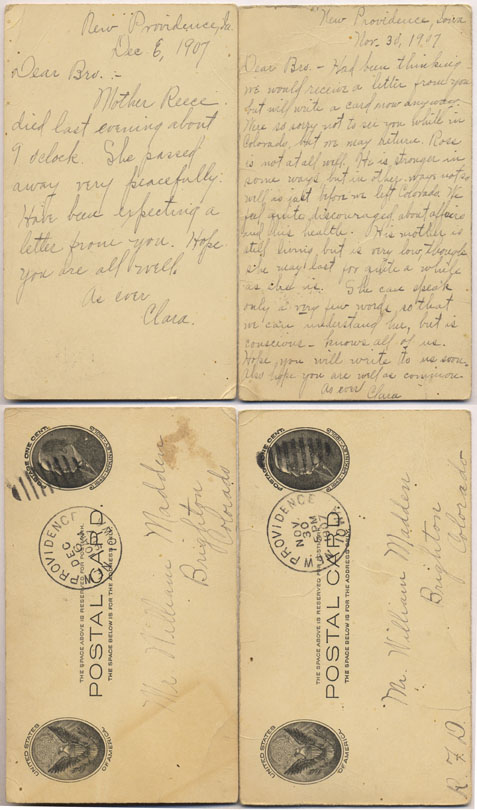
1907 Post Cards from his sister, Clara Madden Reece in New Providence, Iowa. One card mentions the death of her mother in law. |
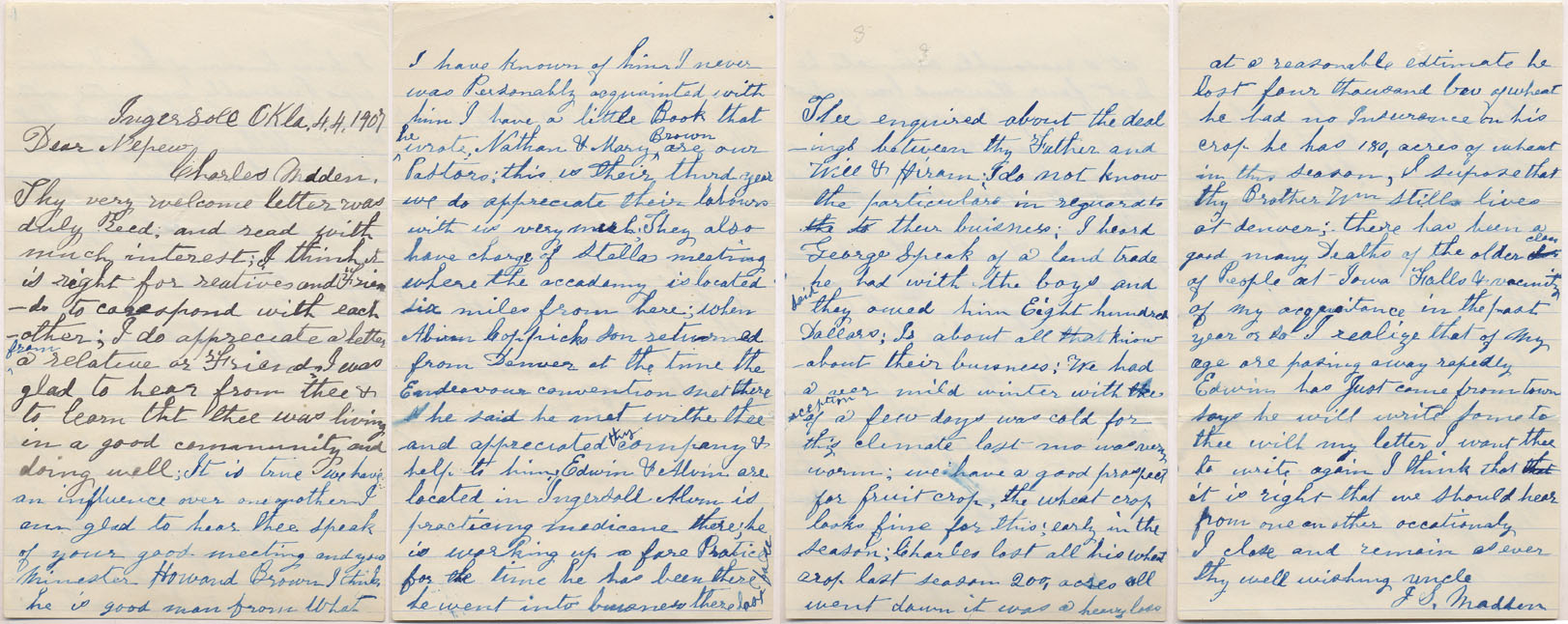
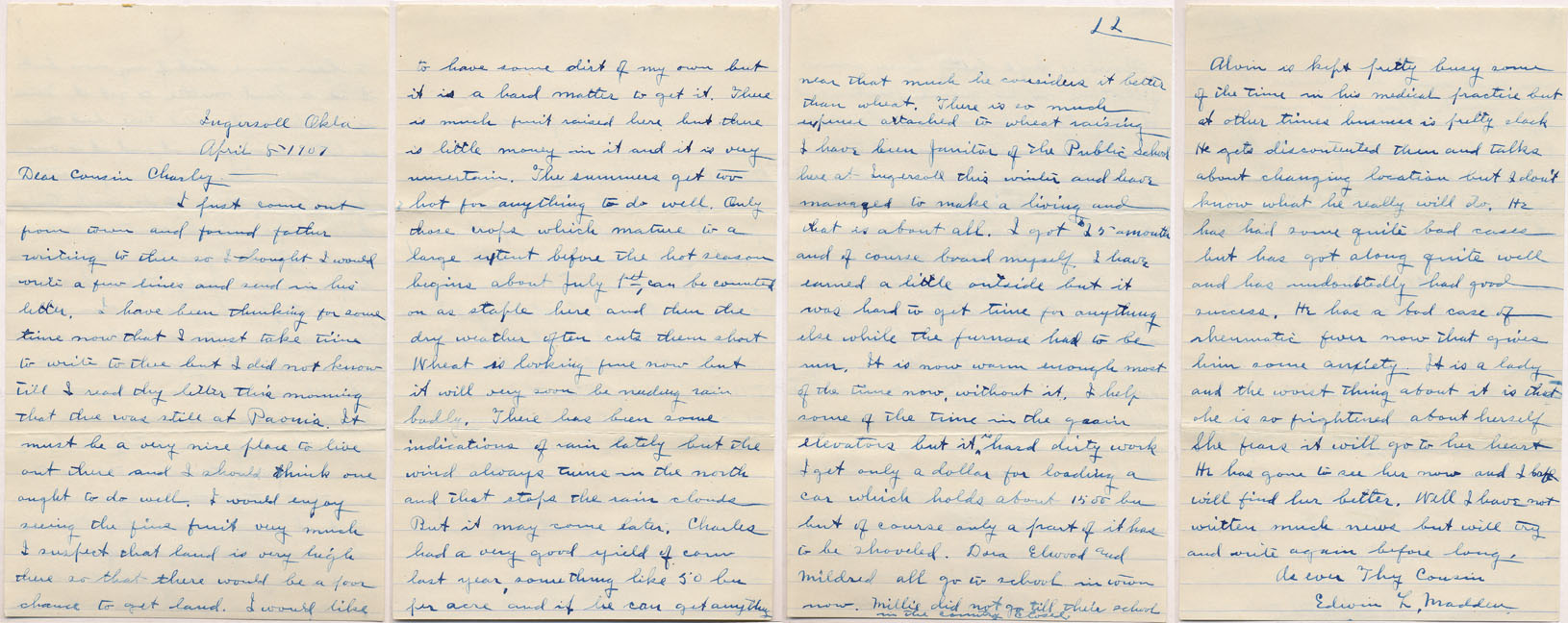
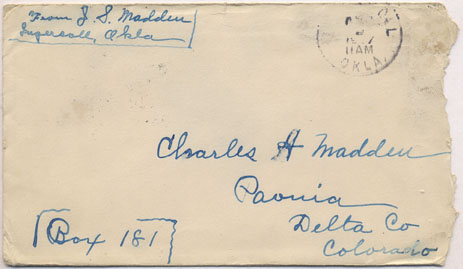
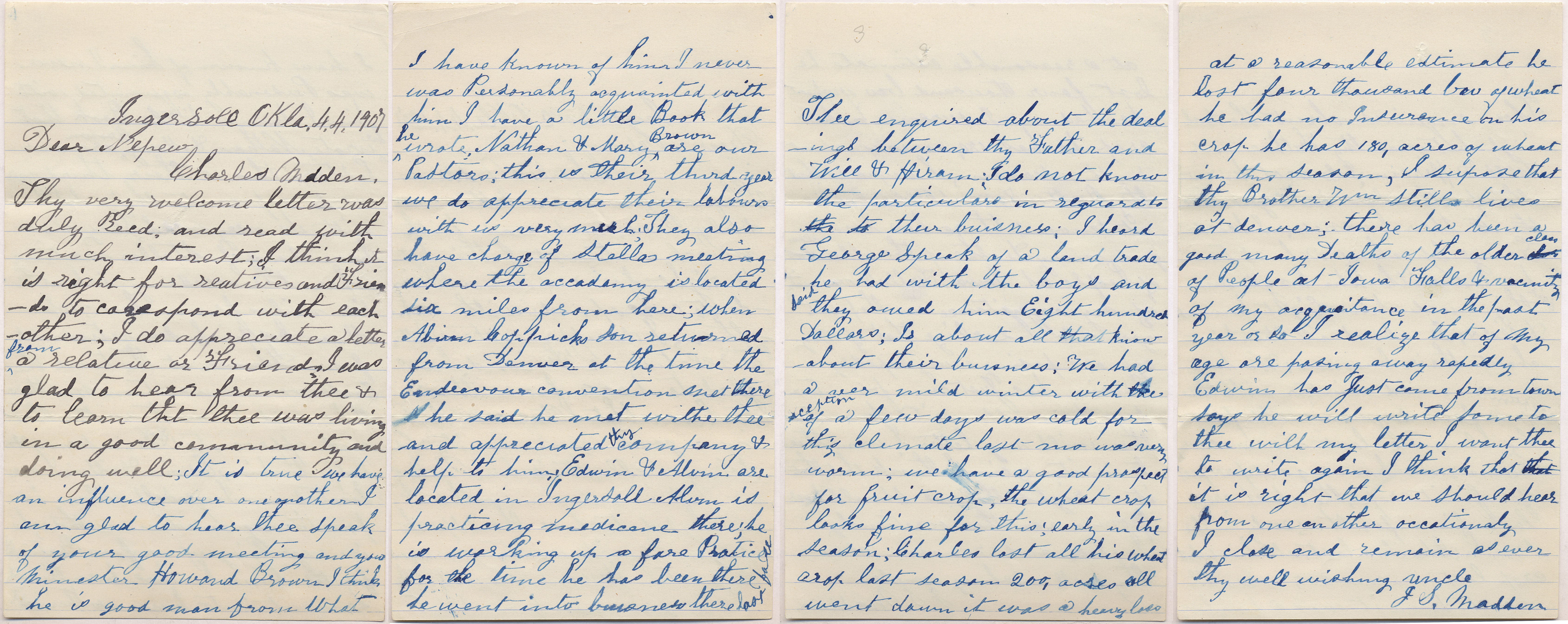
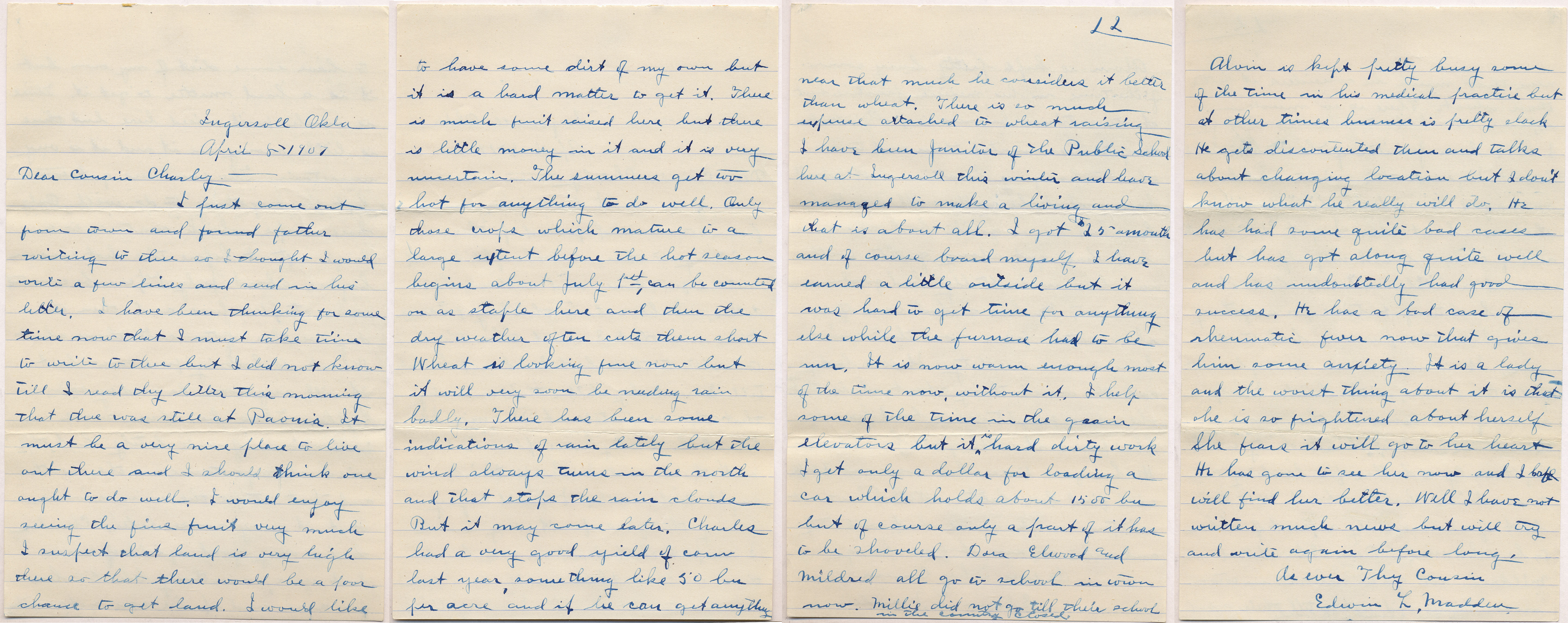
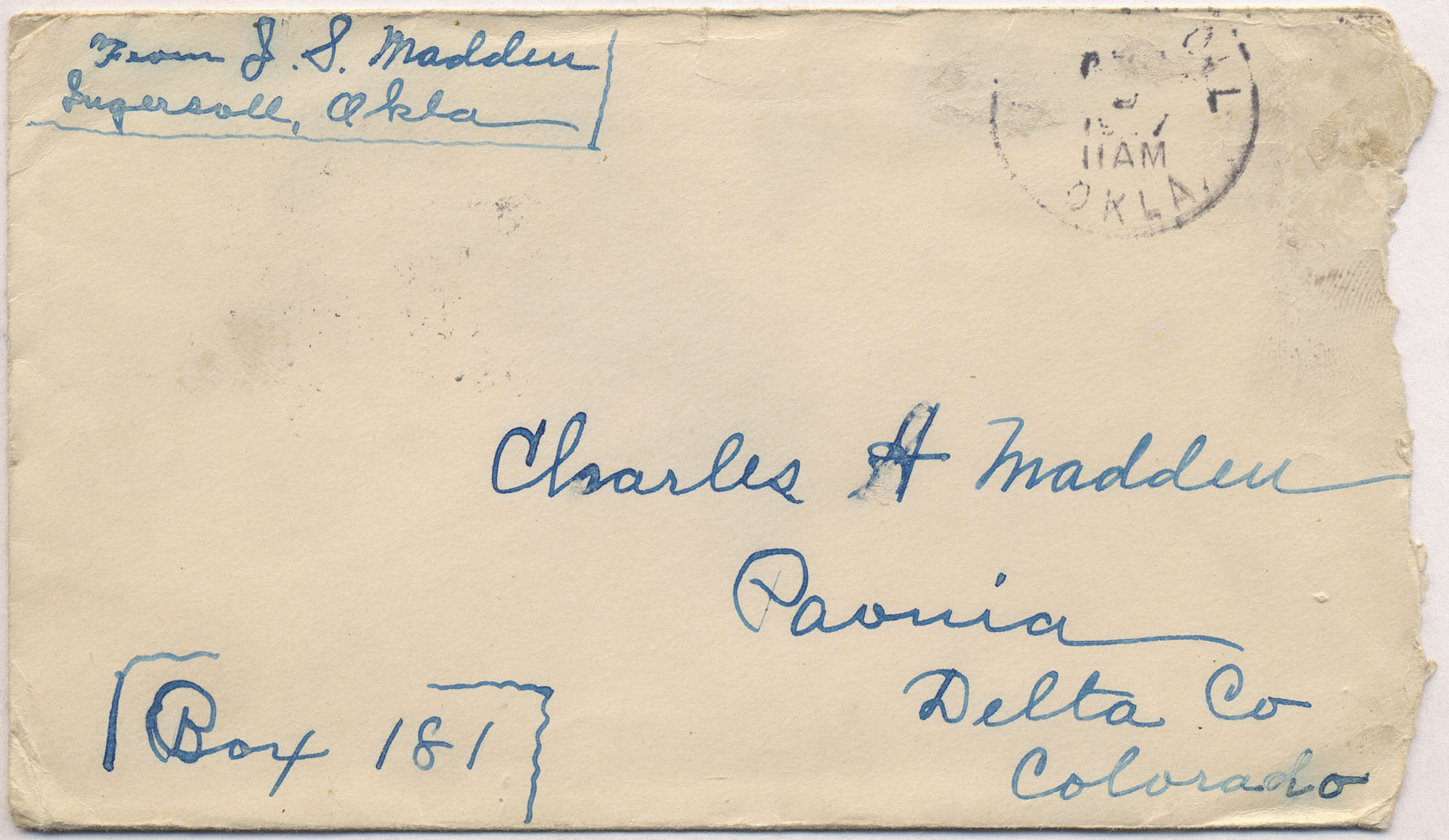
Two letters for Charles A. Madden who was pruning fruit trees an picking peaches in Paonia, Delta Colorado. From Edwin L. Madden and his father J. S. Madden in 1907 in Ingersoll, Oklahoma. Edwin was working as a janitor at a school for $25.00 a month and Alwin who was practicing medicine were both living in Ingersoll, Oklahoma. Another relative named Charles lost his 200 acres of wheat. |
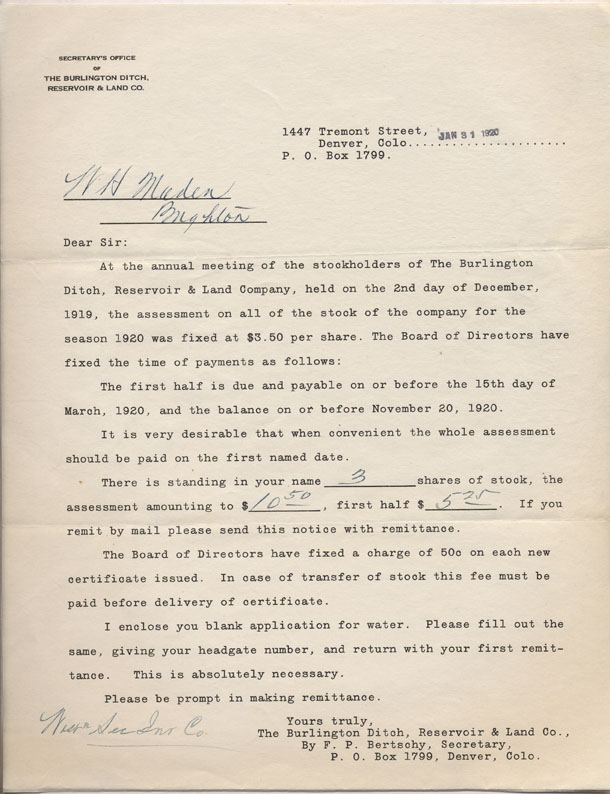
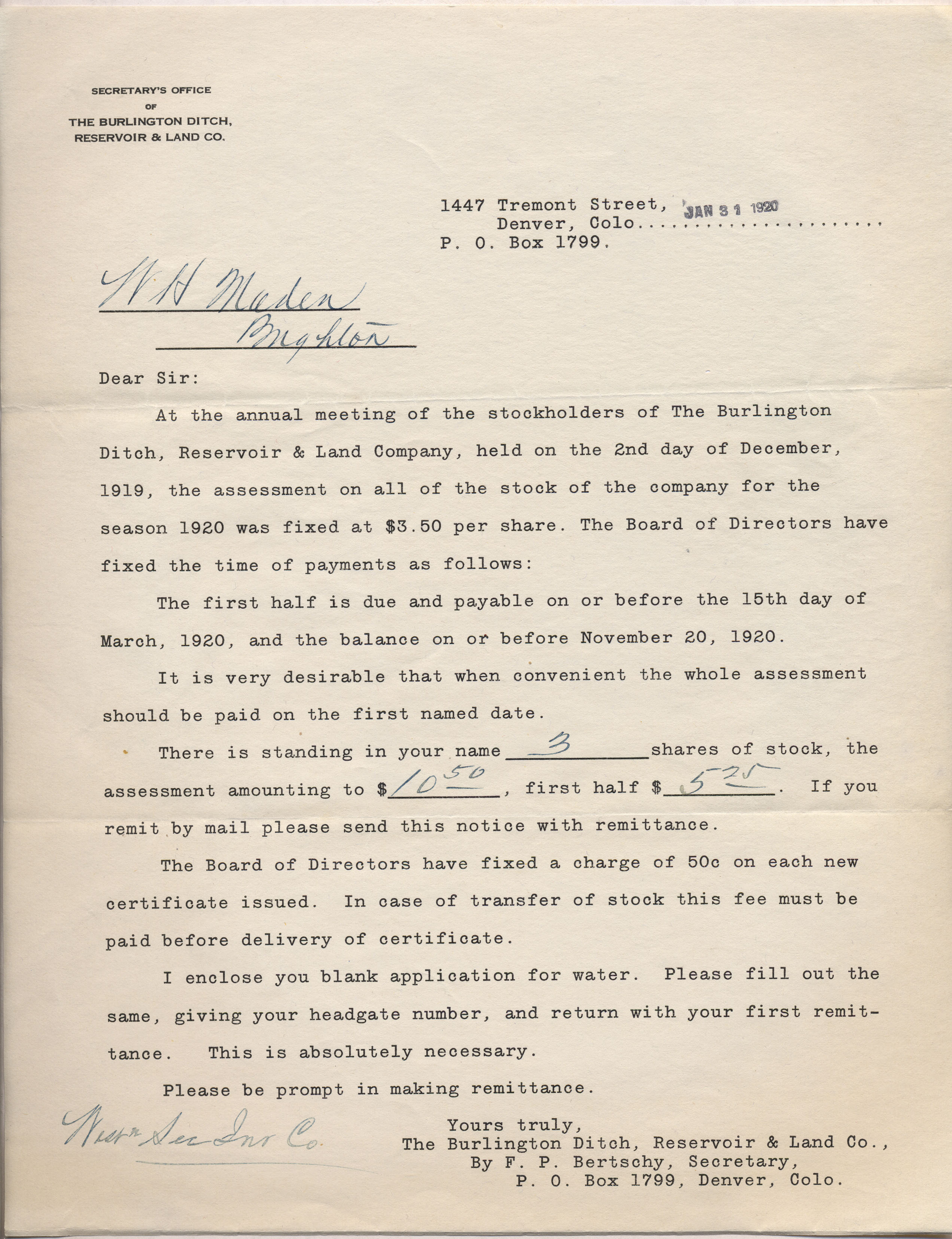
1920 - Water letter for 3 shares of The Burlington Ditch, Reservoir and Land Company with a request to fill out the application for water also "giving the headgate number."
The Burlington Ditch ran water from the Platte River and filled the nearby Barr Lake which once was a buffalo wallow, a natural low area that collected water during the rainy season. A small dam and canal were constructed in 1886 and over the years, the dam was enlarged multiple times and today forms Barr Lake State Park. |

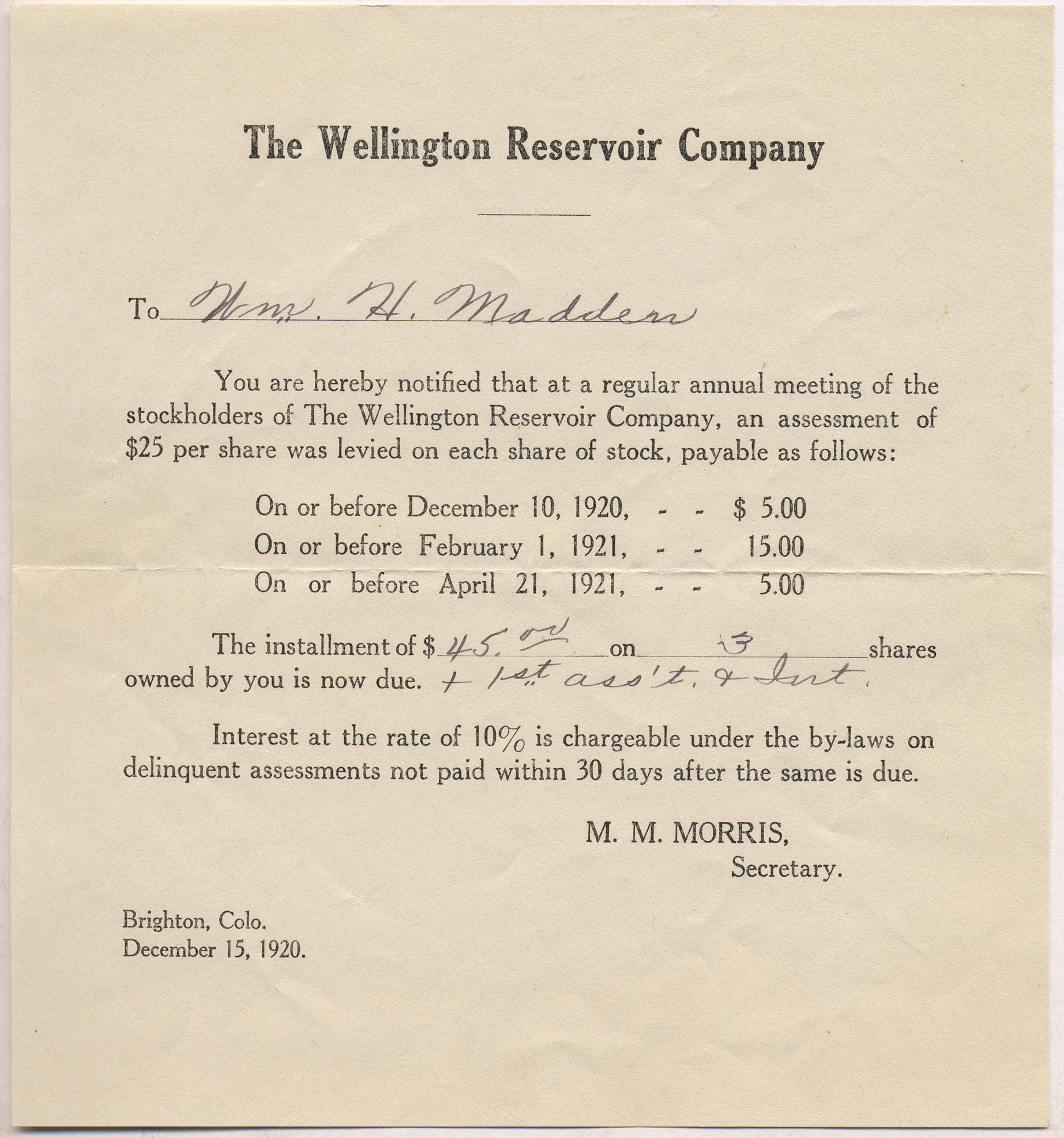
1920 - Payment due of $45.00 on 3 shares of the newly formed (January 22, 1920) company, The Wellington Reservoir Company. |
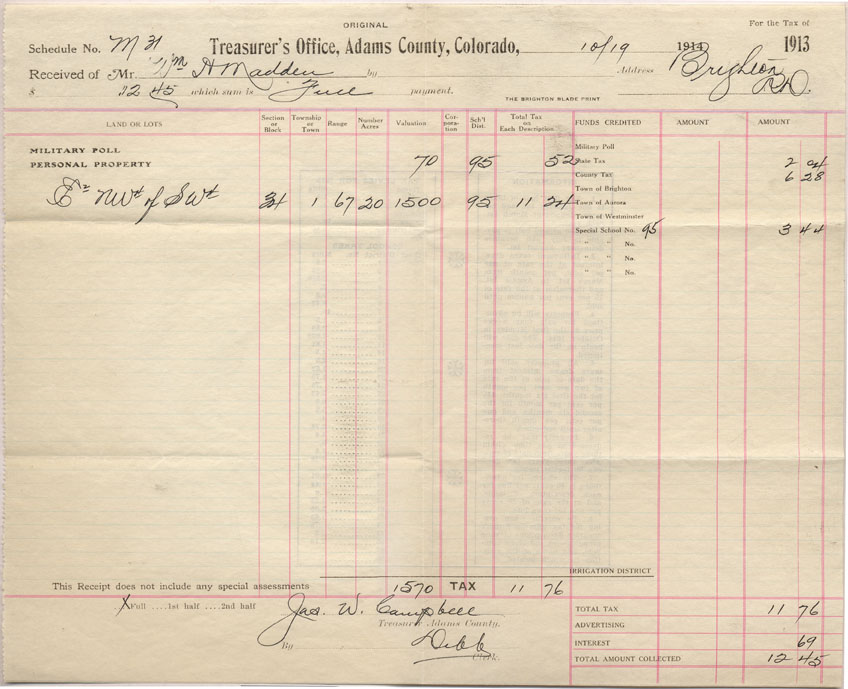 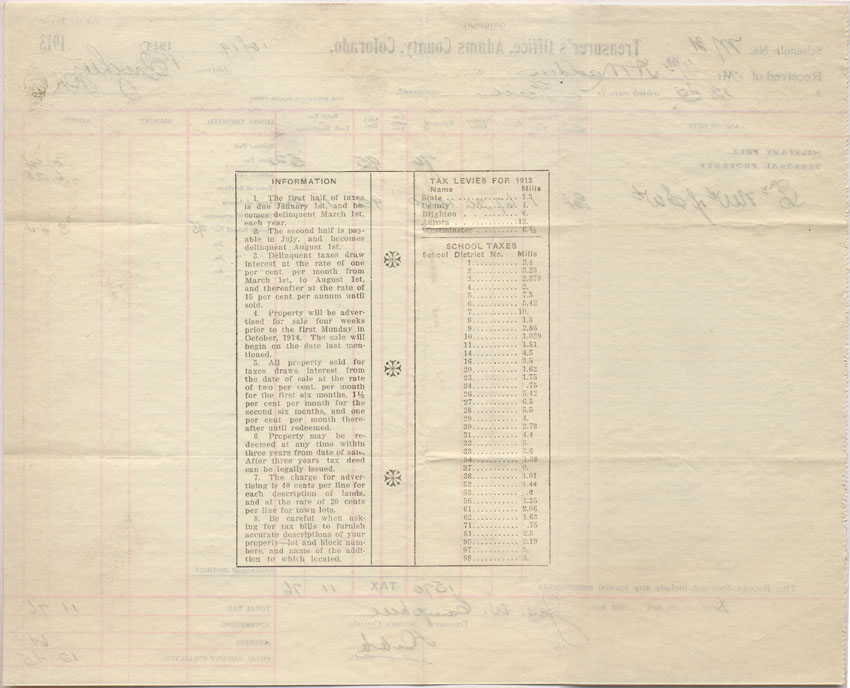
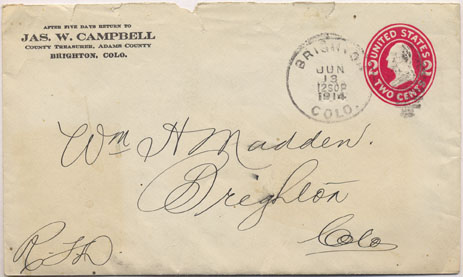
1913 Property tax on the 20 acres east of Henderson. |

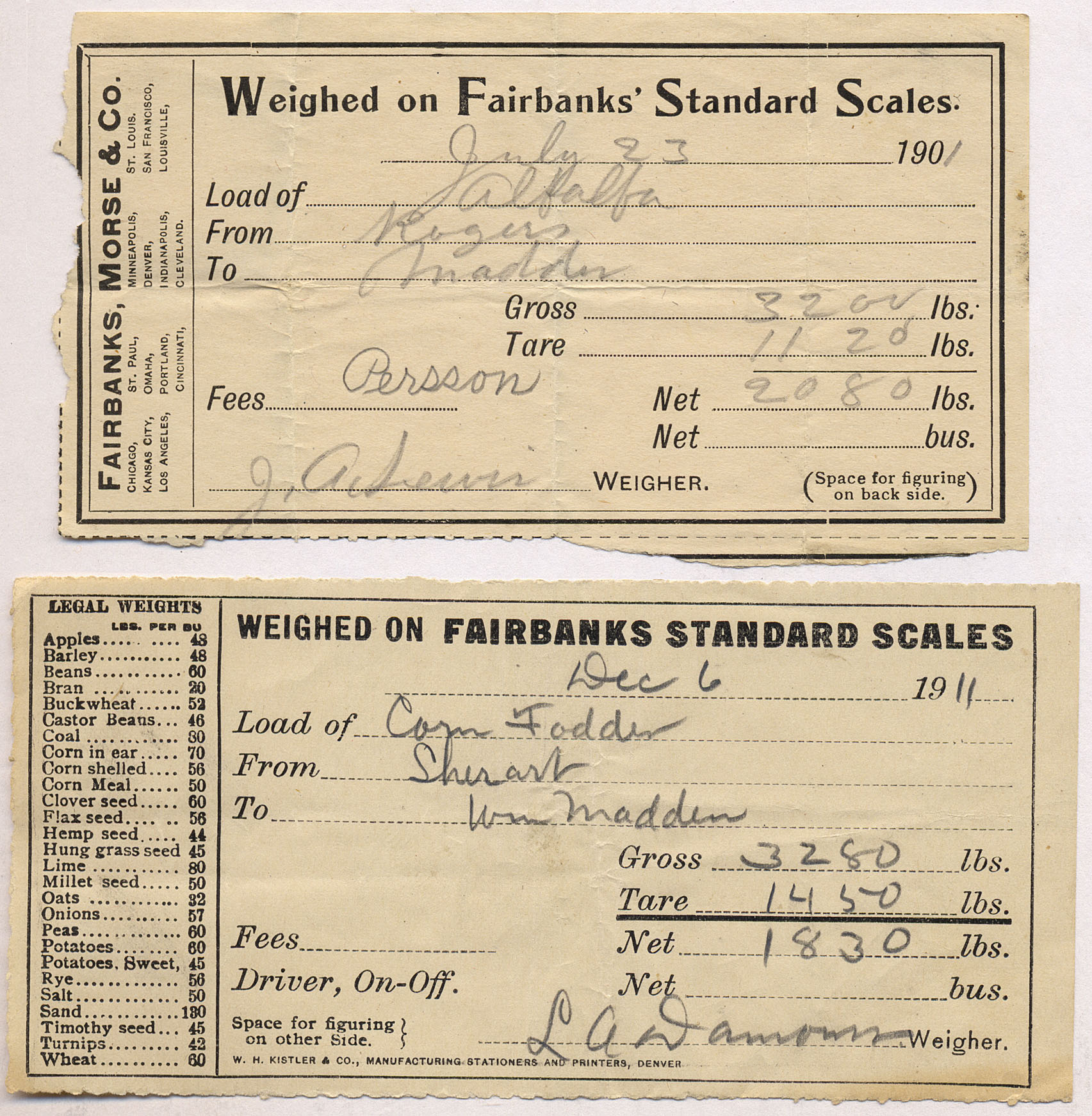
1901 and 1911 weights for alfalfa and corn fodder likely for William's livestock. |
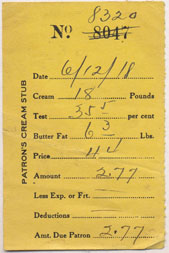 
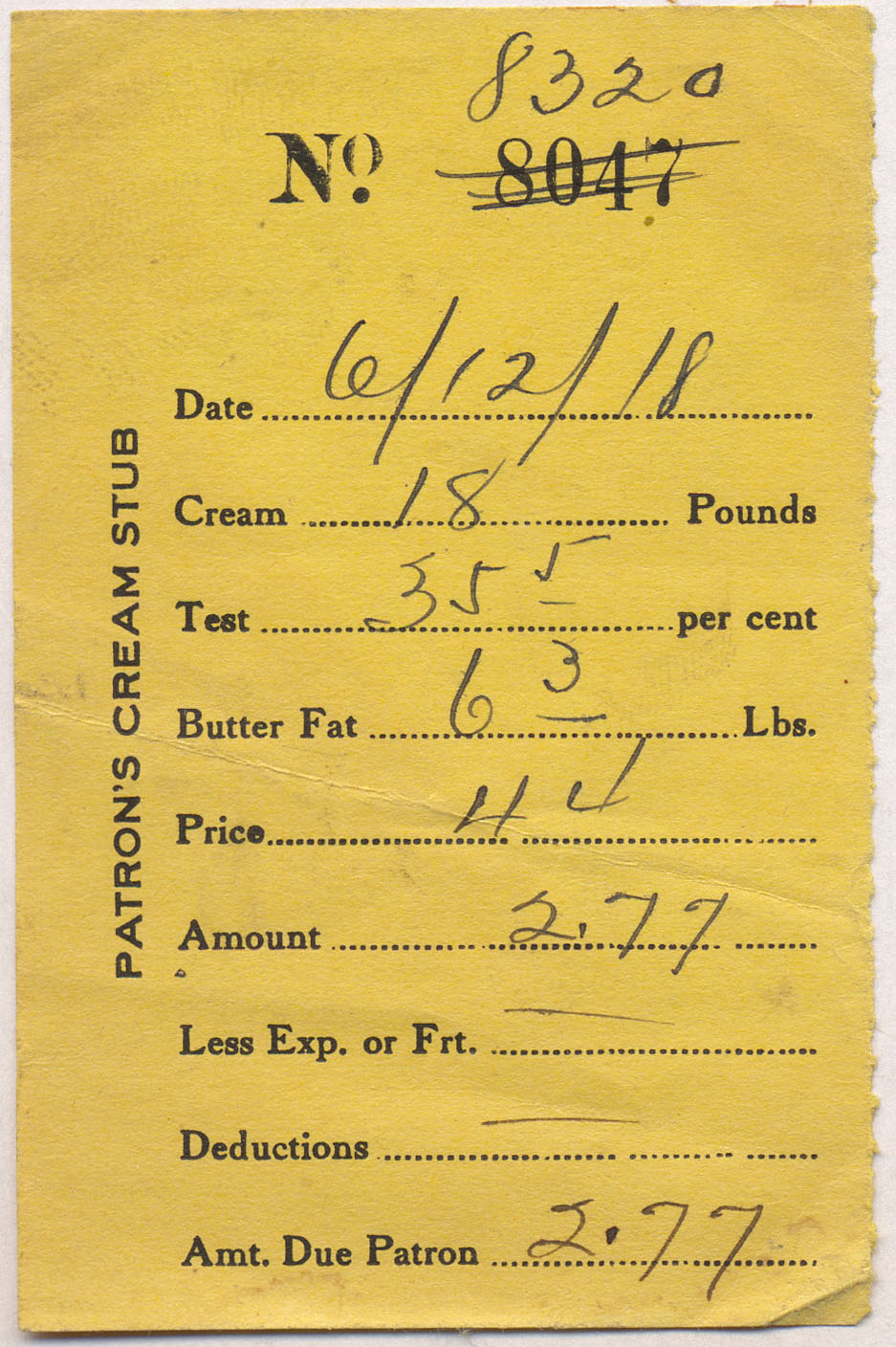
1918 Cream stub and 1919 "dirt tare" notes on a receipt scrap from the Great Western Sugar Co. for harvests of sugar beets.
Accurate tare weights were essential for determining the actual amount of sugar beets delivered to Great Western. By subtracting the Dirt Tare from the total weight of the beets, the sugar comapny calculated the net weight of usable sugar beets. When beets were harvested, they inevitably brought some amount of dirt, soil and debris along with them. The Dirt Tare measured this unwanted material. |
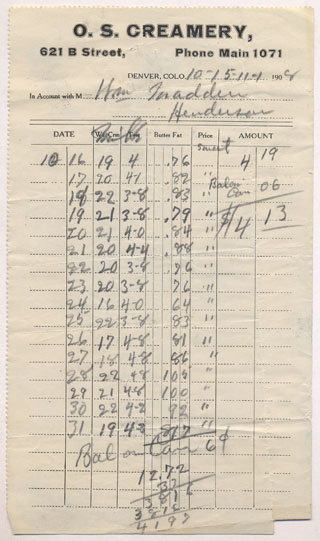 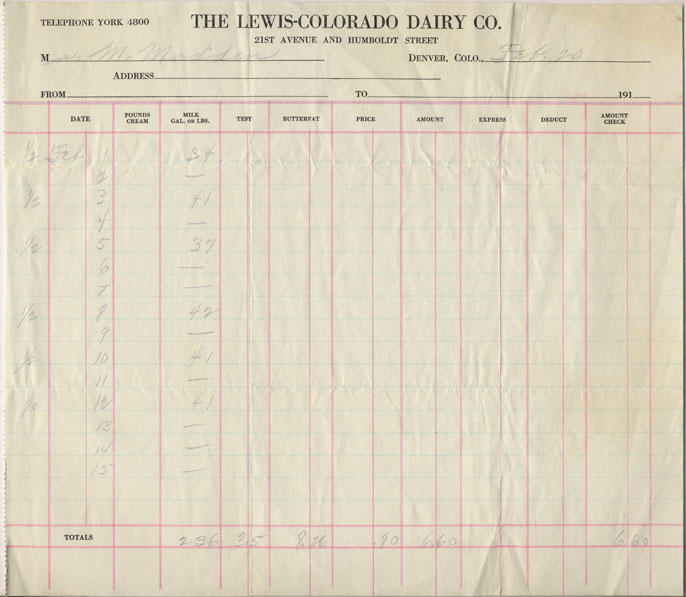
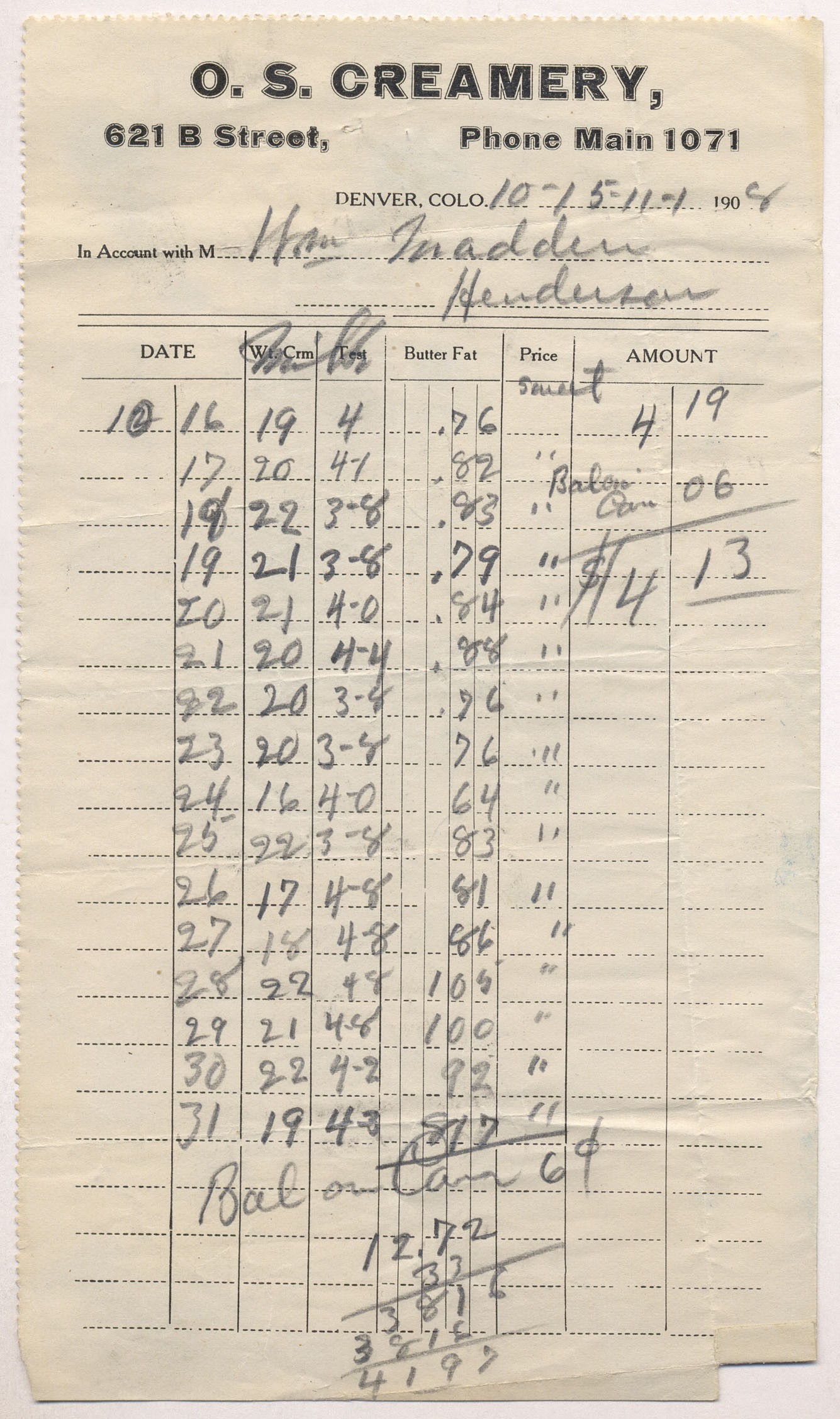
1908 and 1910s accounting lists for Denver companies for cream produced by his dairy cows through the years |
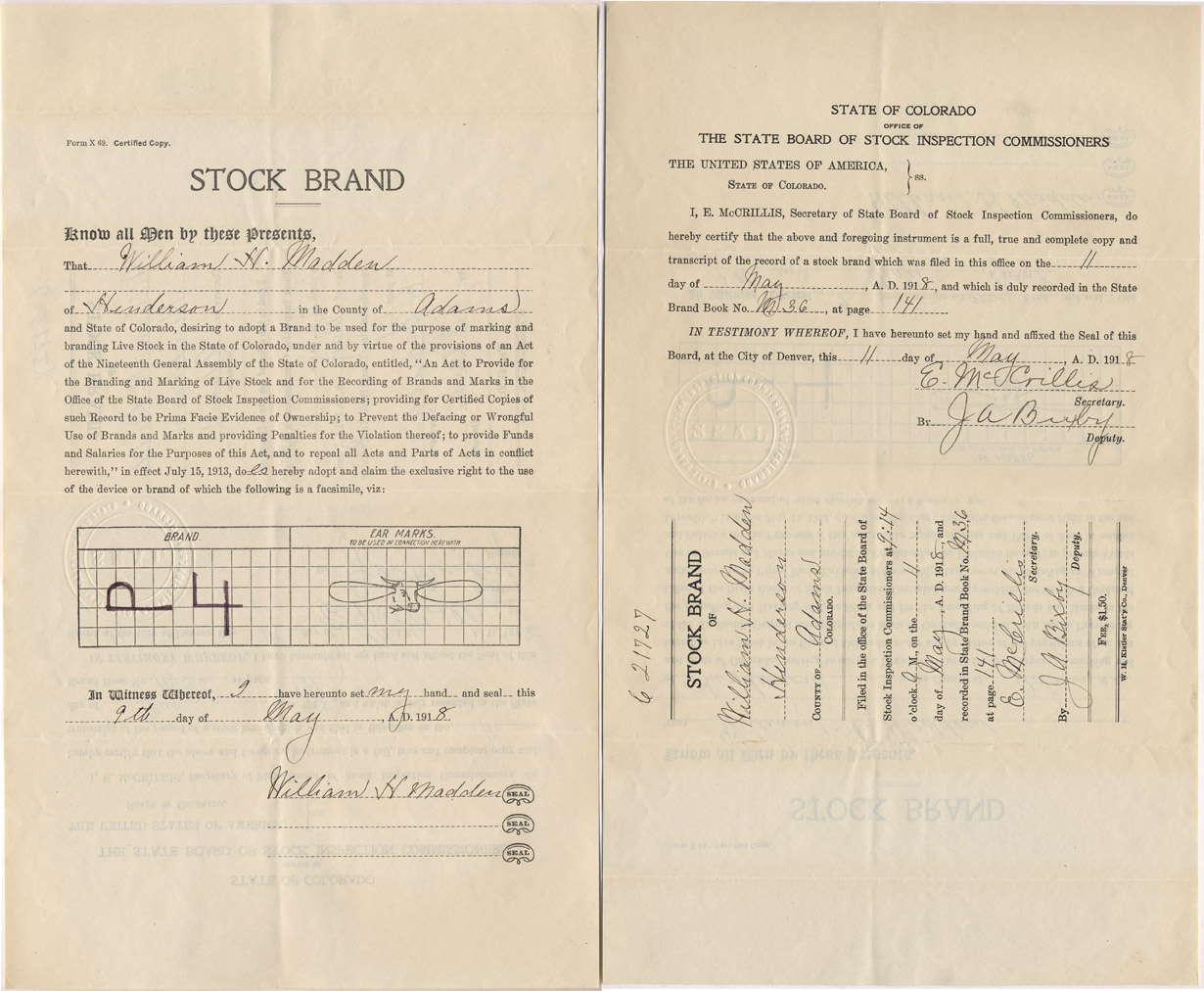
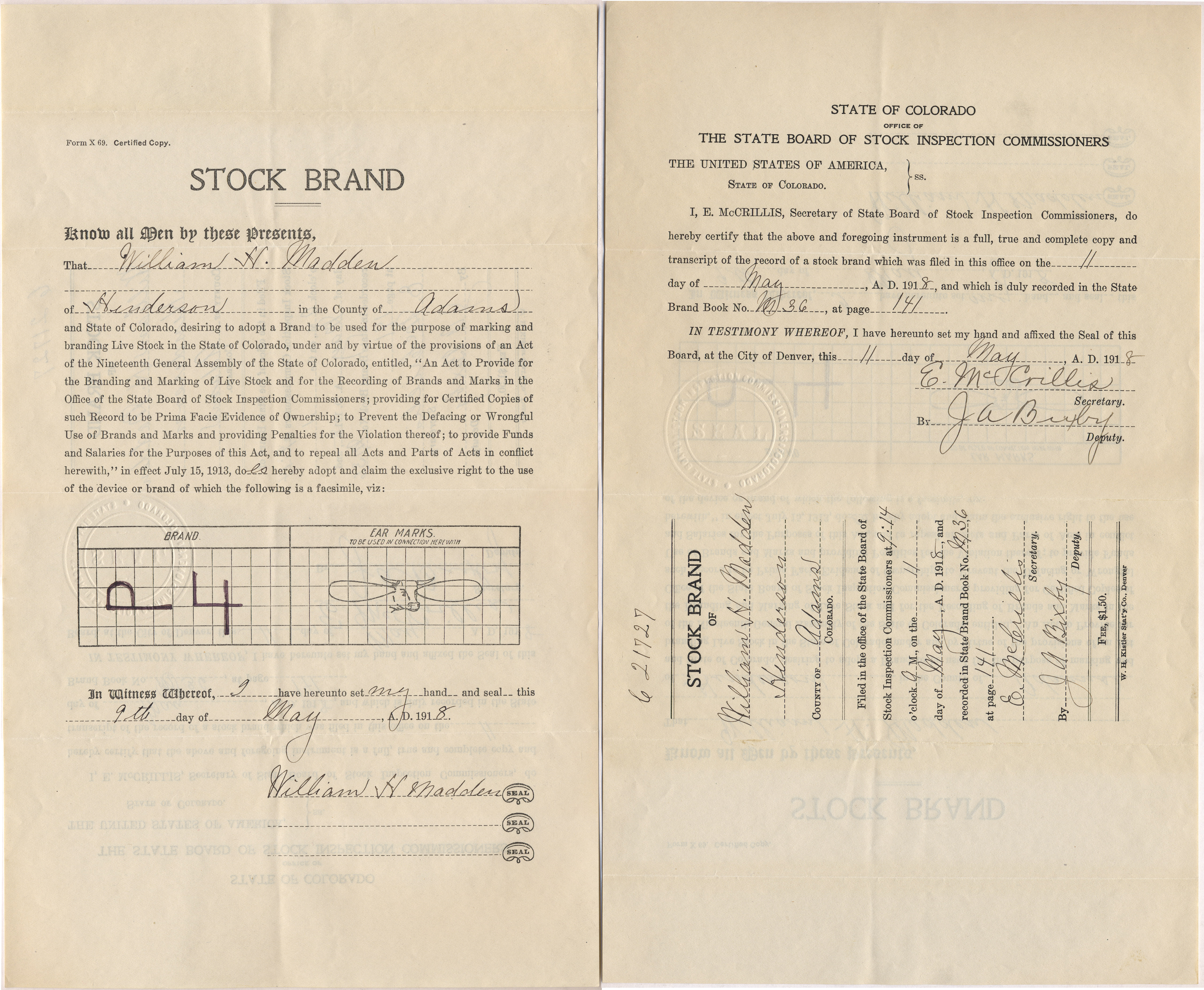
1918 Lazy P4 Brand of William Madden of Henderson (Brighton) in Adams County with the
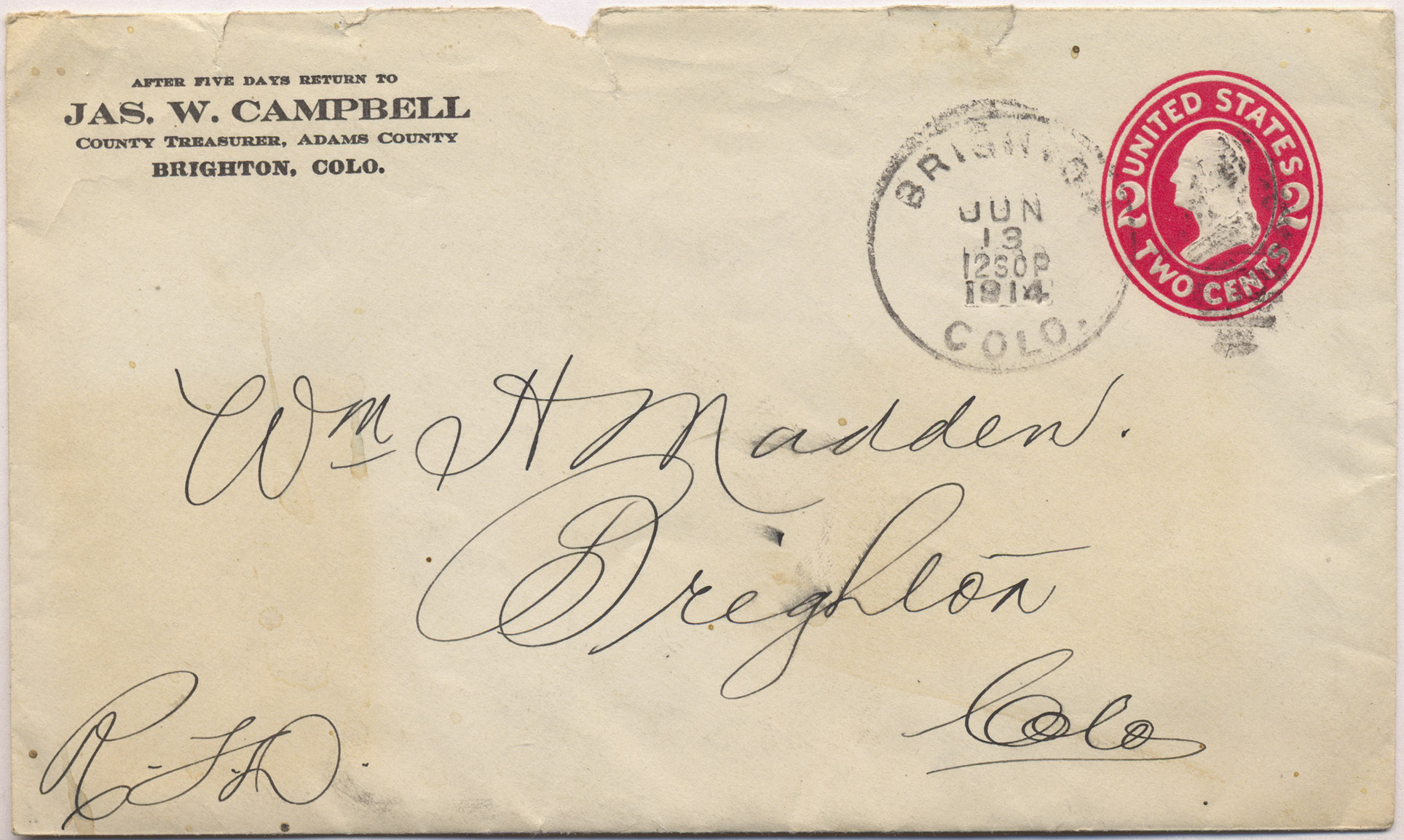
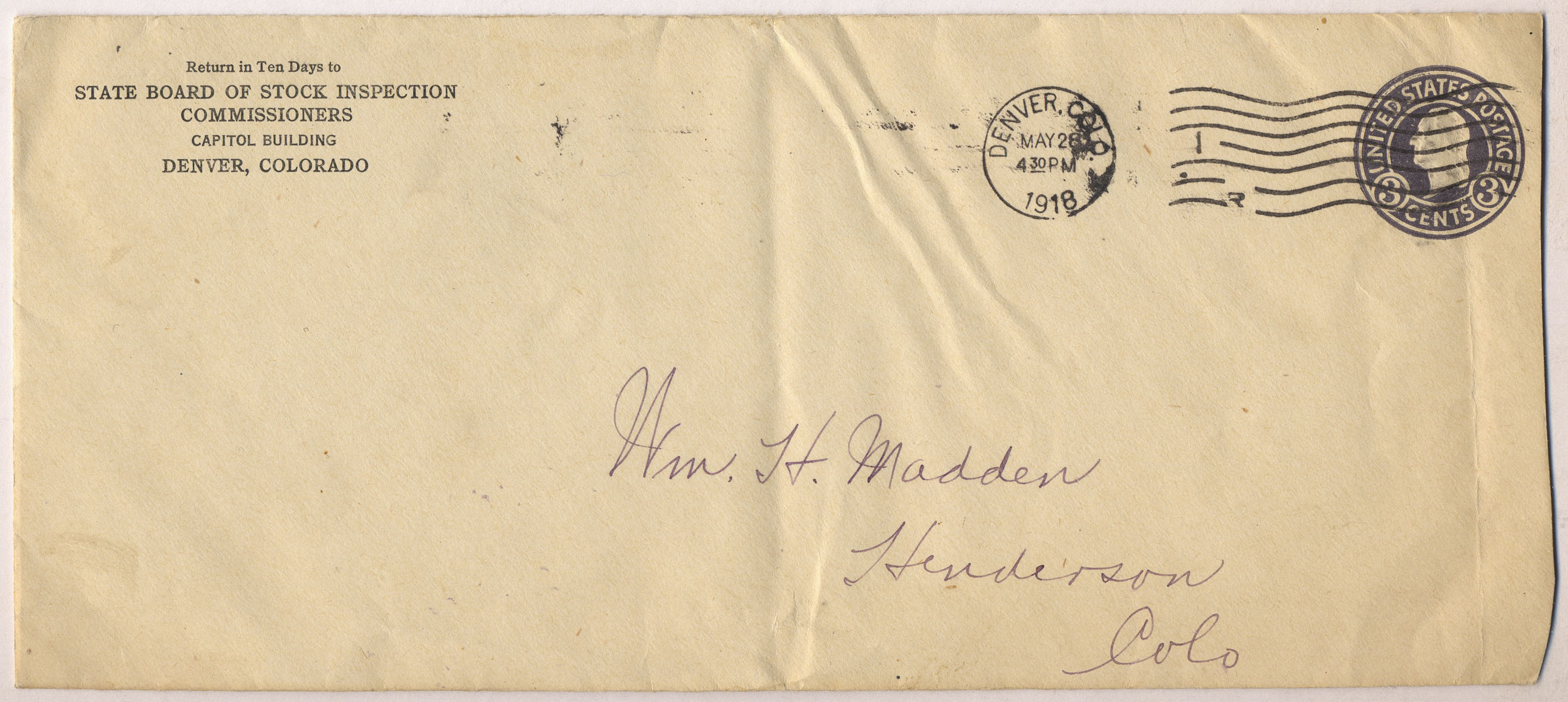
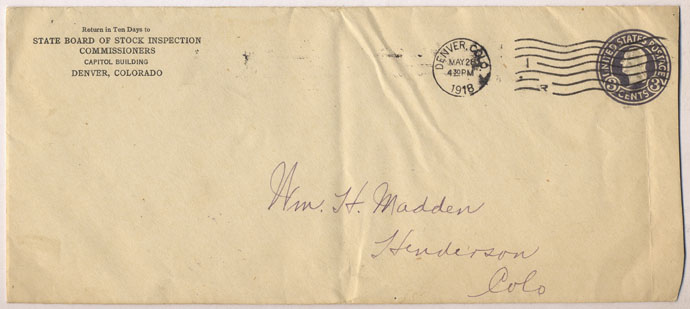
1918 envelope for brand from State Board of Stock Inspection Commissioners in the Denver Capitol Building. |
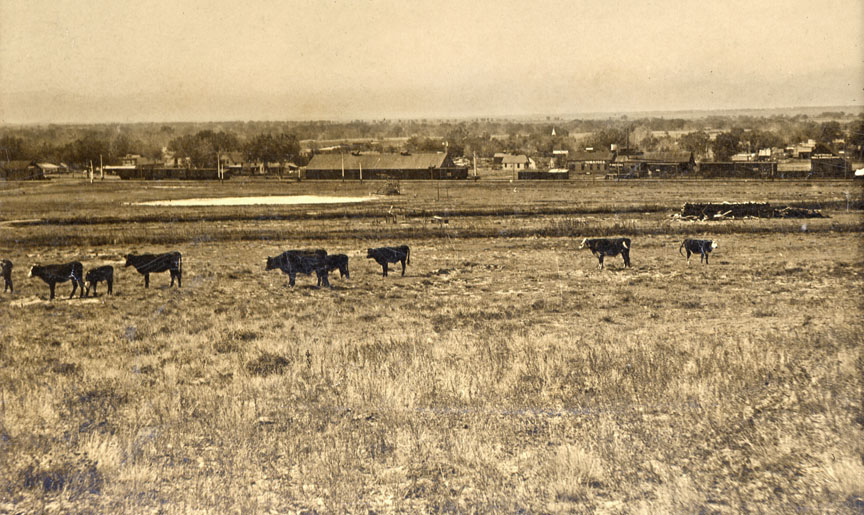
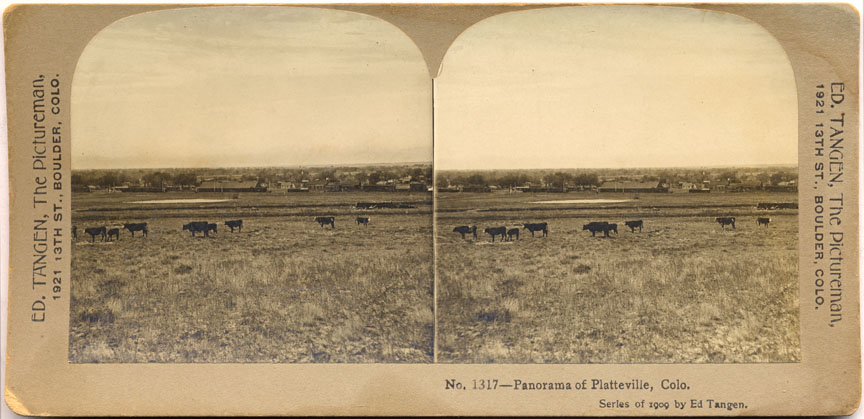
Dairy cows and perhaps beef producing cows (he received a stock brand in 1918) would have been raised on his farm similar to this photo. This small herd of Herefords grazes in 1909 in Platteville, also along the South Platte River north of Brighton. Rail cars perch on the Union Pacific Railroad as the faded Rockies and the town stand in the background, similar to how Henderson would have looked from the Madden farm. The photo was taken by noted Boulder photographer Ed Tangen in a stereoview.
 |
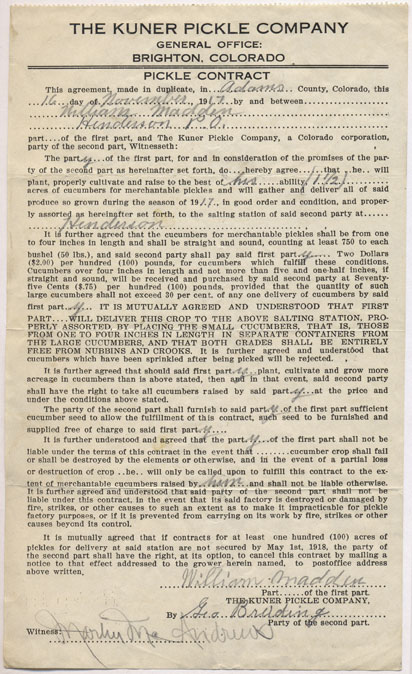
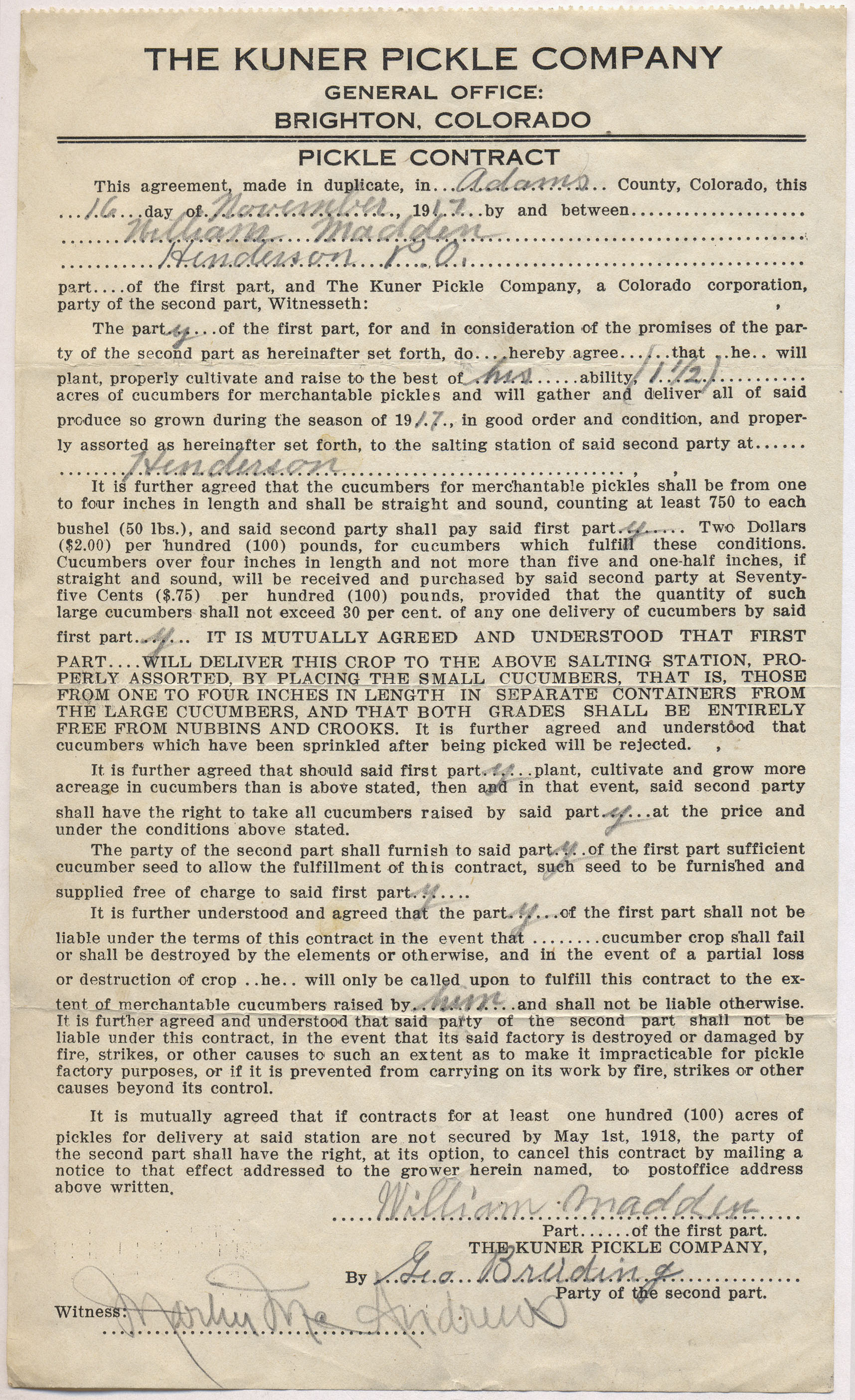
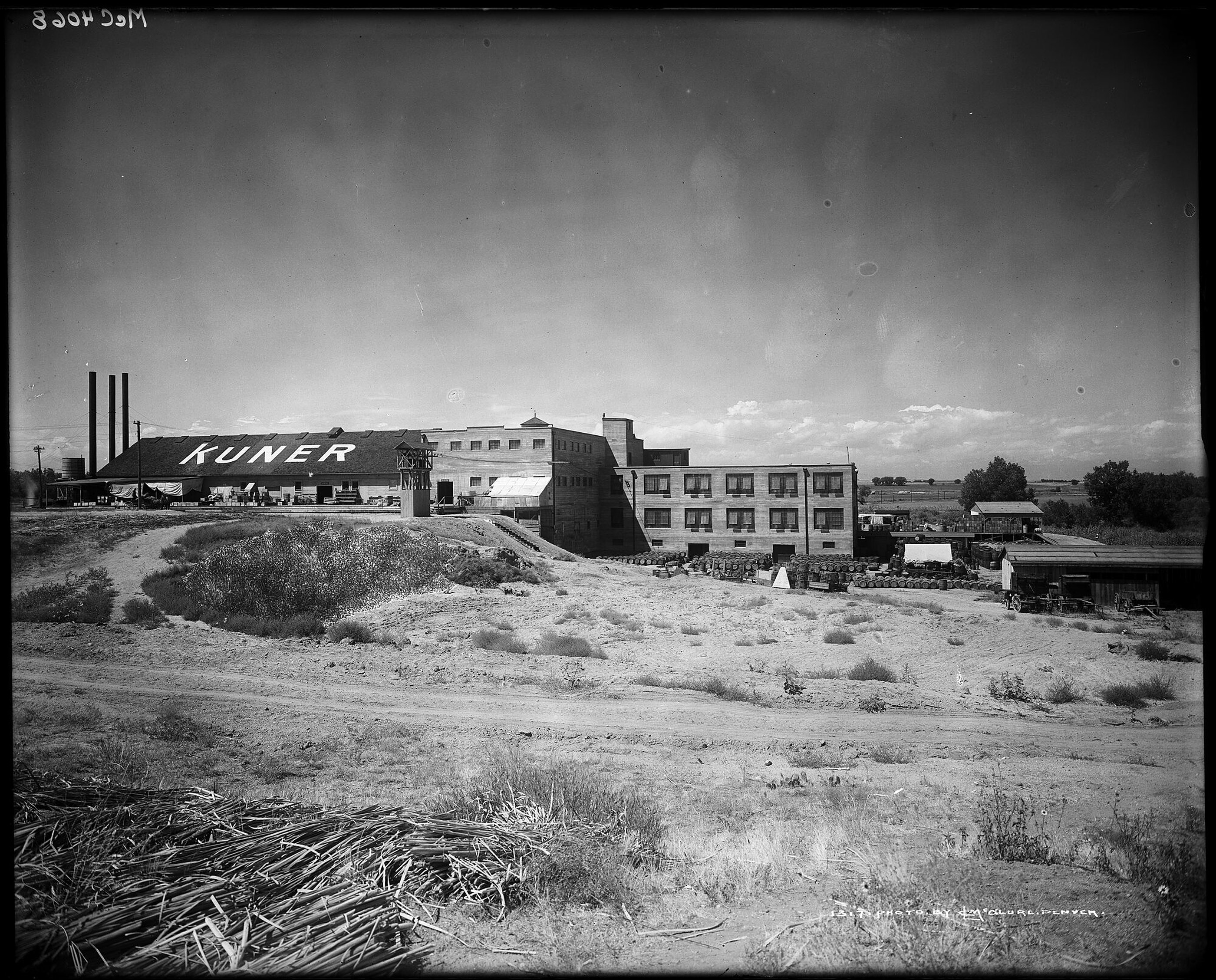
1917 Brighton Kuner Pickle Company contract planting 1-1/2 acres of cucumbers. |

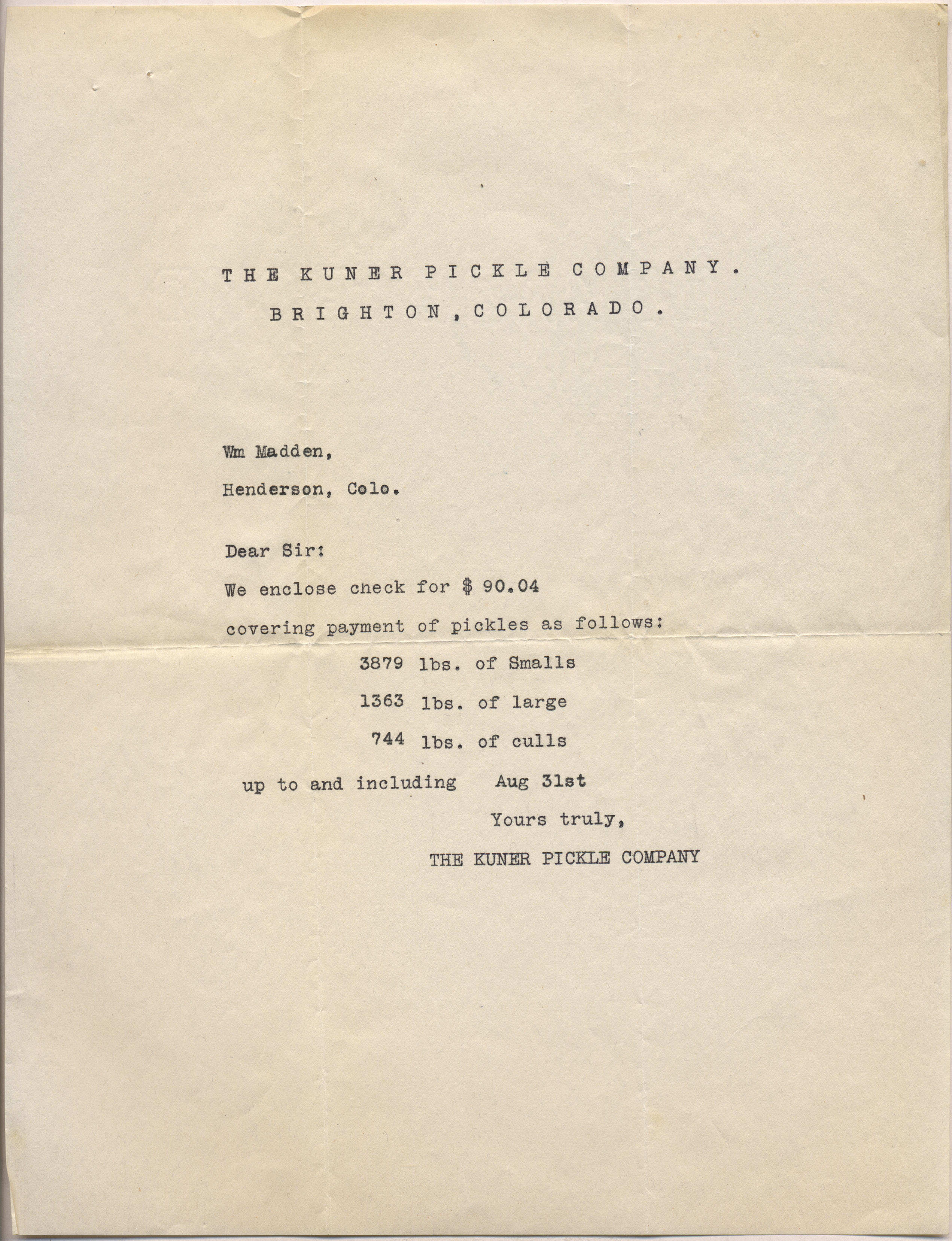
1917 Payment for growing thousands of pounds of cucumbers. |
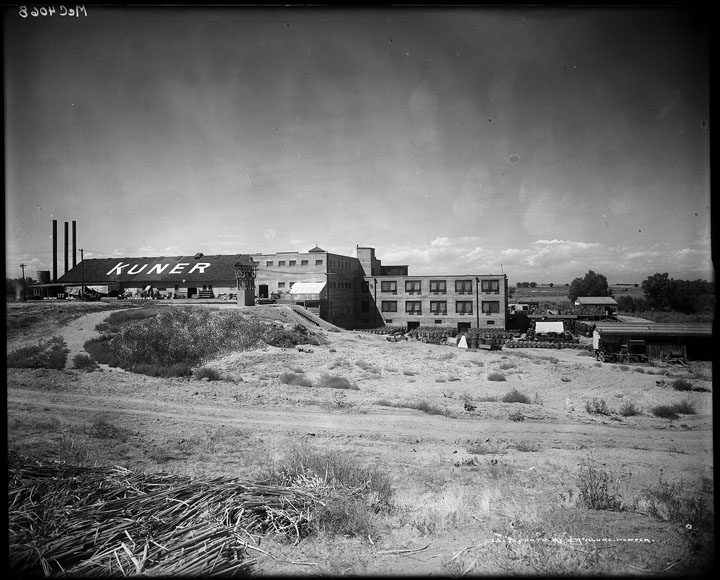
The Kuner Pickle Company factory with rooftop sign and wharehouse in Brighton shows a loading dock, water tank and barrels. Madden's 1917 harvest of cucumbers passed through this factory according to the receipt above. The photo, taken about 1910 is from the Denver Public Library Digital Archives |
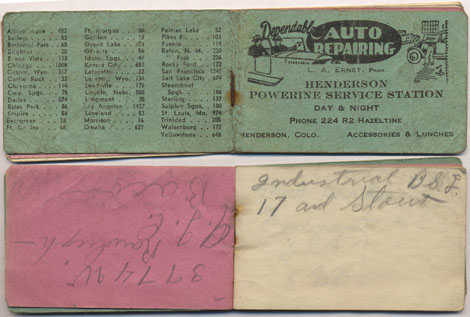
Small note pad from the local garage. |
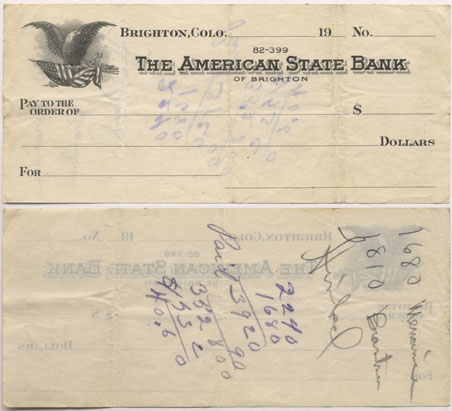
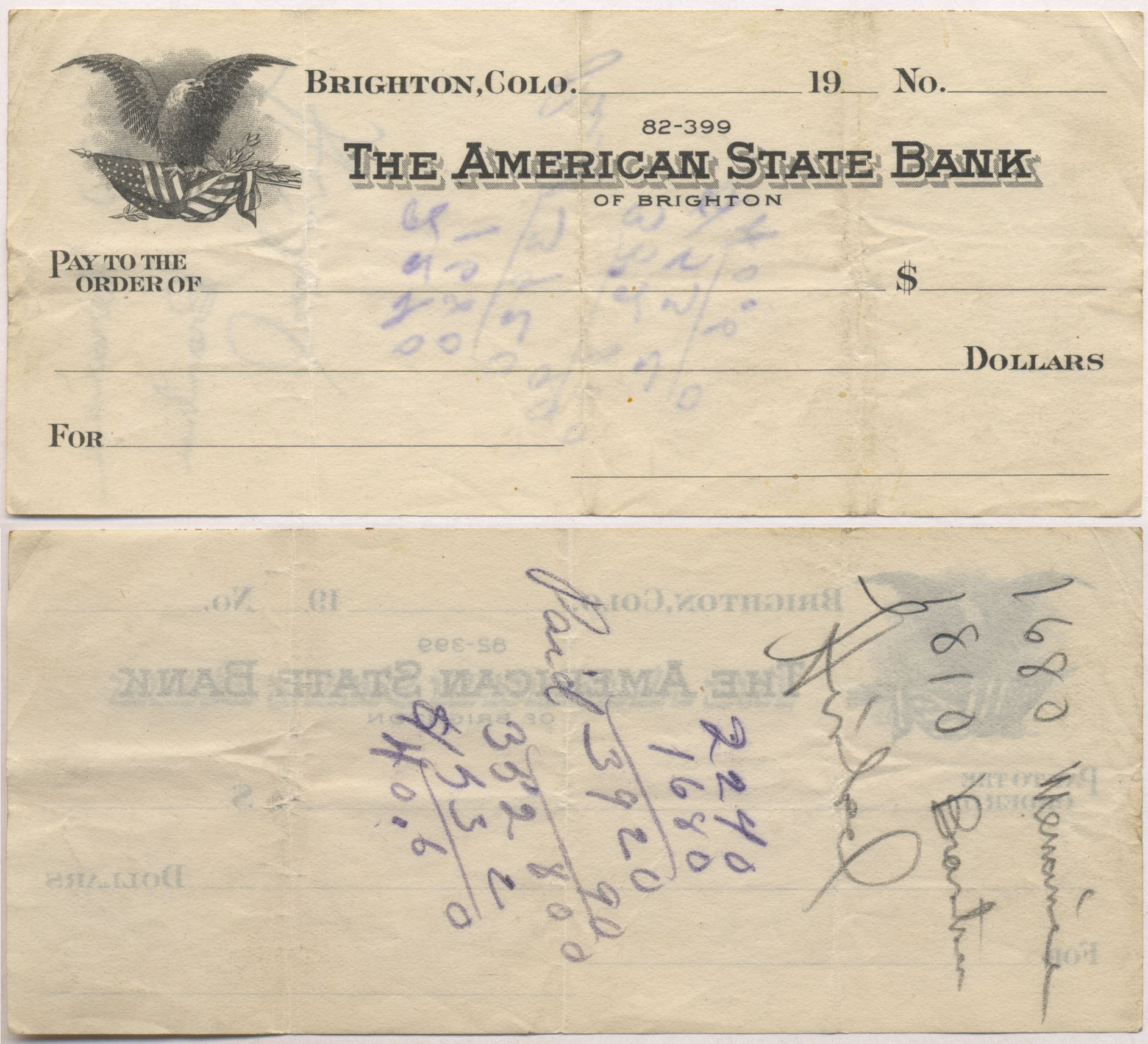
More notes on the back of a check from the American State Bank of Brighton. |
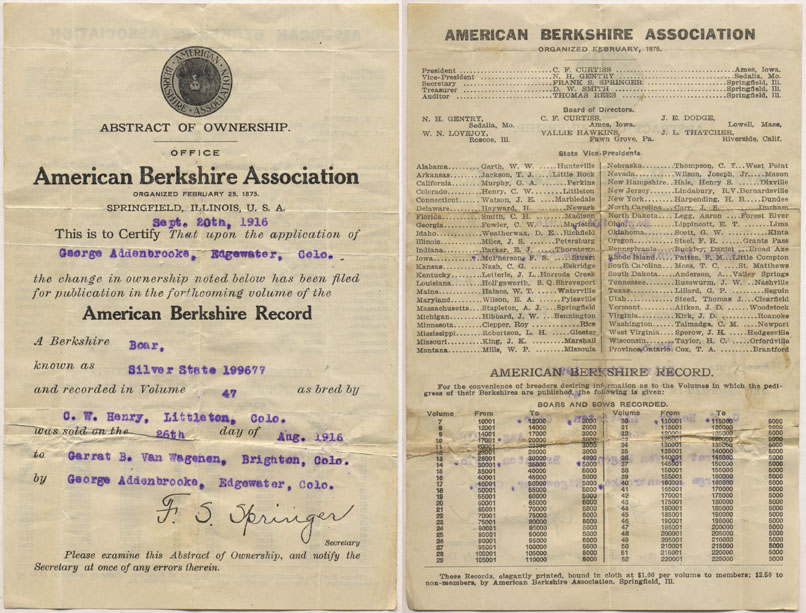
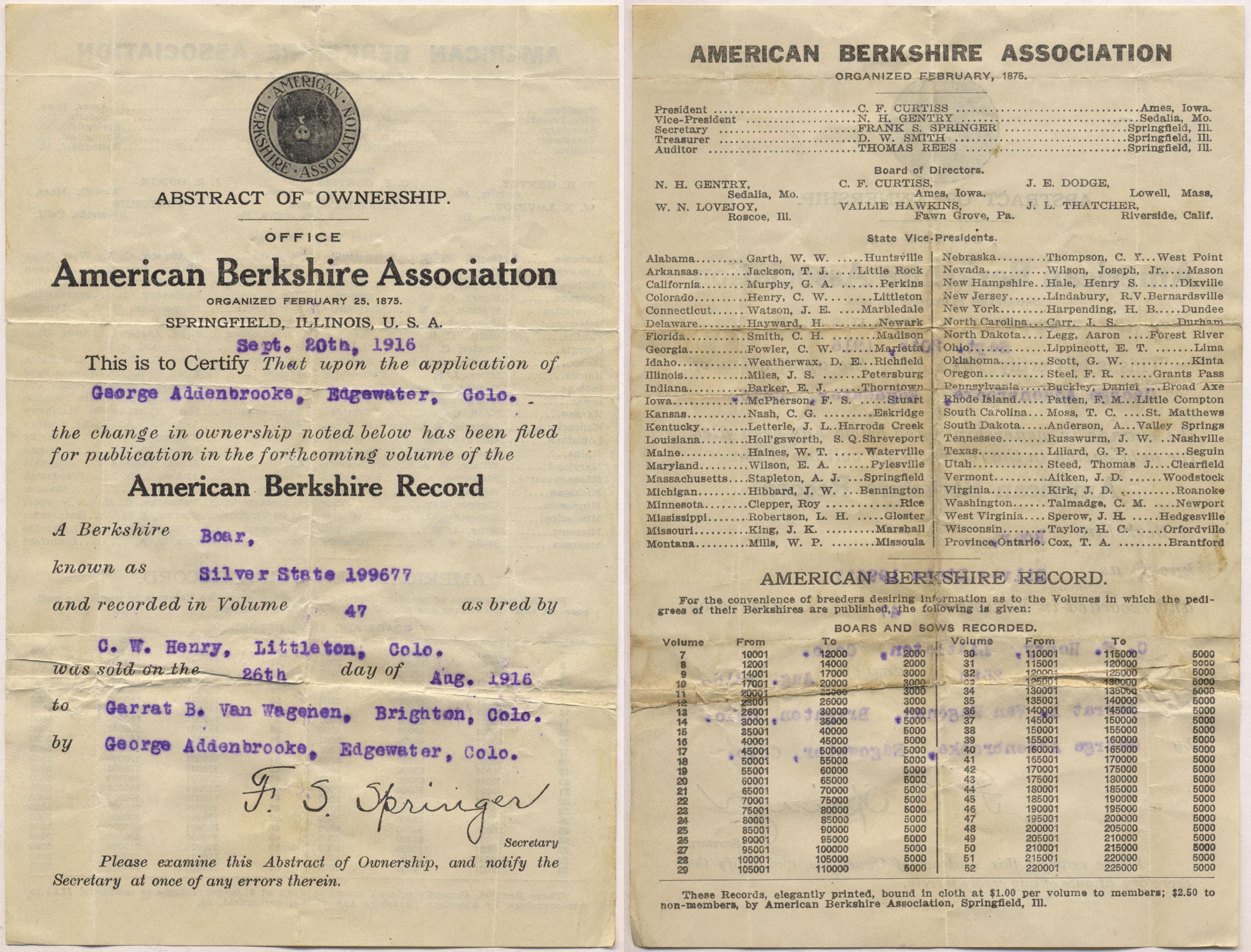
William likely purchased some heritage bred hogs from a neighbor in Brighton. |
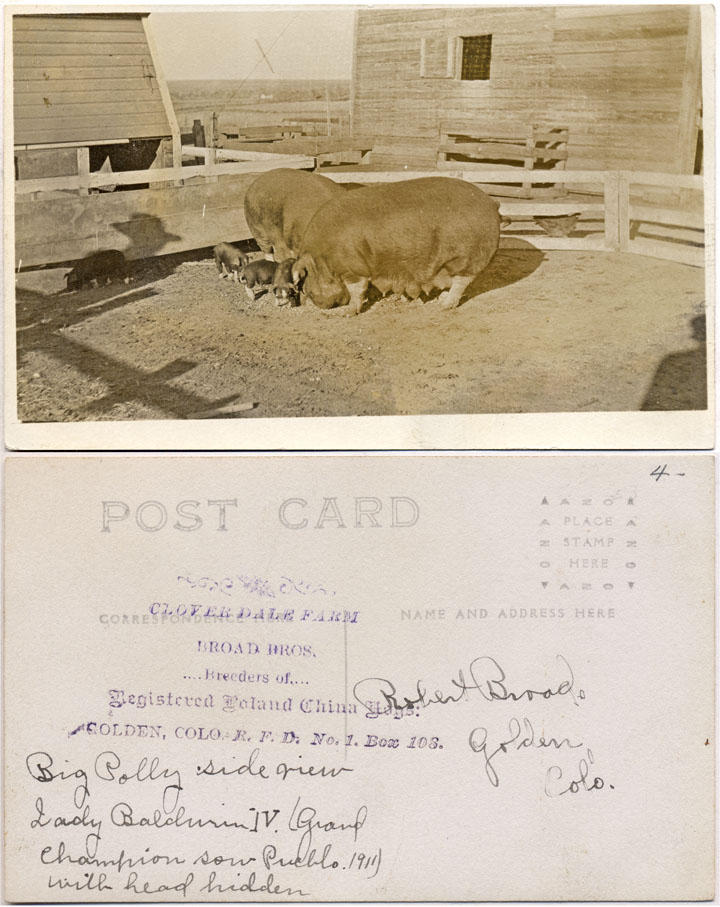
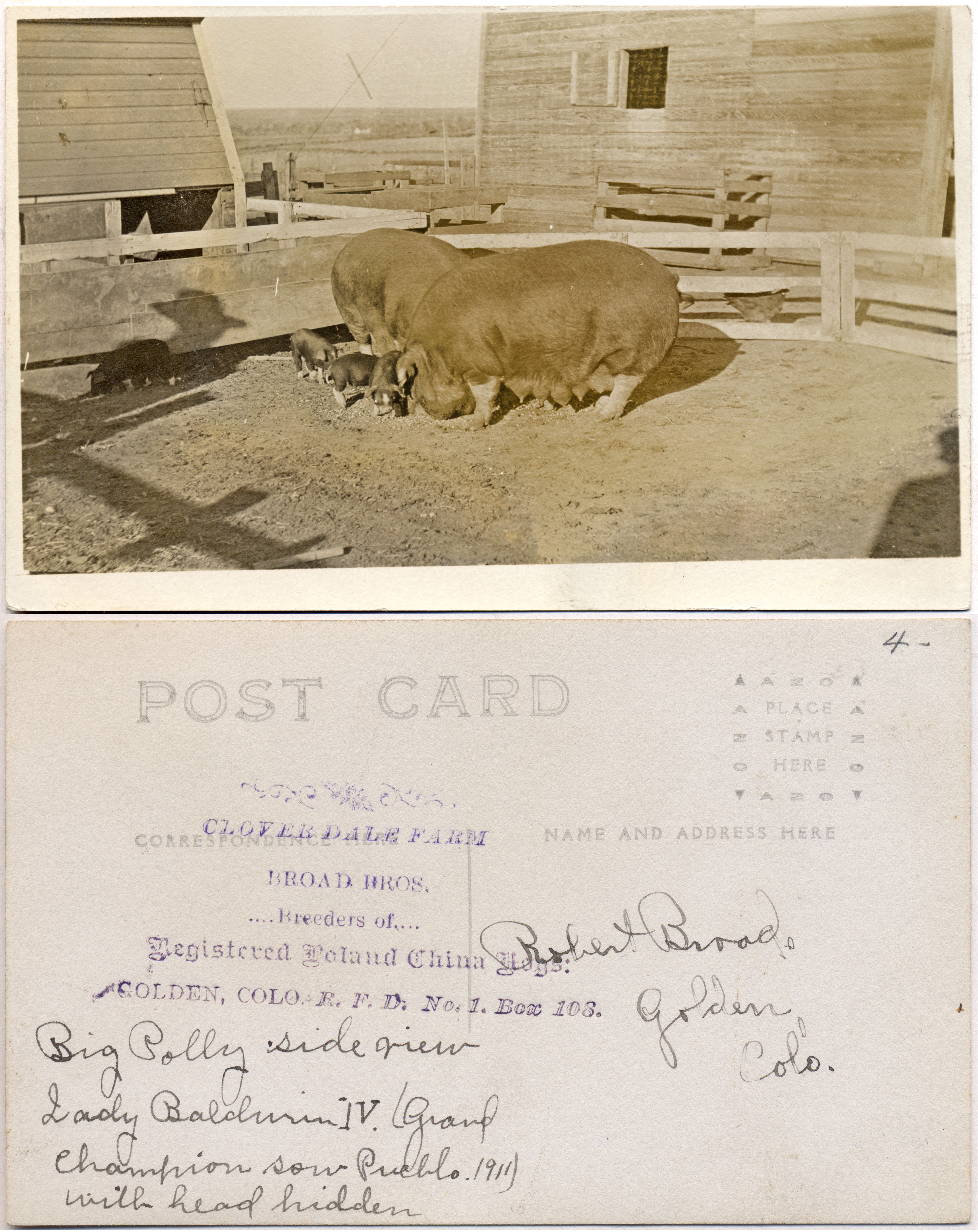
Hogs similar to these in Golden, Colorado would have likely been raised on his farm. |
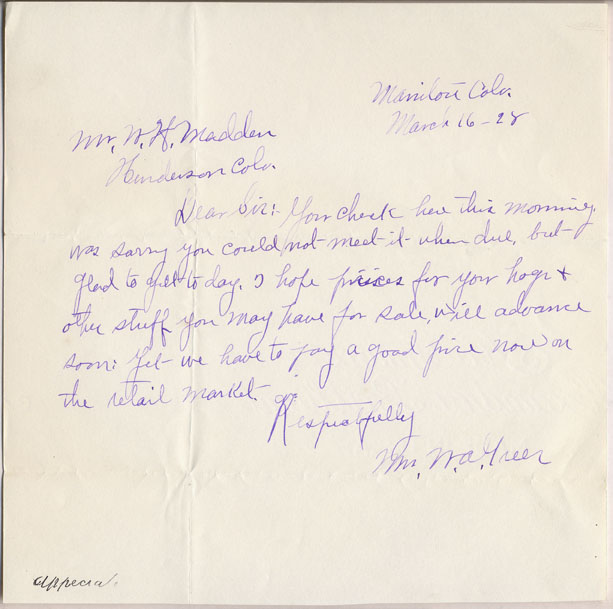
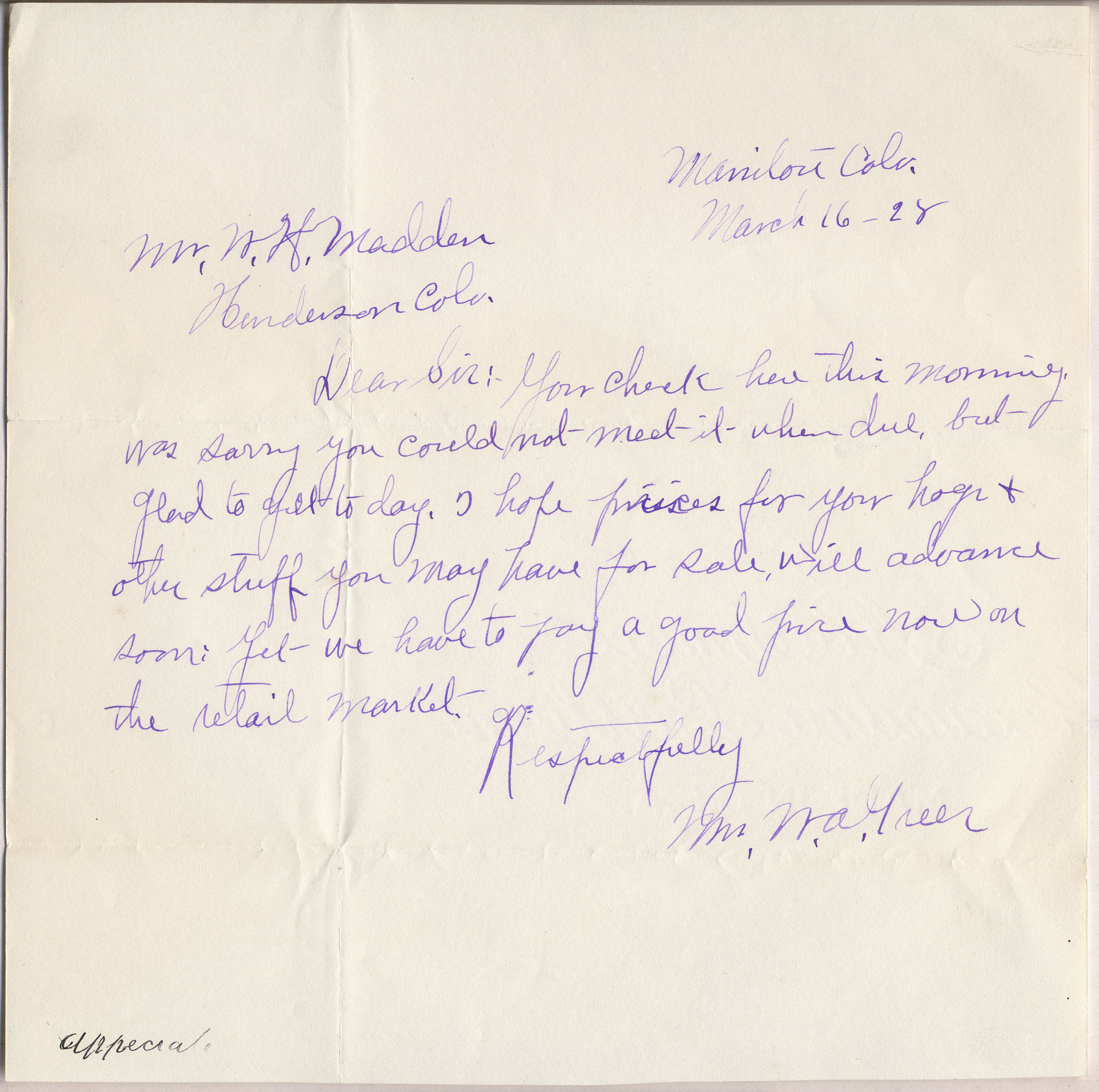
In 1928, William receives a letter from Manitou, Colorado acknowledging his late, but appreciated payment which also mentions "I hope prices for your hogs and other stuff you may have for sale will advance soon: Yet we have to pay a good price now on the retail market." |

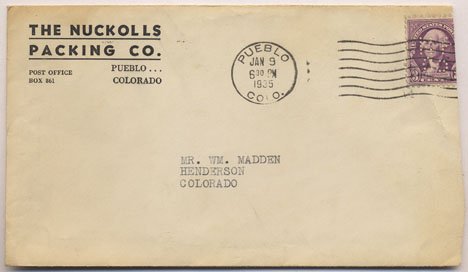
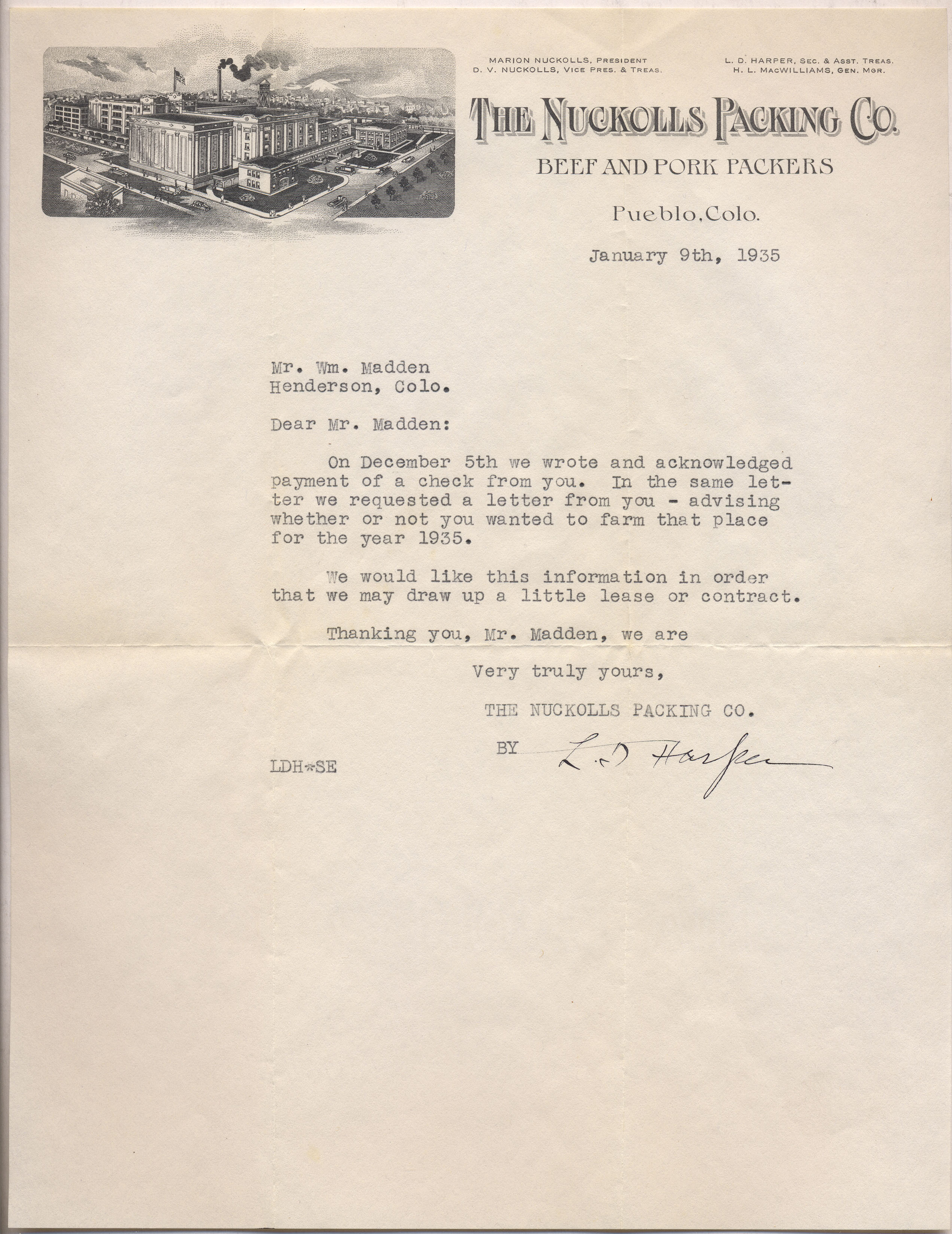
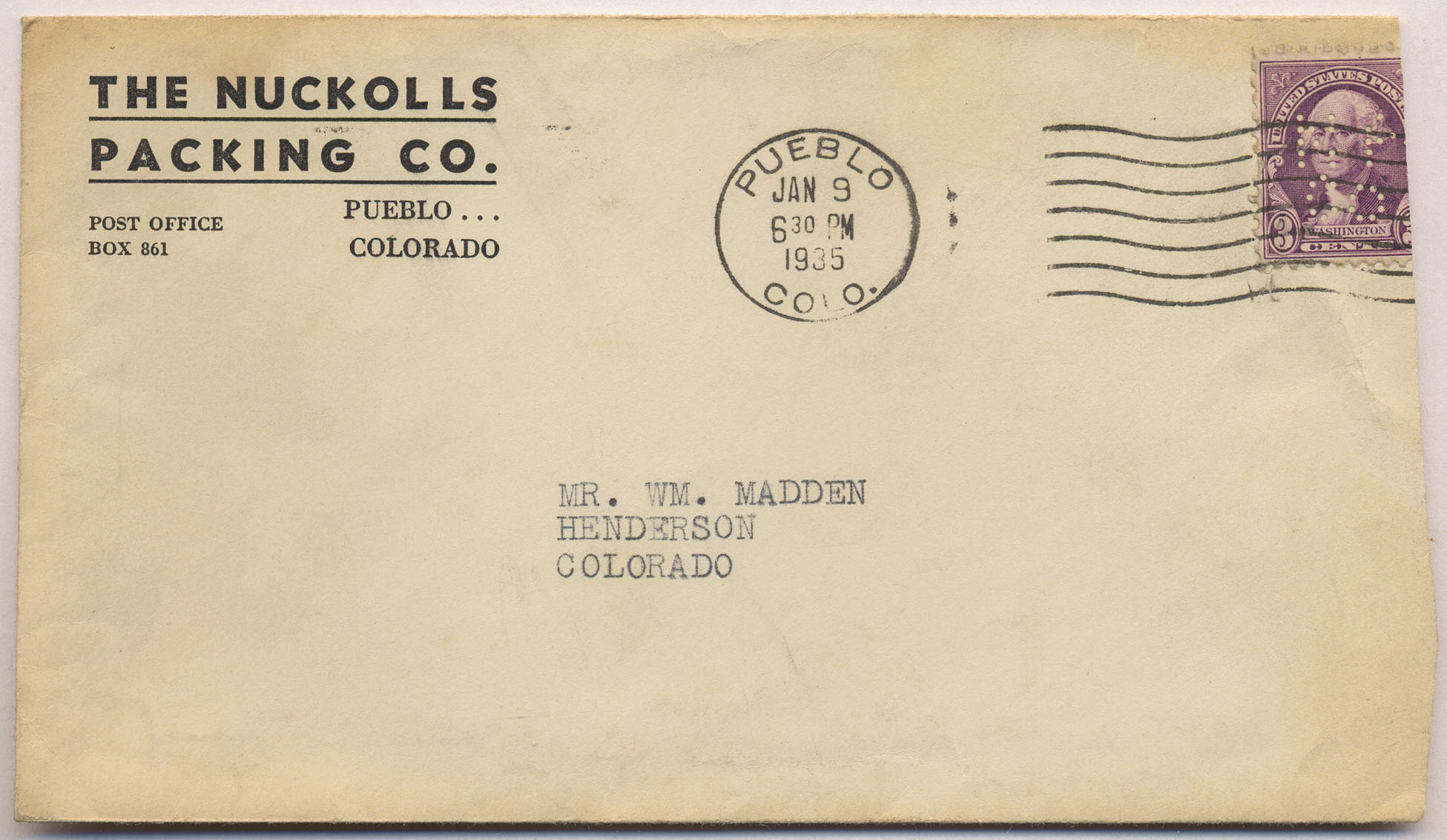
In 1935 he paid The Nuckolls Packing Company in Peublo, Colorado, perhaps for pork and or beef packing. |
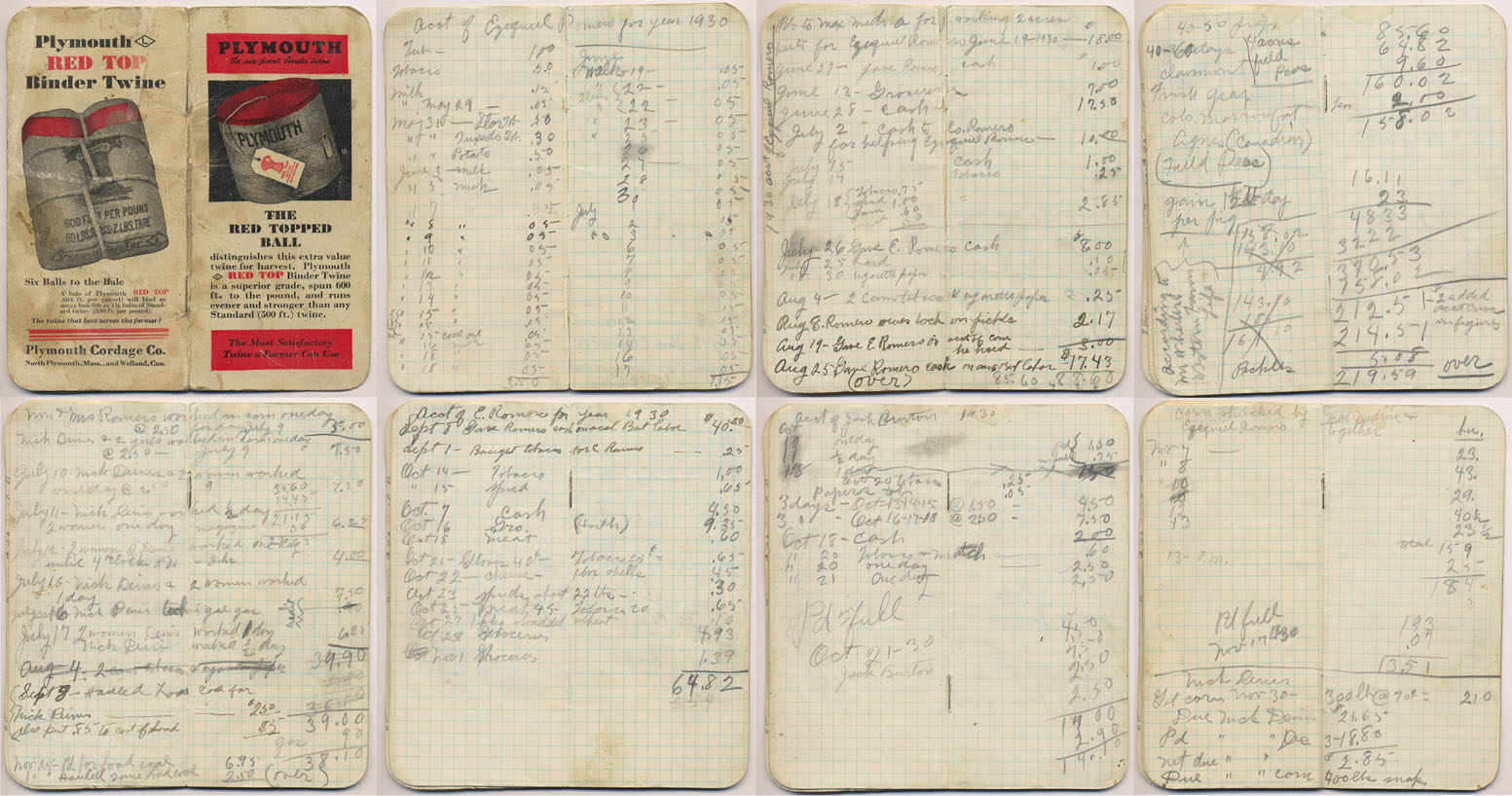
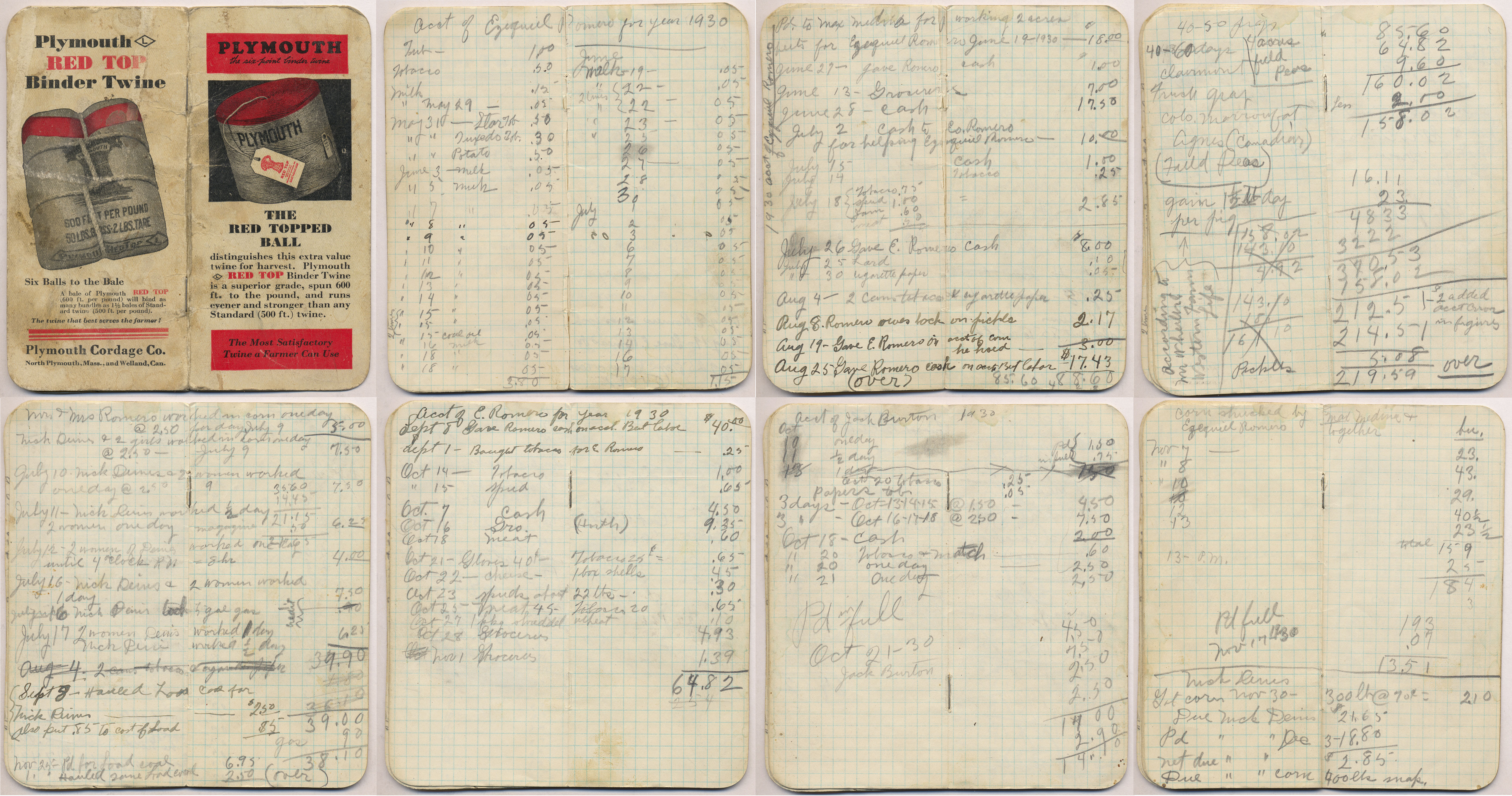
In 1930 William was 72. Always keeping track of money, William used a notepad promoting Red Top ball twine to document work on his farm - who, when and what they did and how much he paid. Ezekiel (Ezequil) Romero seemed to do much of the labor in corn fields, milking, and harvesting potatoes. Throughout July 1930, Ezekiel Romero and his family worked in the corn fields as did Nick Denis and his family. |

1920 - Bill for three visits on November 1, 3 & 4 from the vet B. E. Frailey in Brighton. |

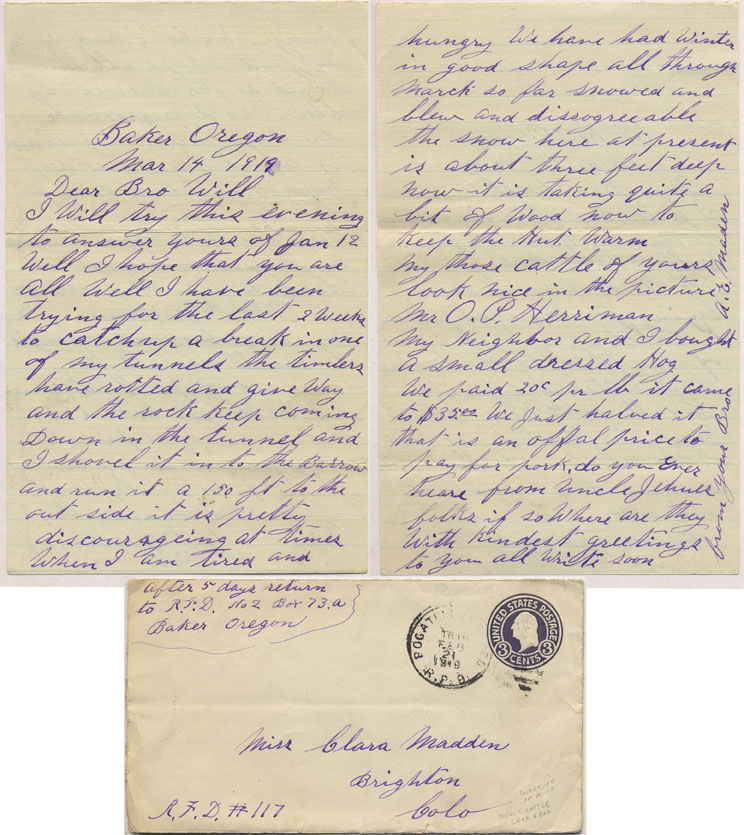
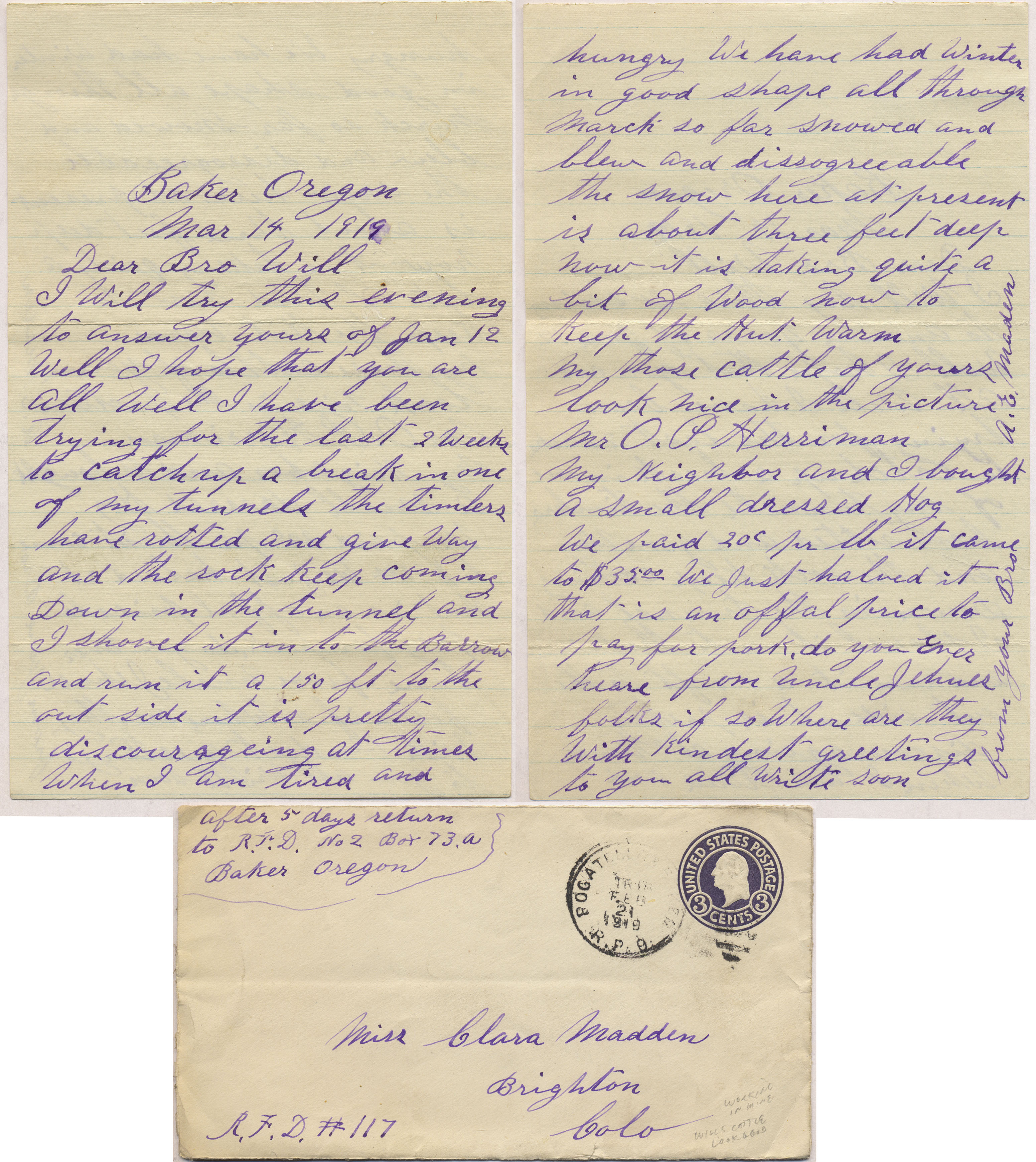
Two letters for William Madden and his daughter Clara from Alpheus E. Madden in Baker, Oregon in 1919. He mentions working in his gold mine with rotted timbers causing collapses and shoveling rock into the the wheel barrow. He also mentions William's cattle look good. In the other letter, Alpheus writes about a soldier in WWI |
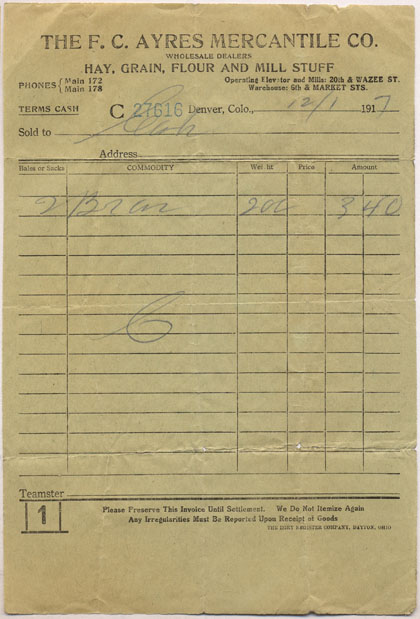
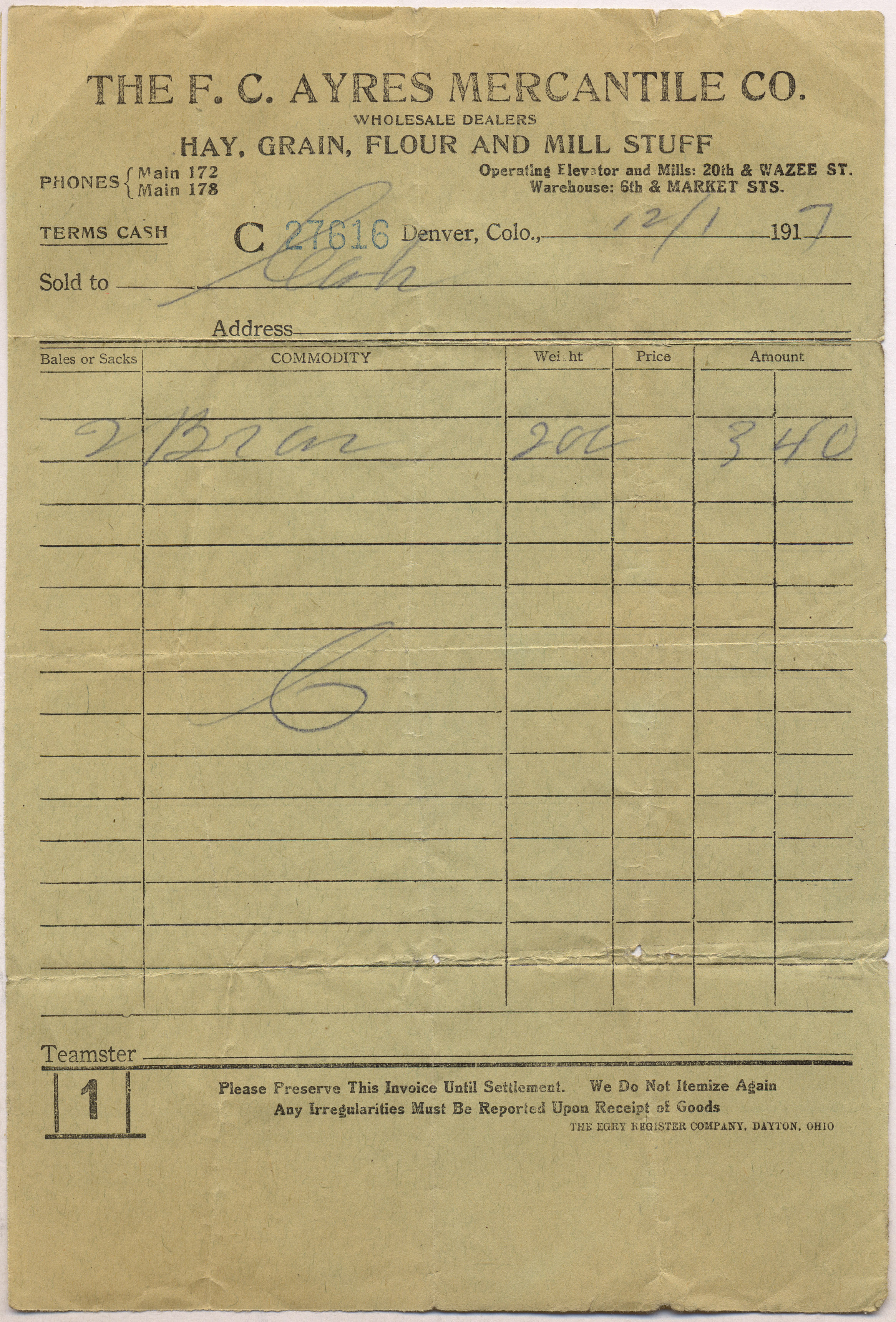
Two sacks of bran from F. C. Ayres Mercantile Co. in Denver. |

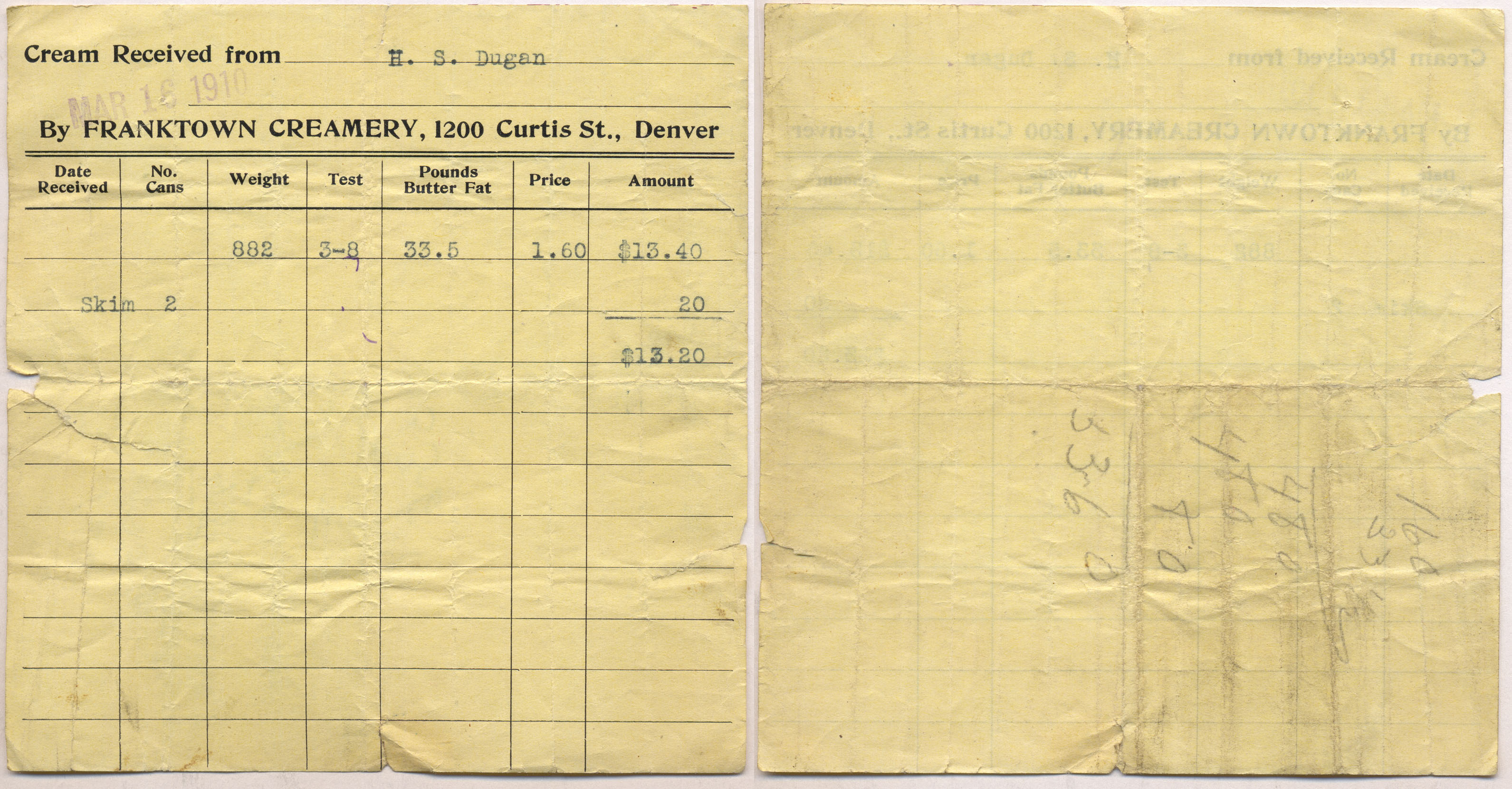
Addition calculation on the back of a Franktown Creamery receipt for H. S. Dugan. Did William borrow a scrap of paper to do a quick bit of math? |
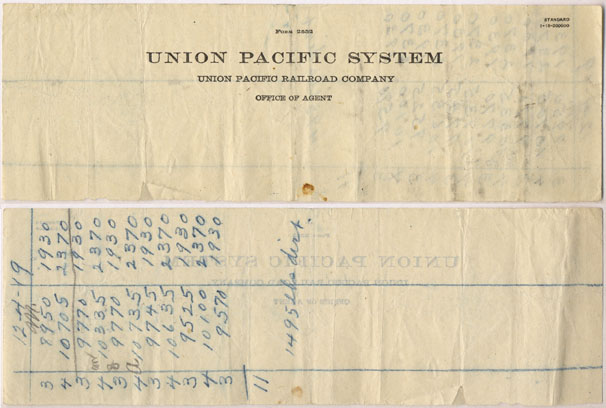
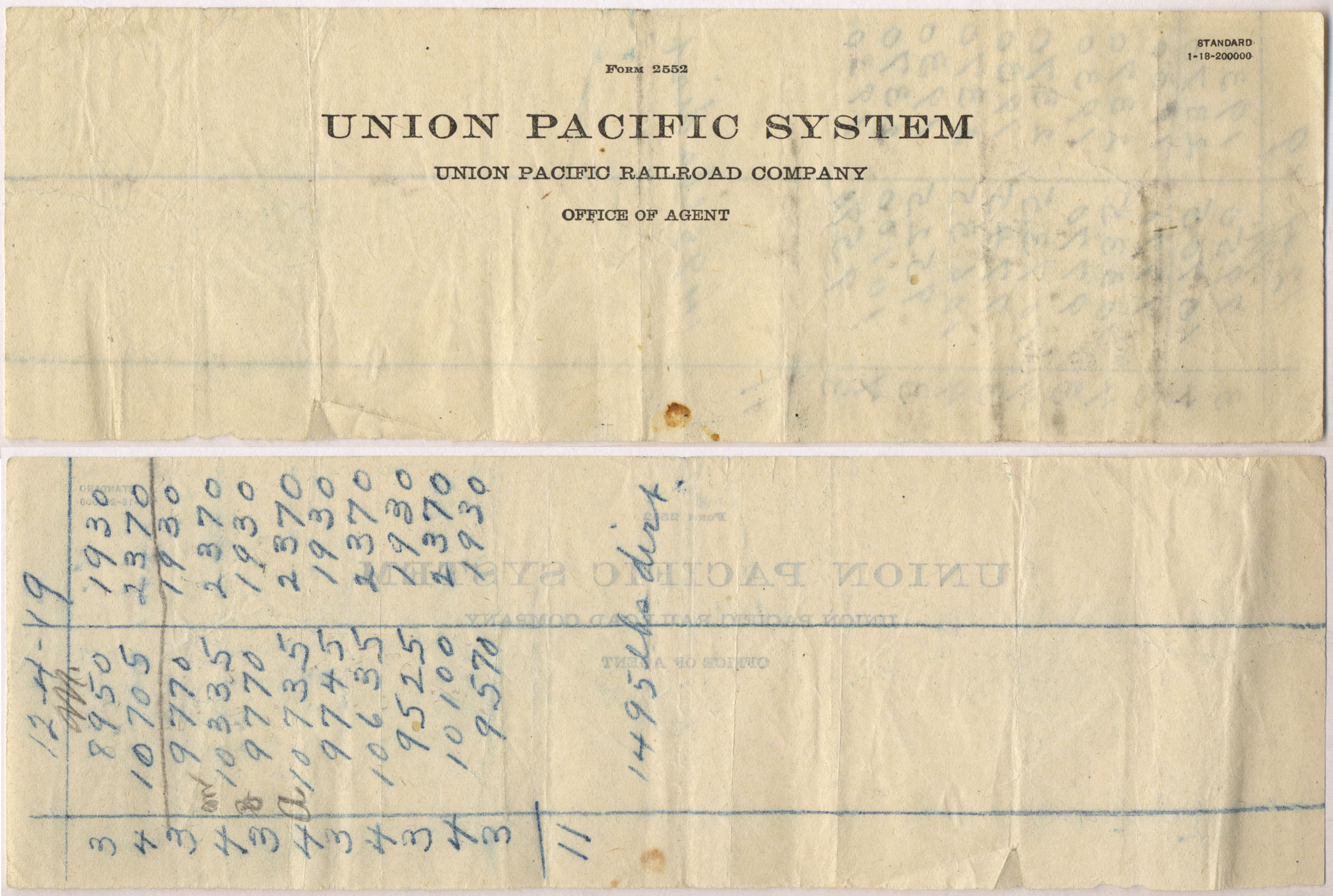
More 1919 calculations on the back of a Union Pacific letterhead. |
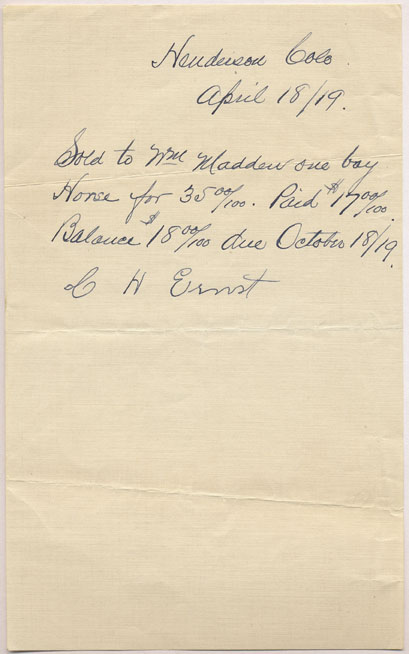
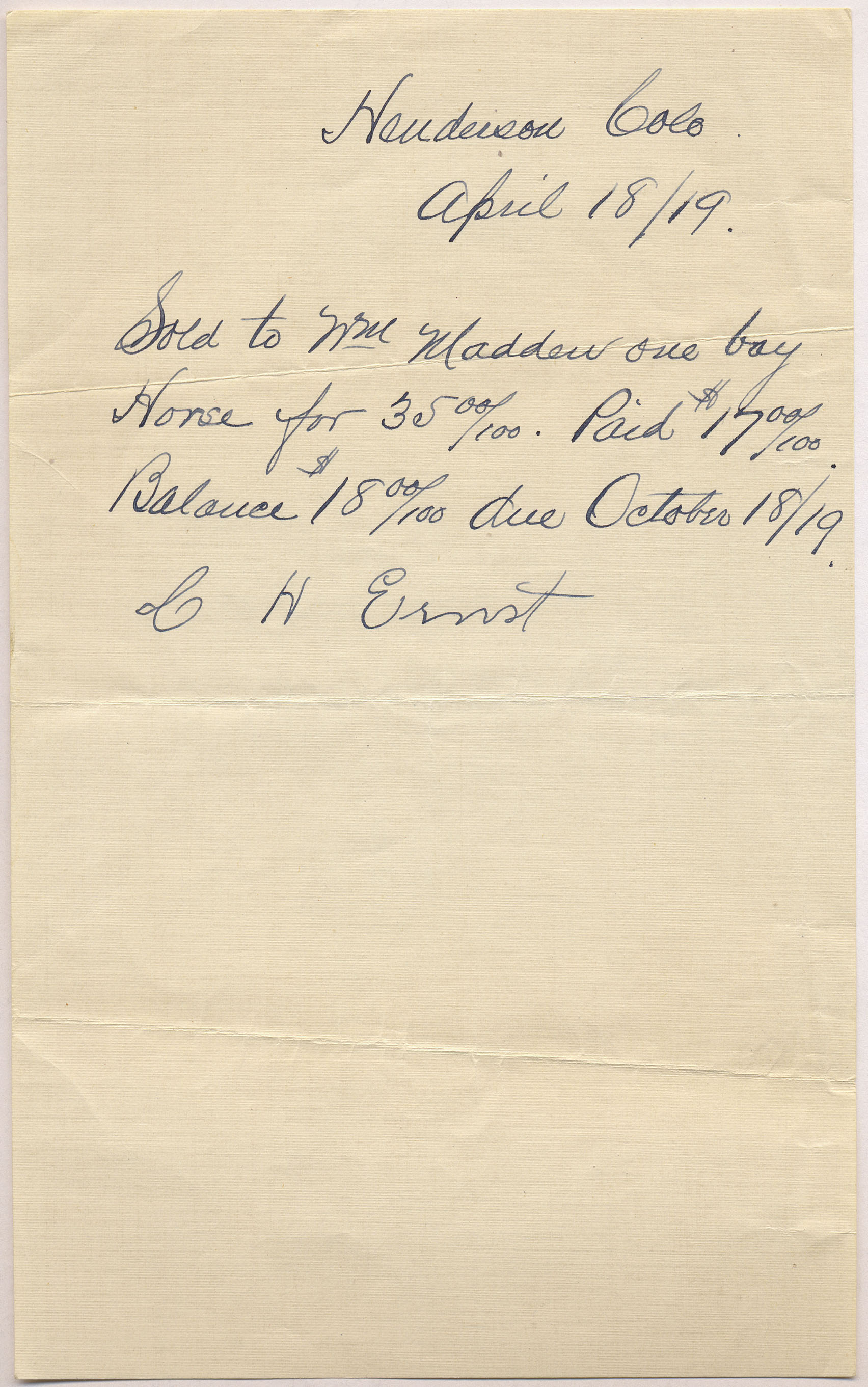
Written receipt for a $35.00 bay horse from C. H. Ernst on October 18, 1919 |
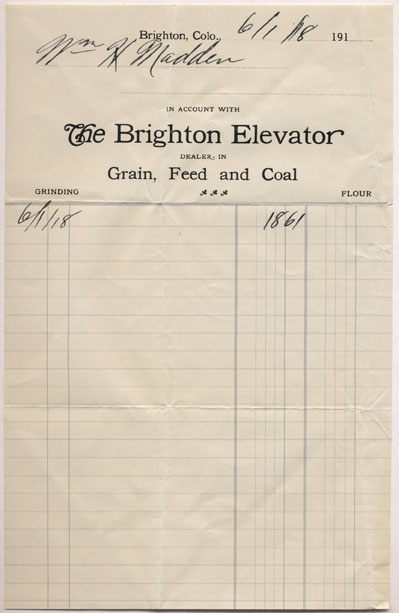
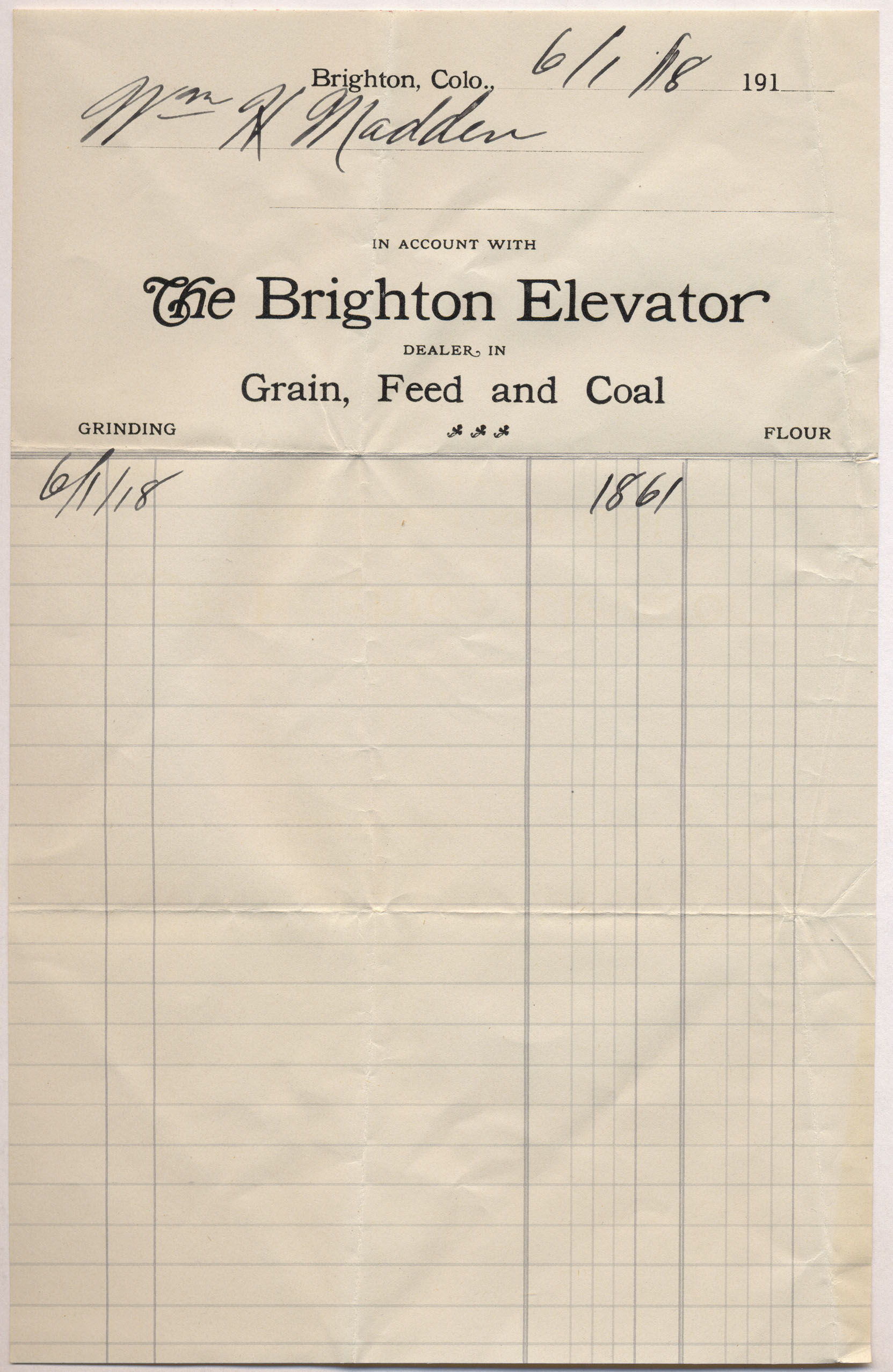
June 1, 1918 Receipt from the Brighton Elevator for William - paid settled his bill below. |
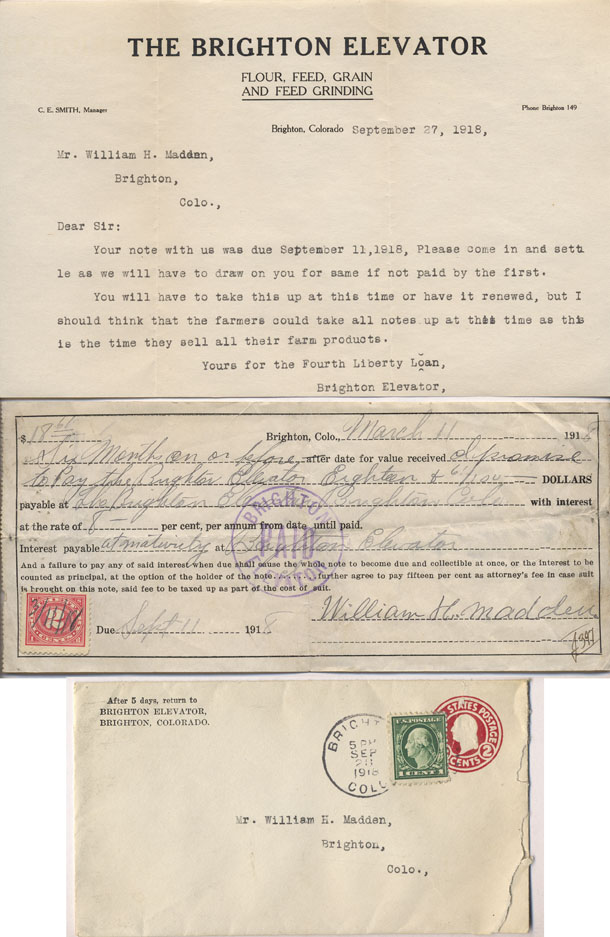
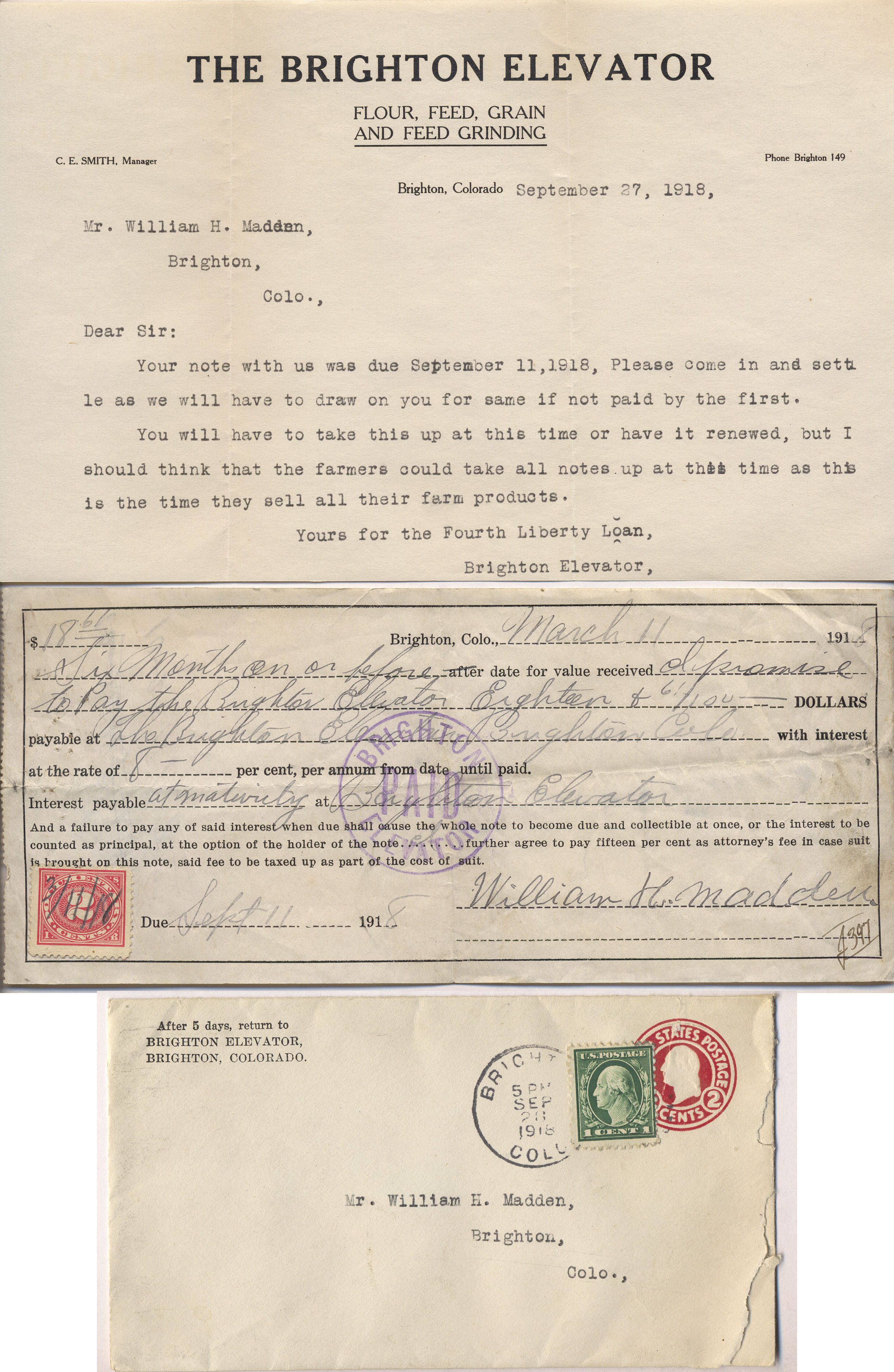
September 11, 1918 - $18.61 Receipt with letter and envelope from the Brighton Elevator for William's grain crops. |
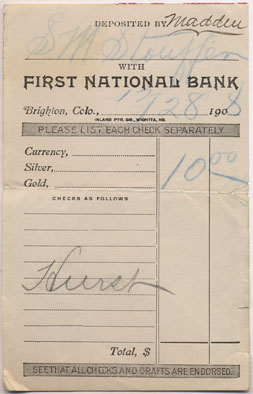
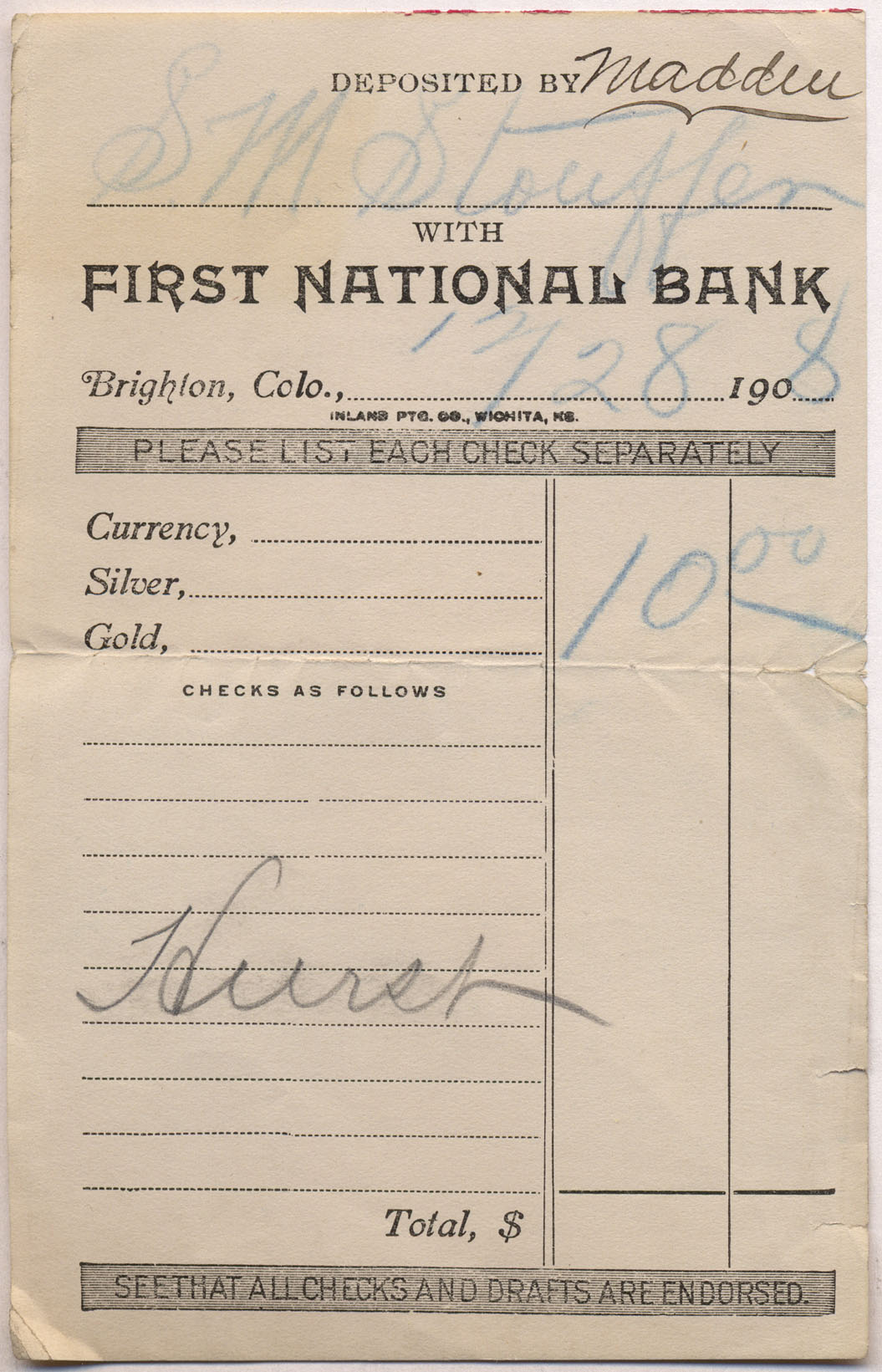
1908 First National Bank in Brighton deposit slip for $10.00 |
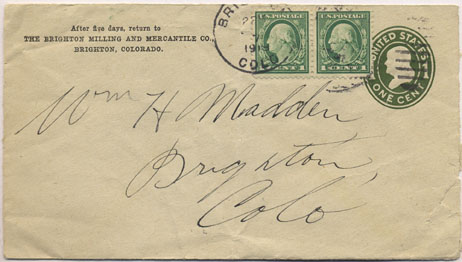
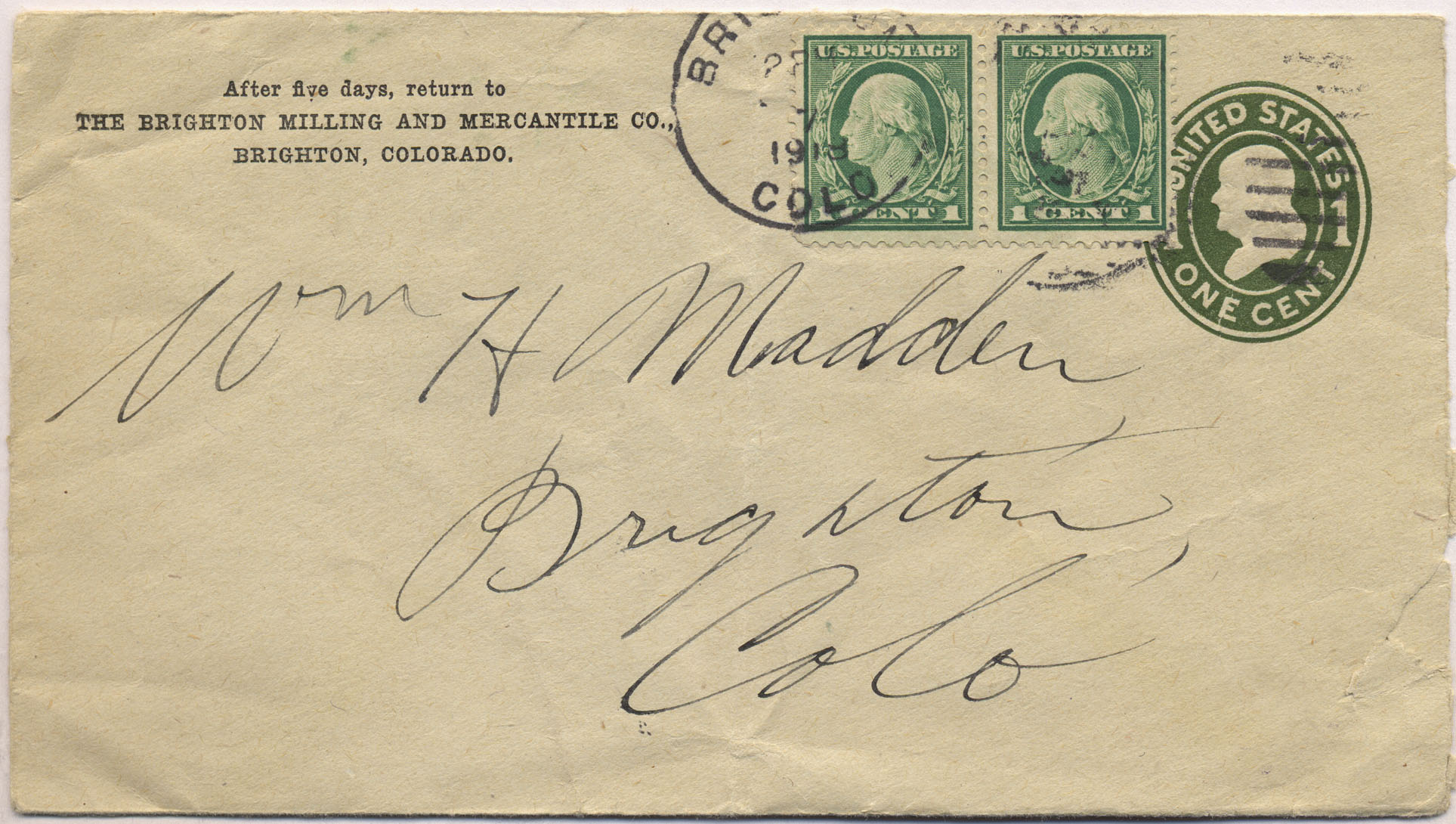
1918 Envelope for Brighton Milling and Mercantile Co. |
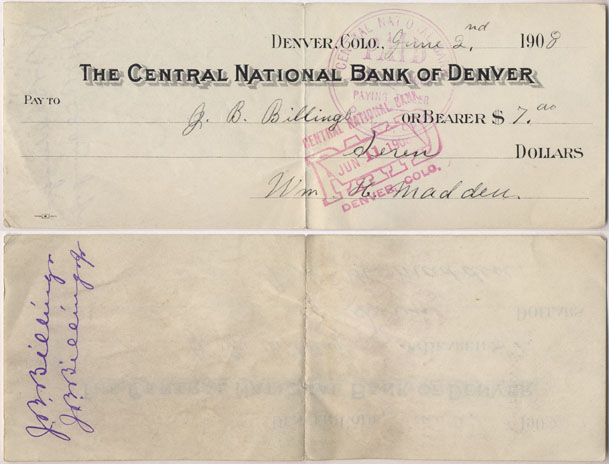
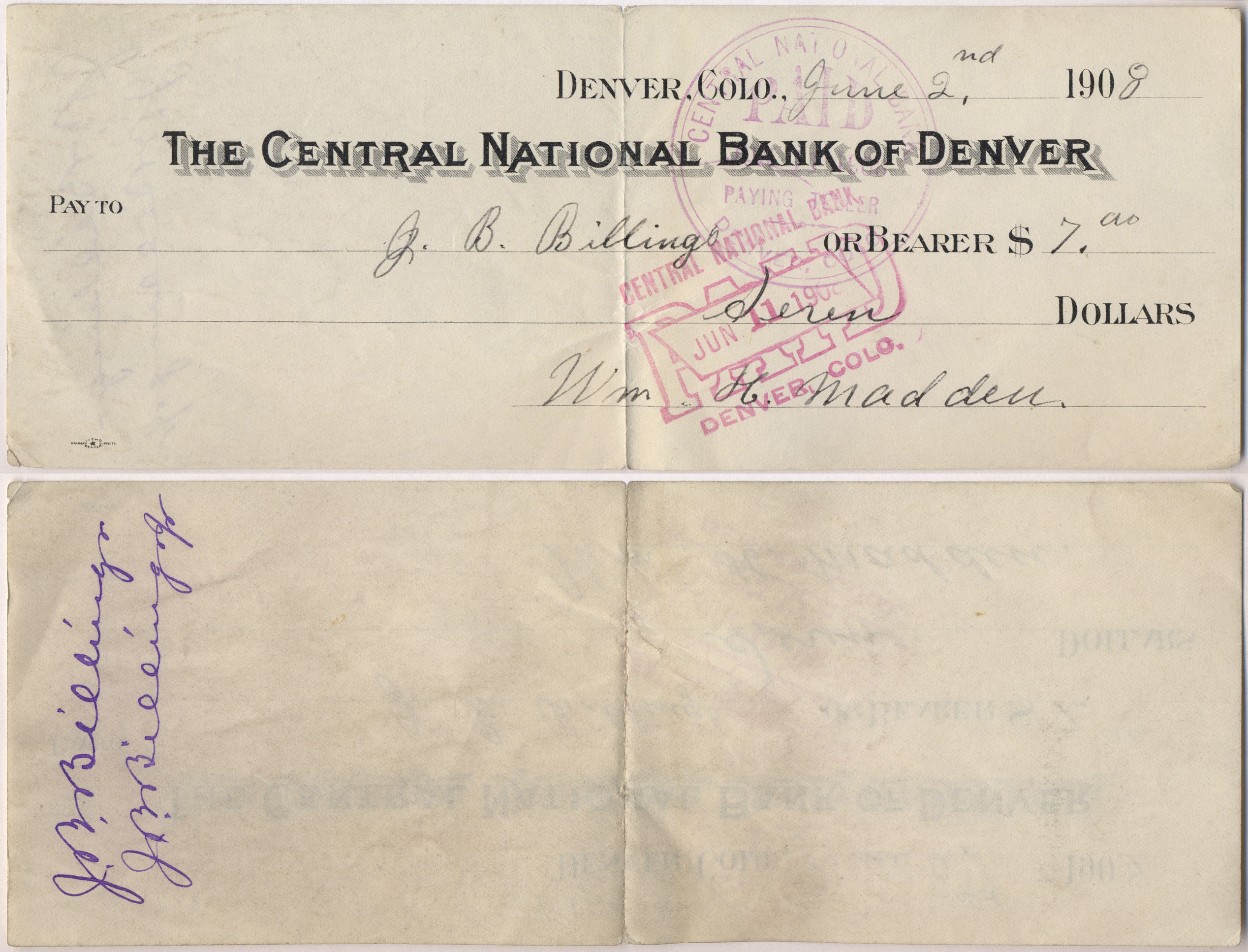
Endorsed check William wrote for $7.00 to J. B. Billings in 1908. The signature is the same on the letter below. |
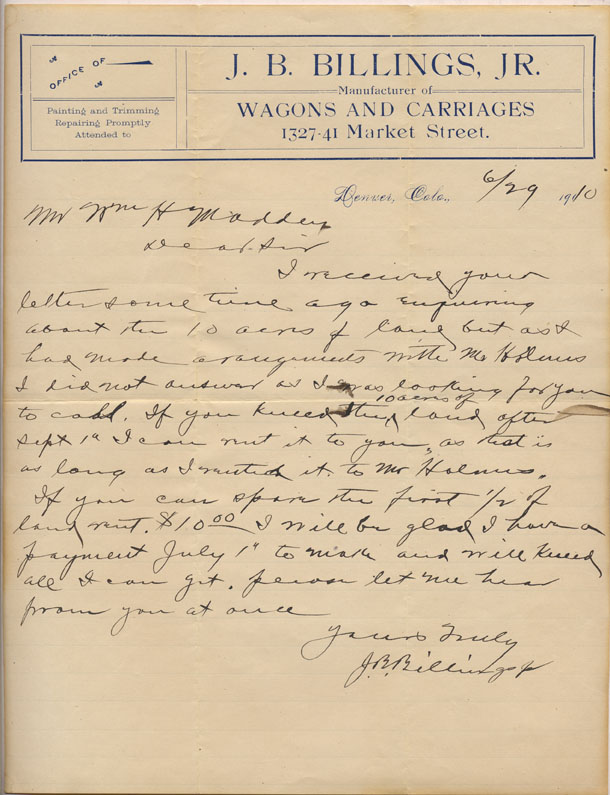
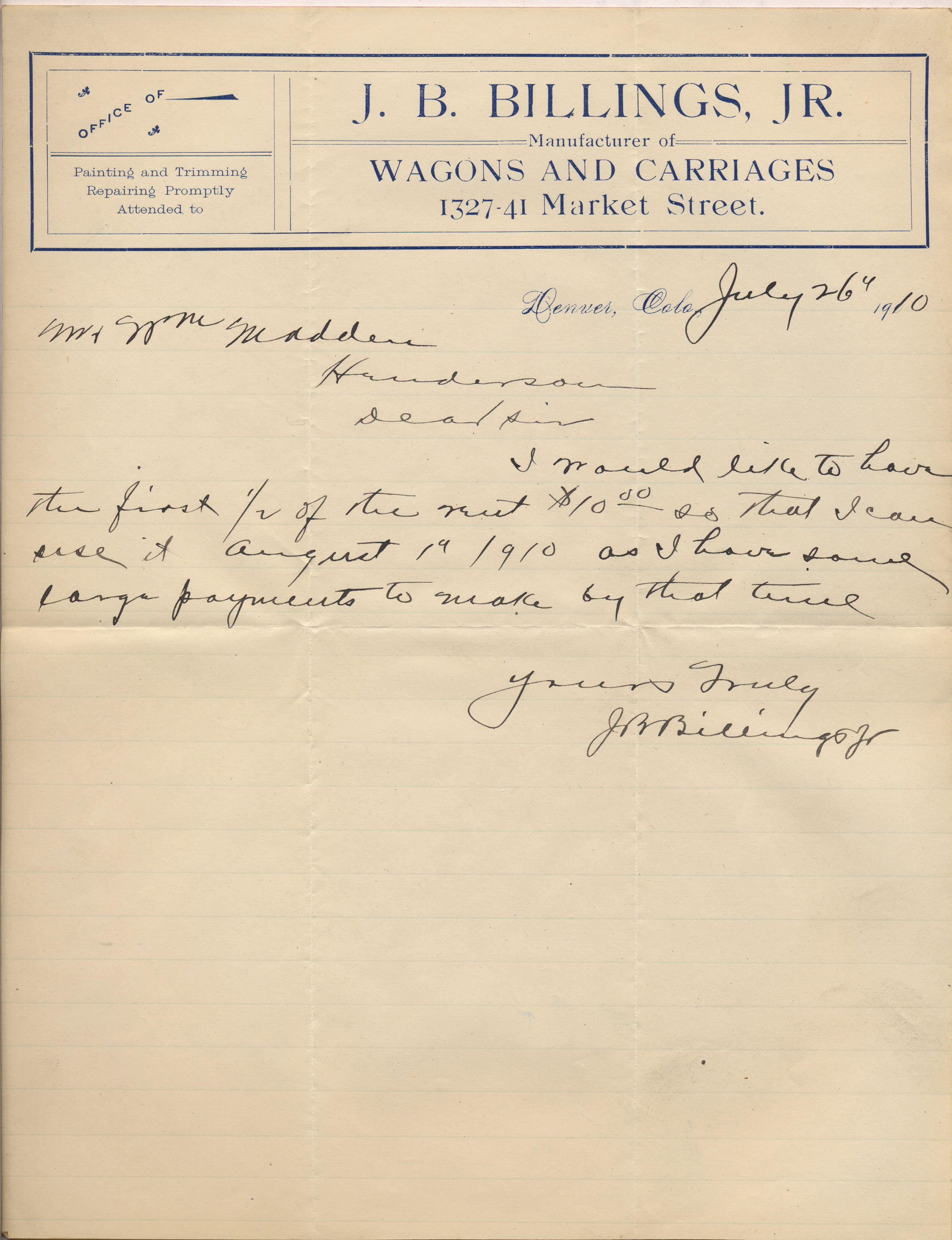
June 29, 1910 Letter from J. B. Billings Jr., wagon and carriage manufacturer in Denver inquiring about ten acres of land. |
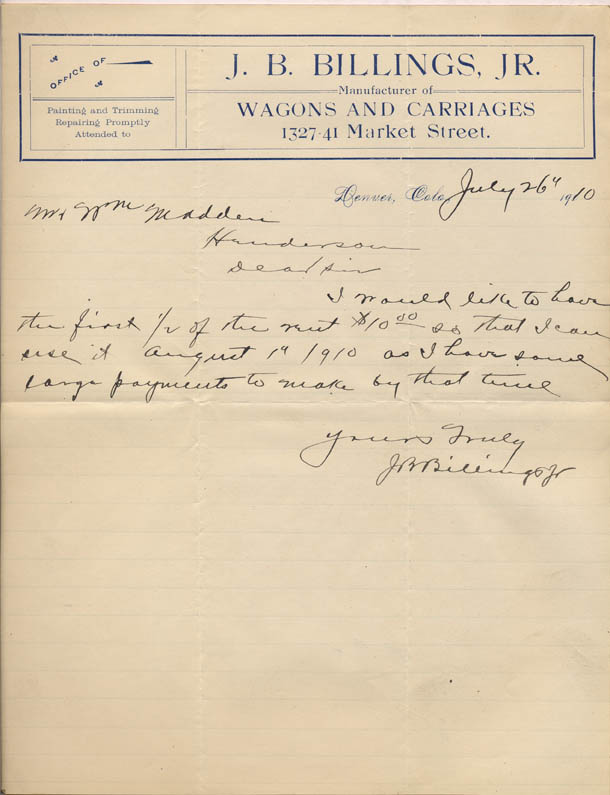
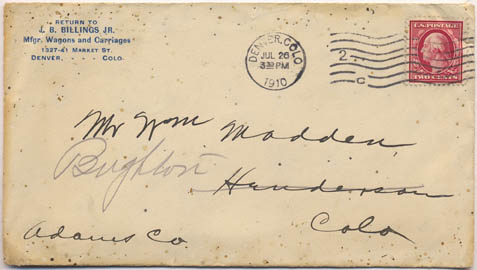
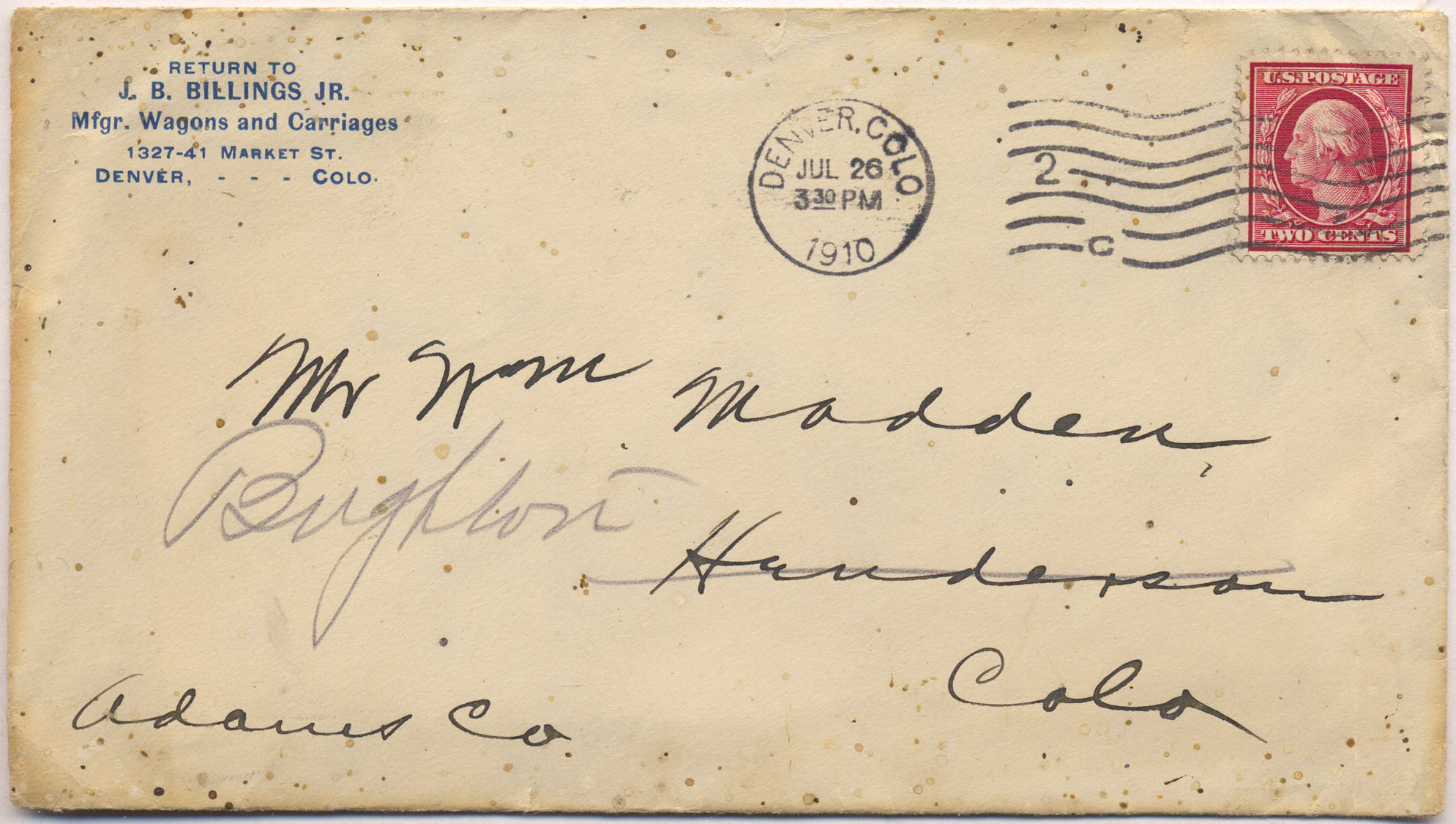
An earlier June 26, 1910 Letter from J. B. Billings Jr. with envelope. |
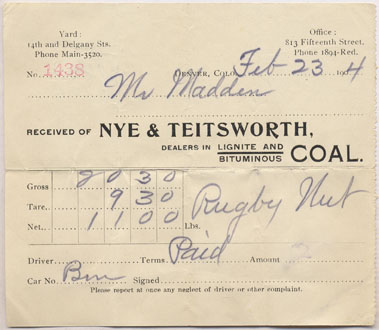
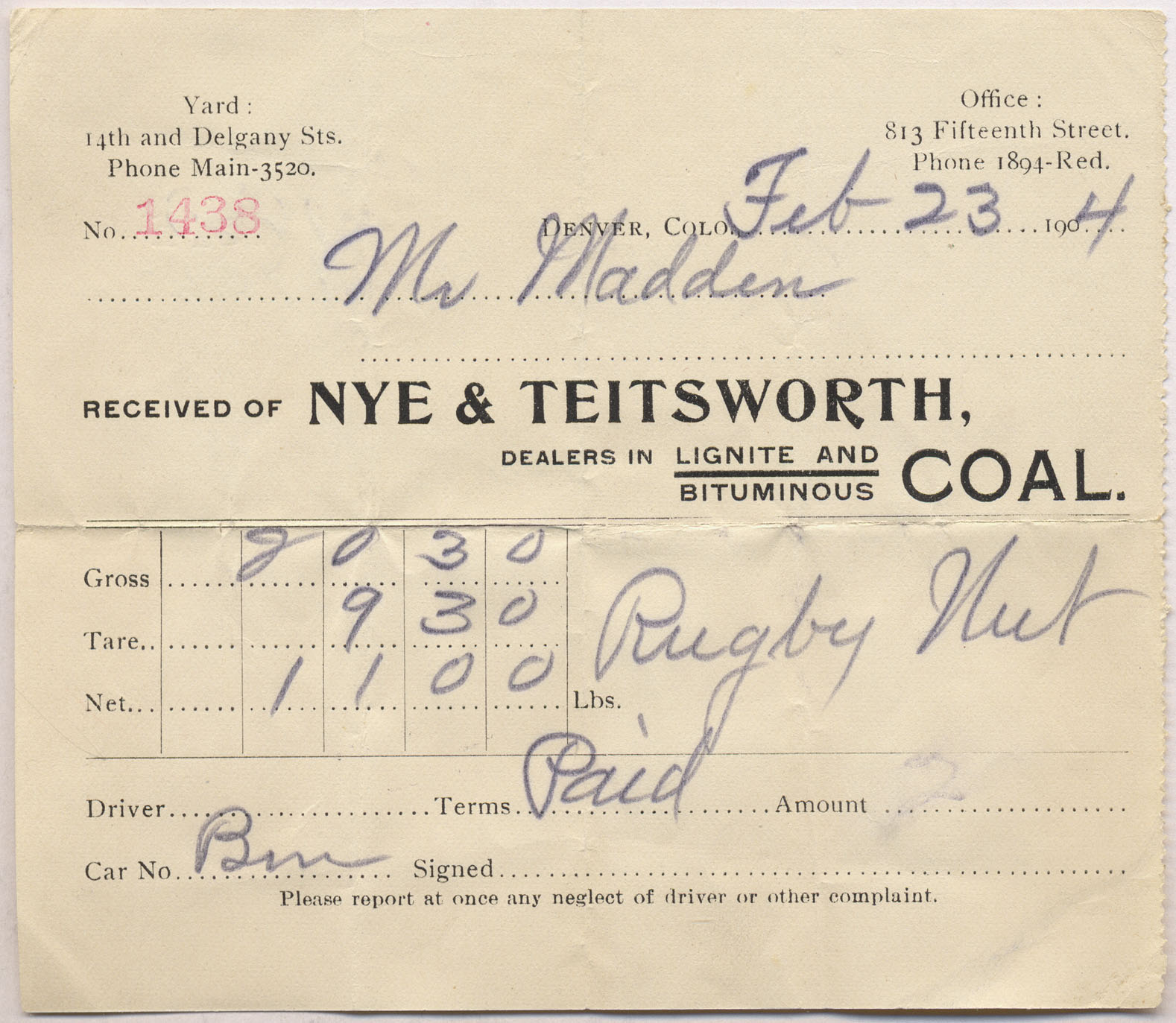
1904 receipt for Rugby Nut coal on February 23, 1904. |
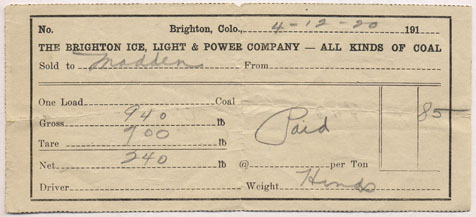
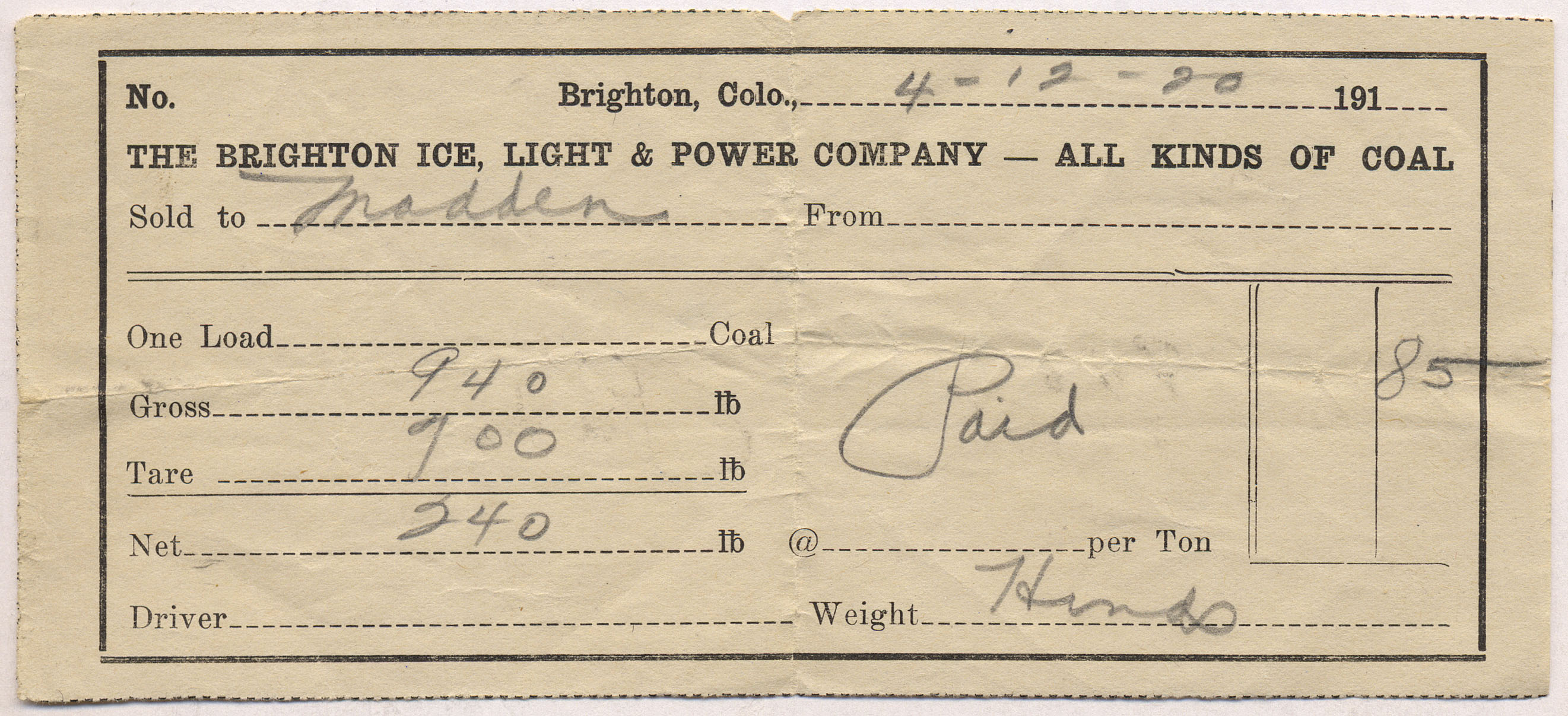
1920 receipt for coal from the Brighton Ice, Light and Power Company. |
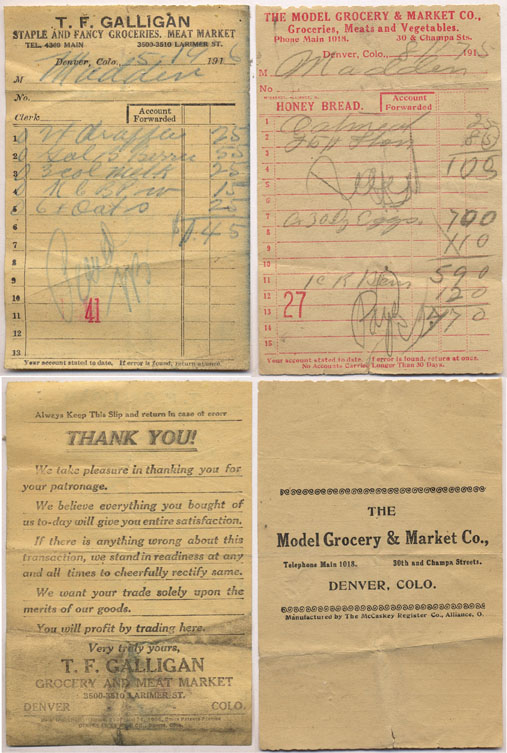
1915 and 1916 grocery receipts from Denver. There were dozens of receipts in the milk can. |
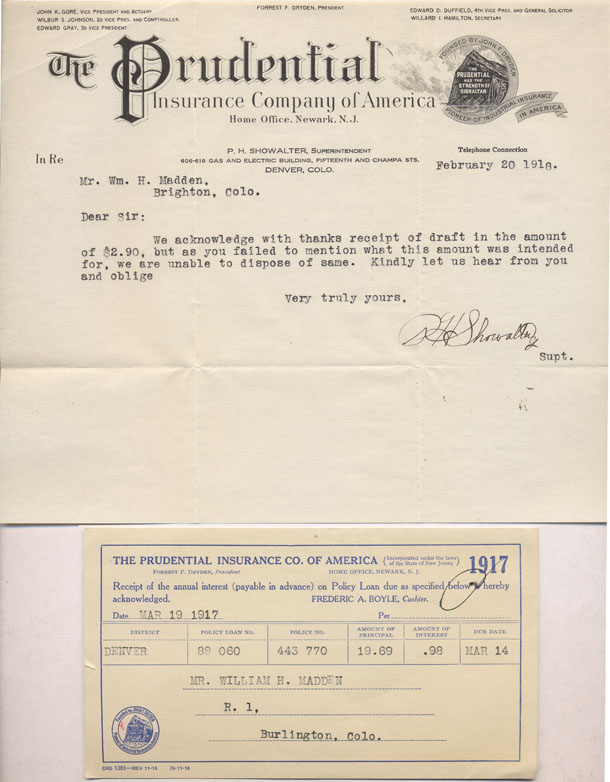
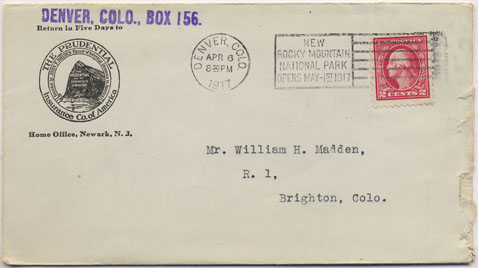
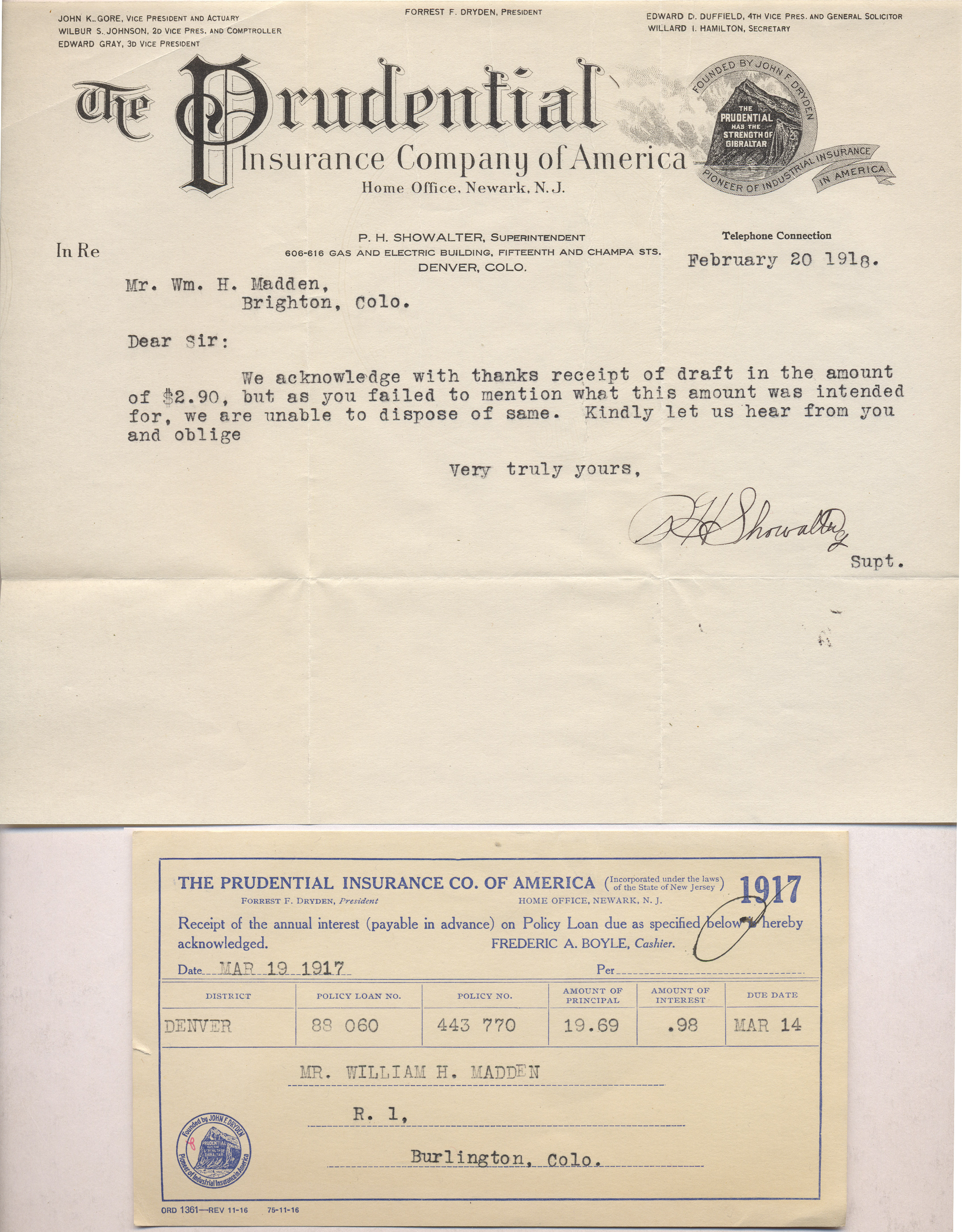
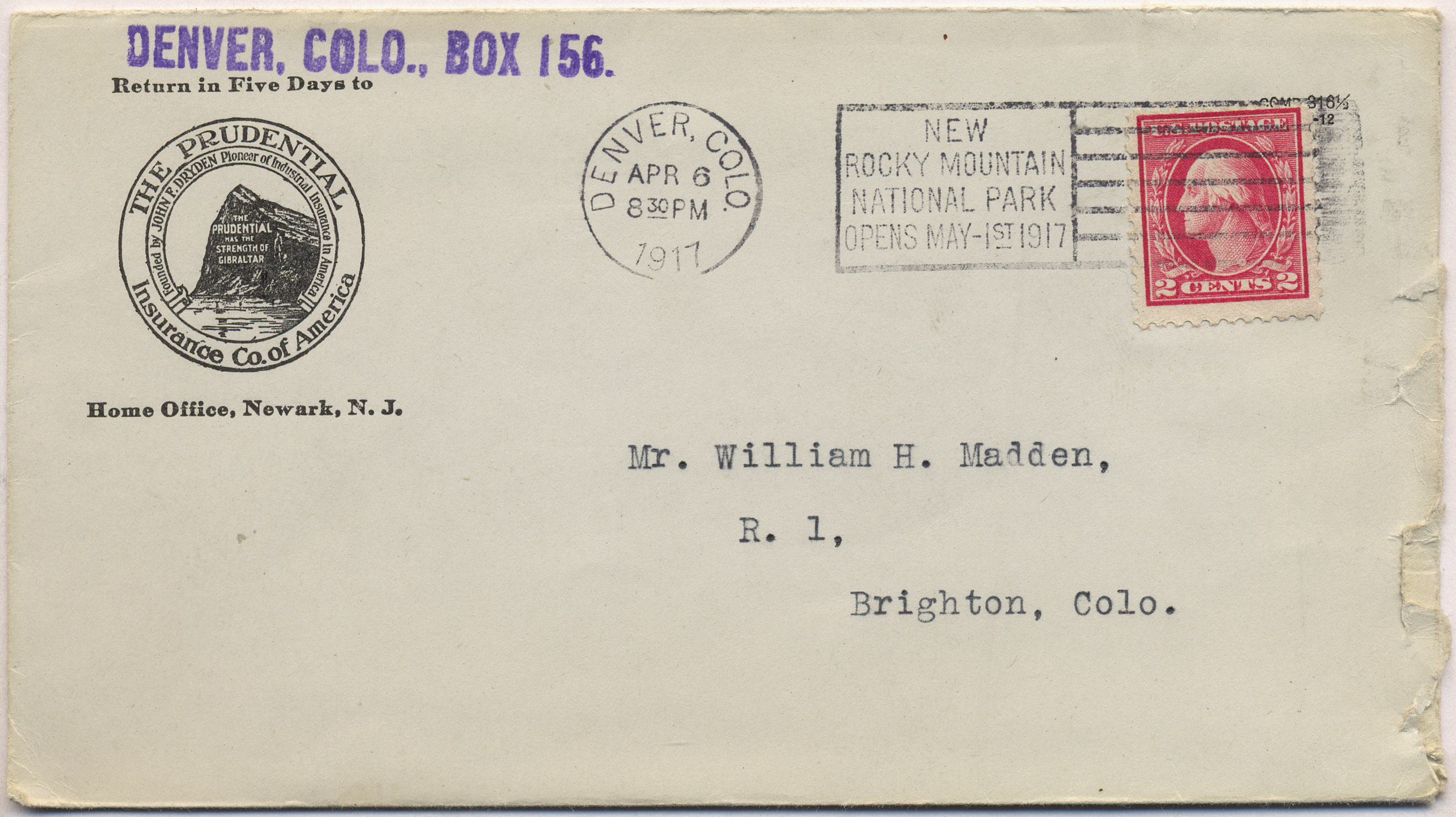
1917 Receipt For Prudential Insurance for William. Notice the envelope with the postal stamp for the "NEW ROCKY MOUNTAIN NATIONAL PARK OPENS MAY 1st 1917." A stack of payments through the years also filled the milk can. |
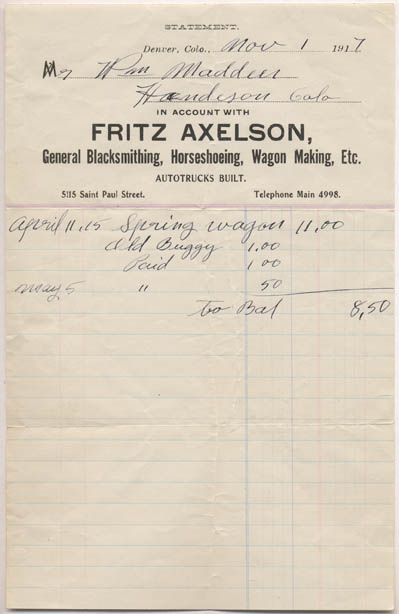
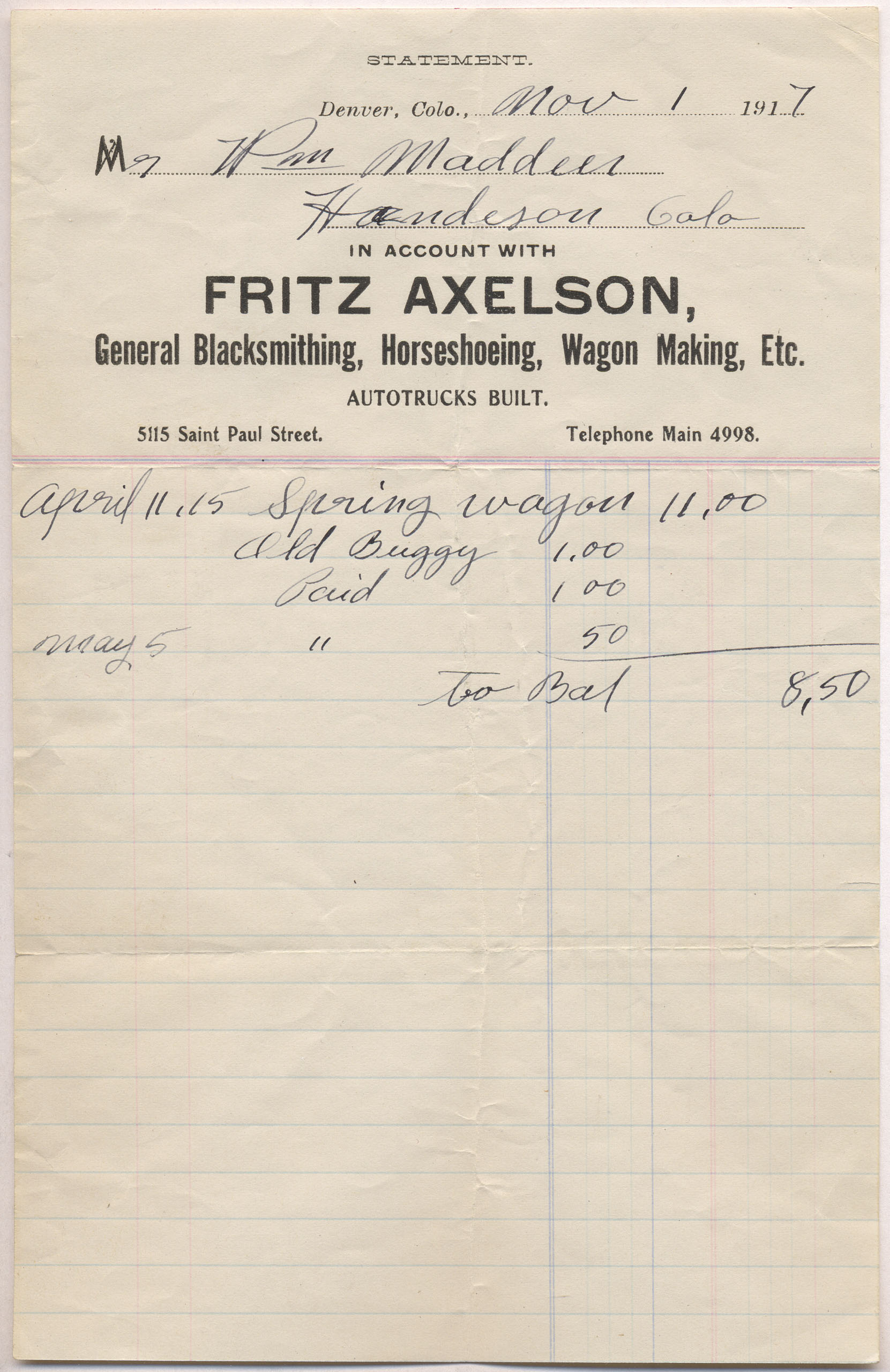
1917 Receipt for a spring wagon and old buggy from Fritz Axelson, a blacksmith in Denver. |
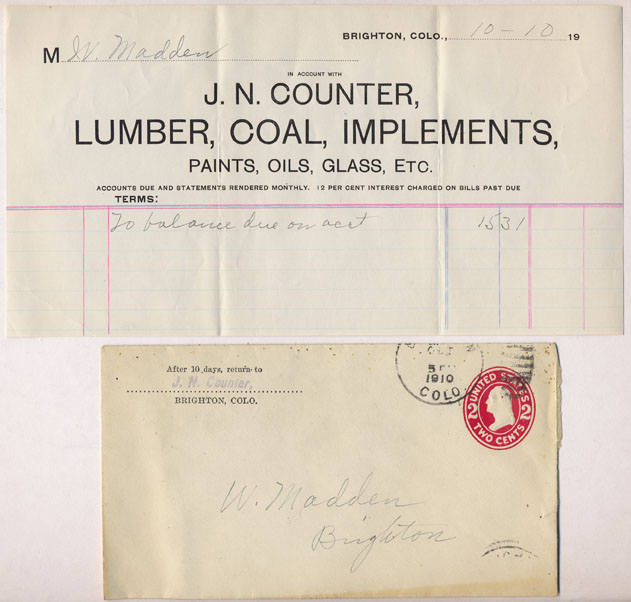
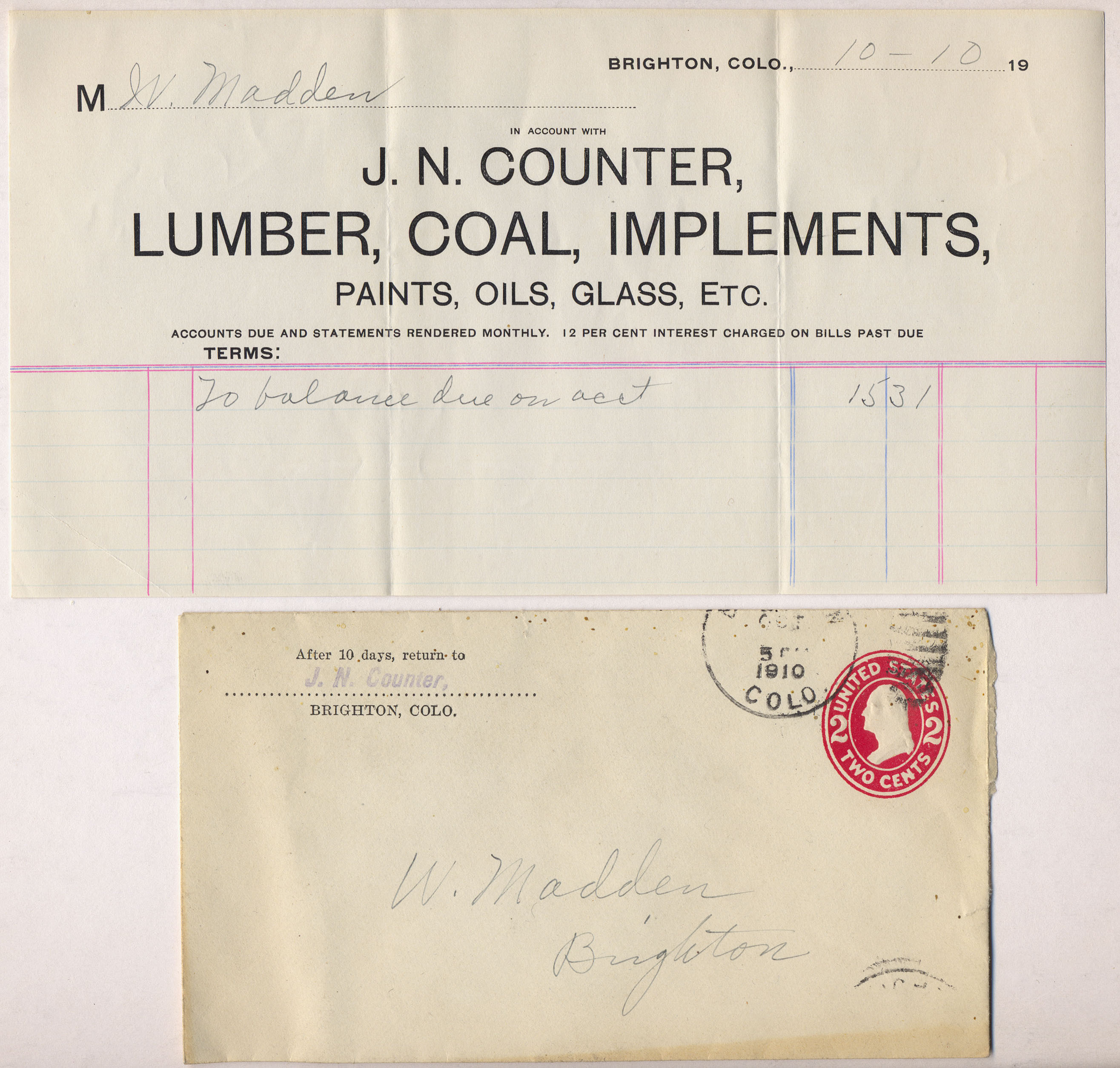
1910 Receipt for balance on account from J. N. Counter lumber yard in Brighton. |
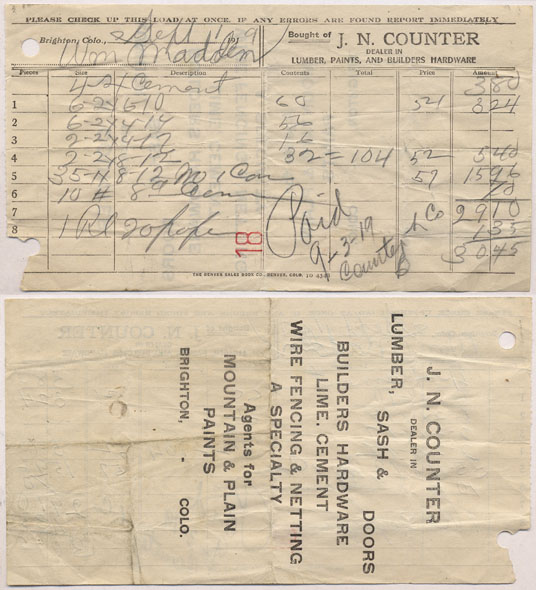
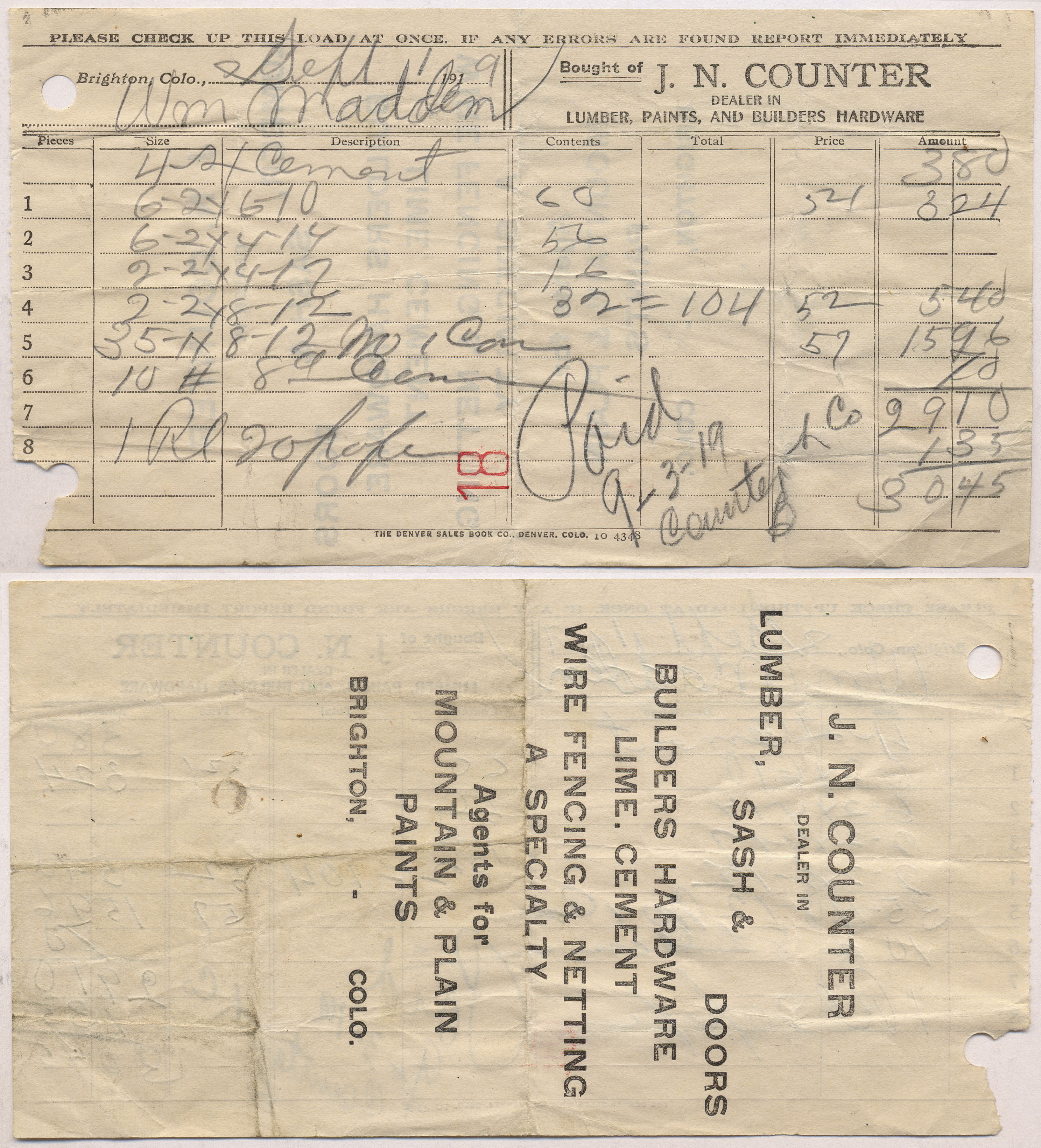
1919 receipt for William at J.N. Counter for lumber and cement. |
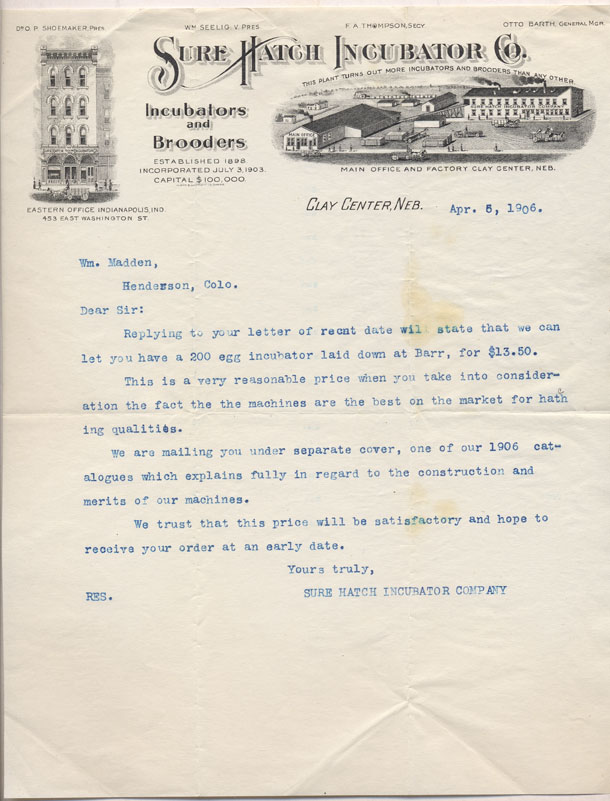
1906 Letter from Sure Hatch Incubator Company in Nebraska for raising chickens. |
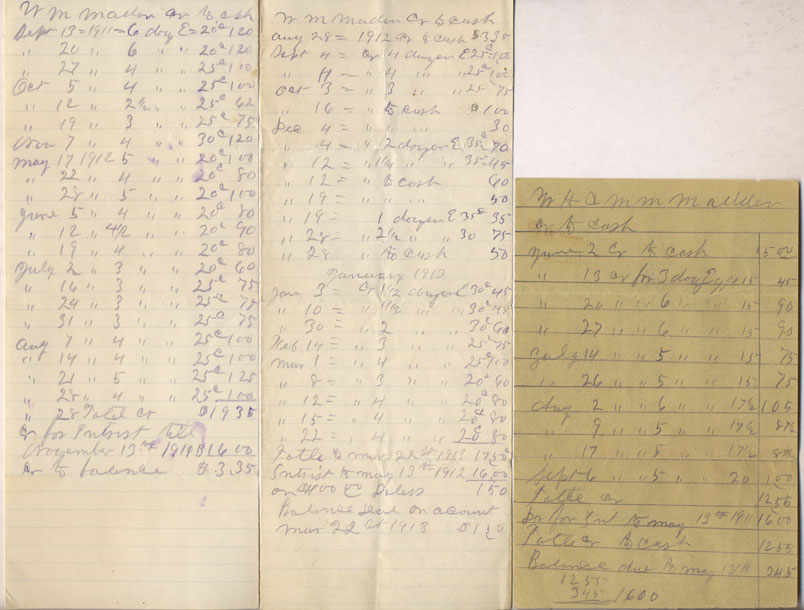
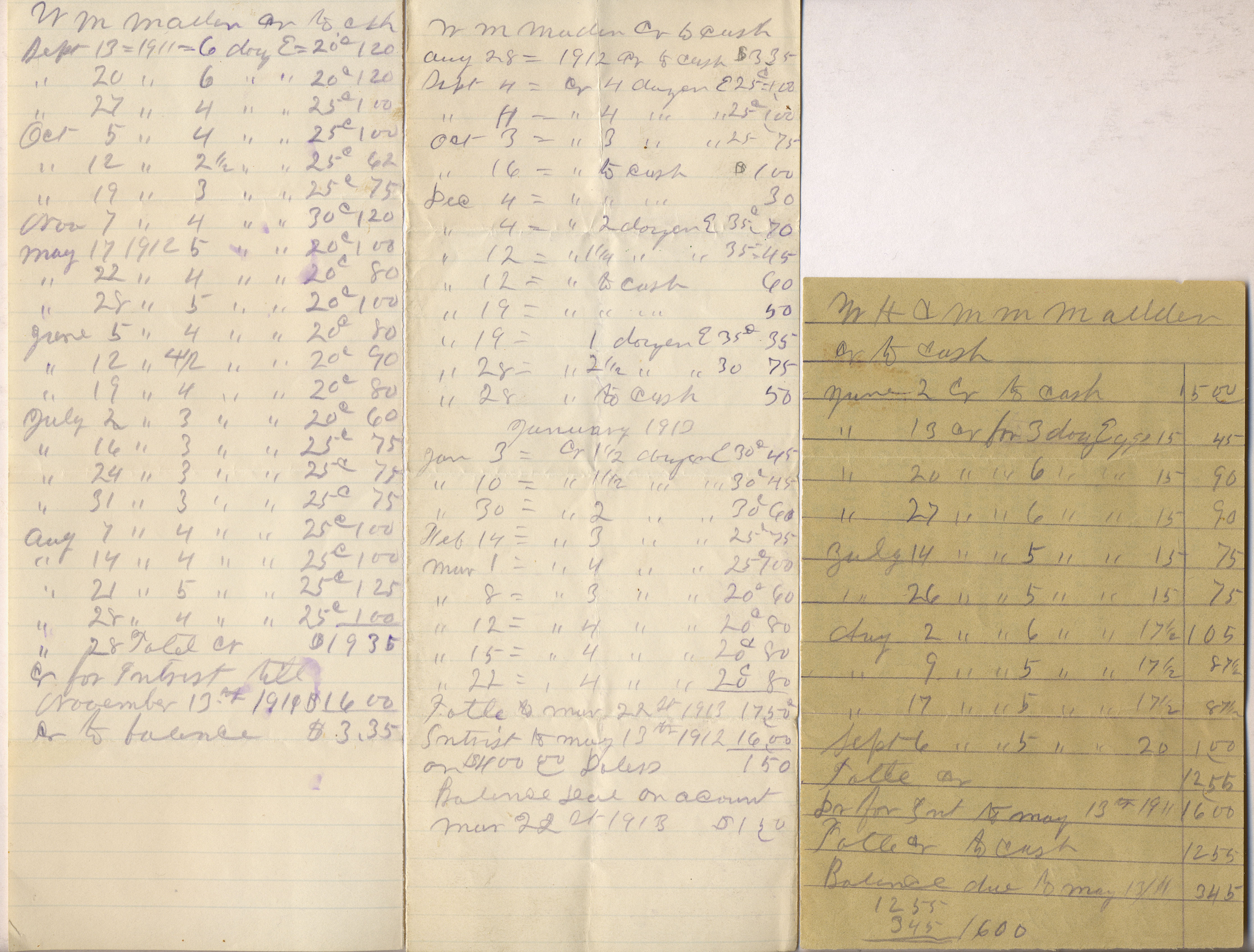
1911 - 1913 Accounting for egg production. |

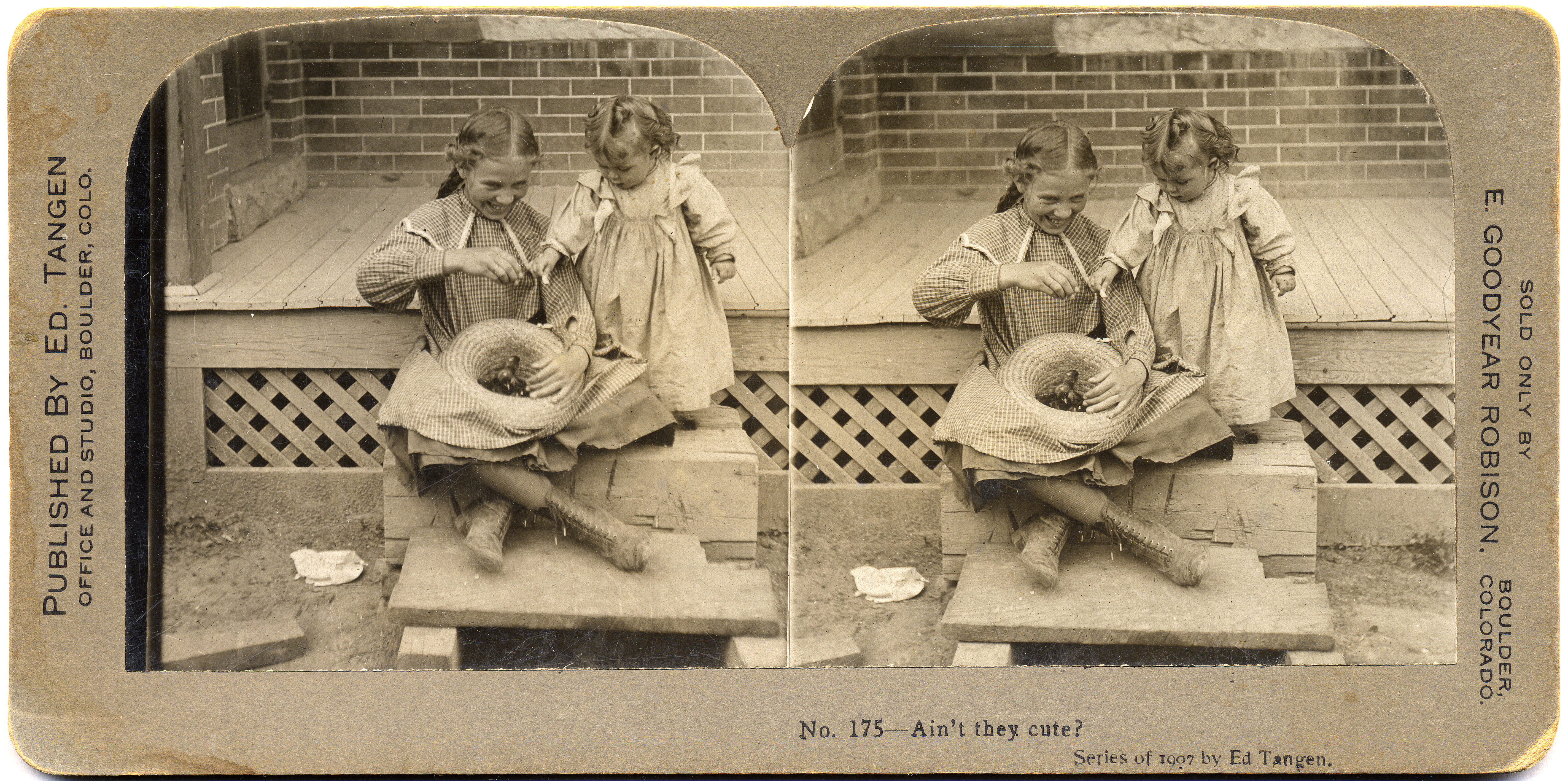
William's kids, Frank and Clara would have likely played the the young chickens, similarly portrayed in this 1907 photo of kids playing with chicks in Boulder, Colorado. Photo taken by Ed Tangen. |

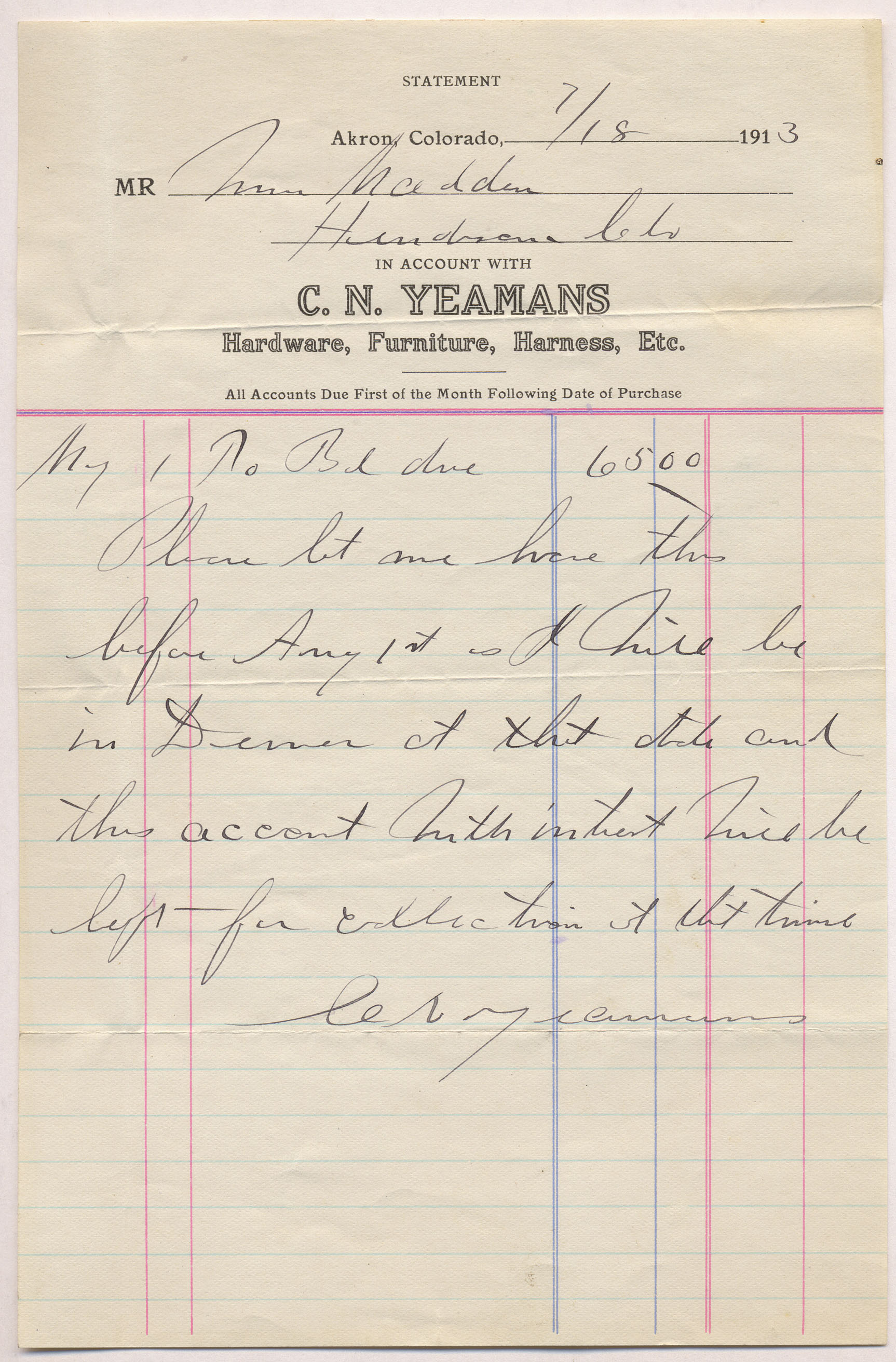
1913 Receipt for balance due at Akron, Colorado C. N. Yeamans Hardware. Money always seemed to be in short supply throughout his years as a farmer in Brighton. |
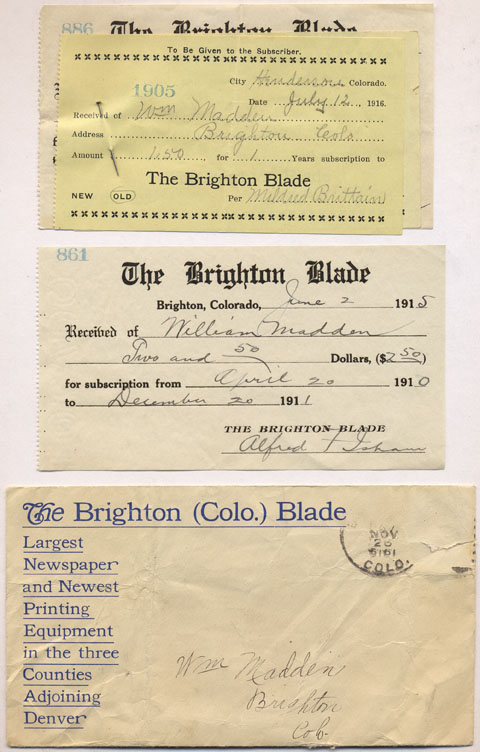
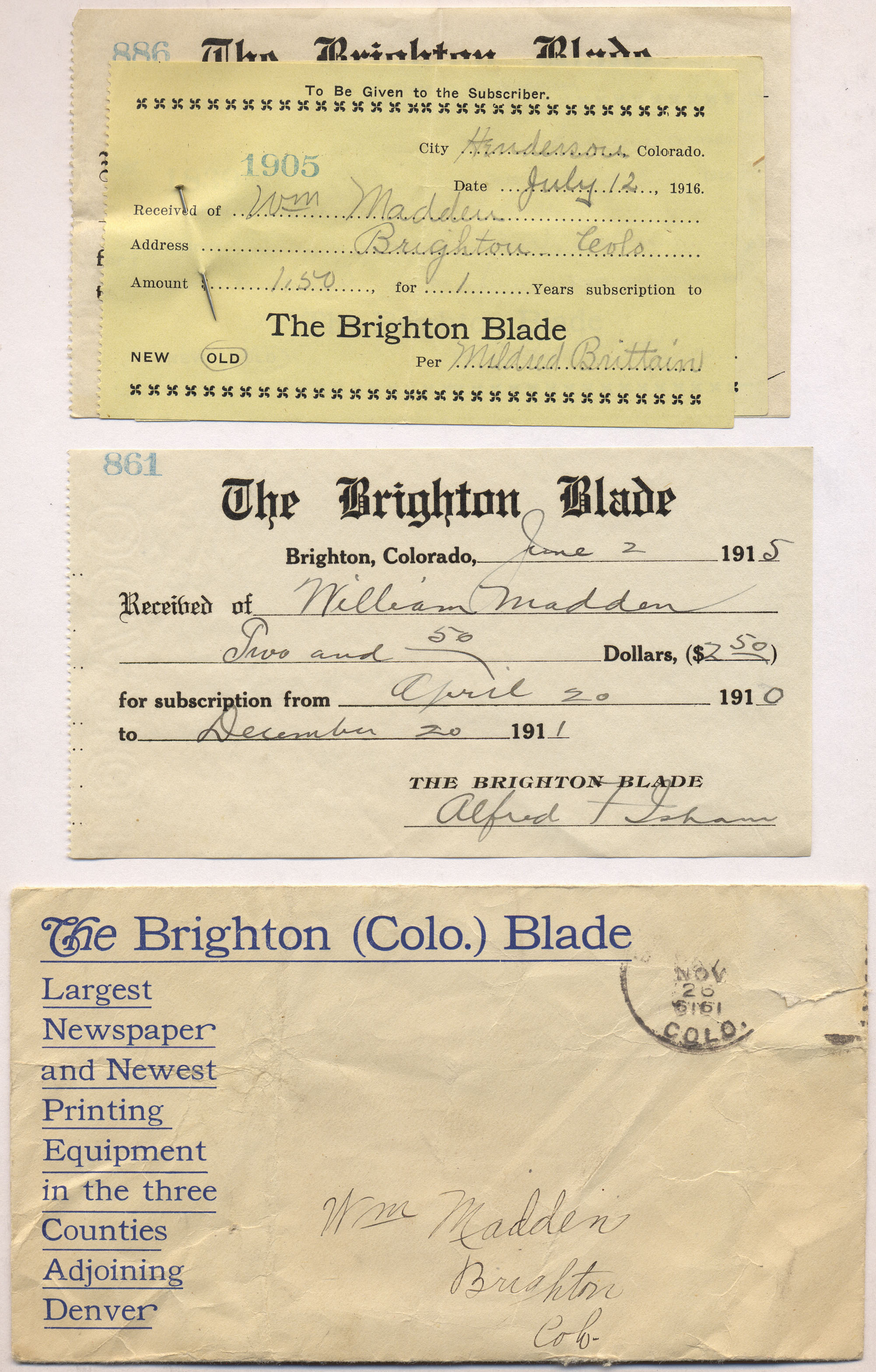
1910 - 1919 subscriptions to the Brighton Blade newspaper. |
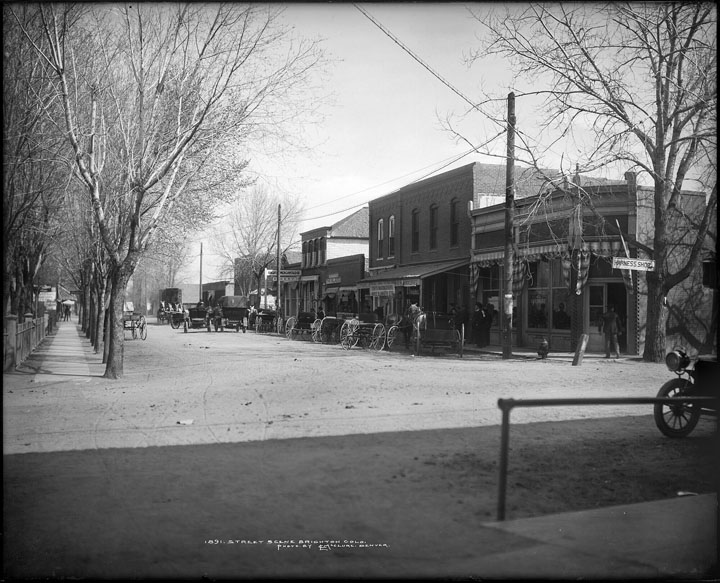
Streets and shops William would have frequented. Taken about 1908 by Louis Charles McClure, the photo looks north on Division Street, renamed North Main Street, from the northeast corner of Bridge and North Main Street in Brighton, Colorado. Horse-drawn wagons and carriages are parked near sidewalk lined with brick and wood shops and businesses including, A.S. (Archie Scott) Leffingwell Hardware (see recipt below), the Brighton Blade (multiple subscriptions), Brighton Mercantile and Bakery, and Elite Saloon. Additional signs include "Ice Cream", banner advertising "For sale, canvas for ditch dams, tents, wagoncovers, horse blankets, etc.," "Lincoln Paints," and directional sign pointing to "Harness shop." The photo also includes early vehicles, a large enclosed wagon with "Movies" on top part of enclosure drawn by four or more horses on dirt street, fire hydrant, and bar for tethering or hitching horses. Photo from the Denver Public Library Digital Collections. |
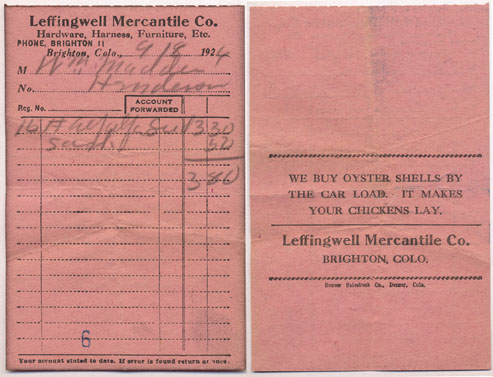
1926 Grocery receipt for William at Leffingwell Mercantile Co. in Brighton for 15 lbs of seed. |

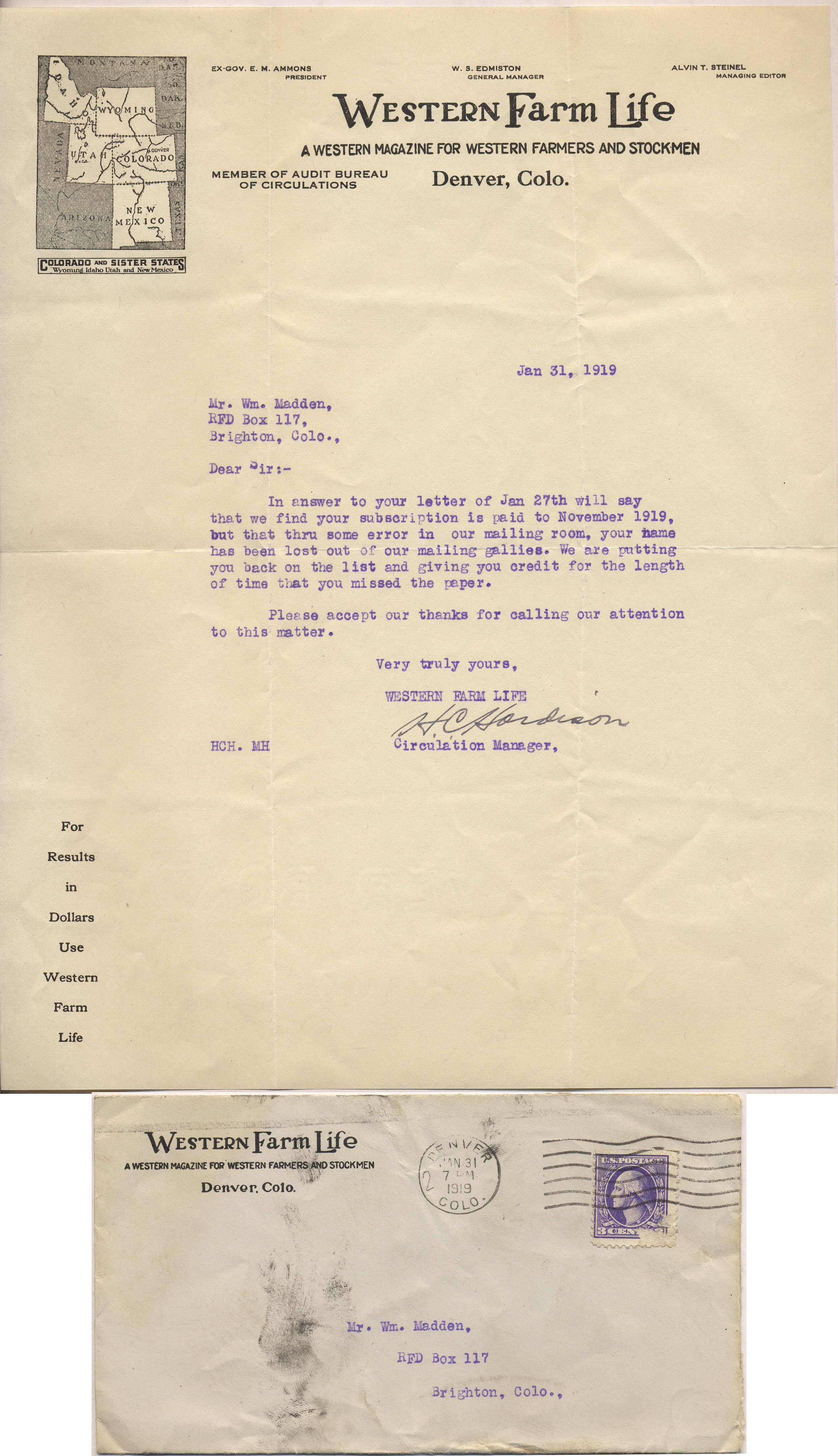
More reading - 1919 subscription to Western Farm Life. |
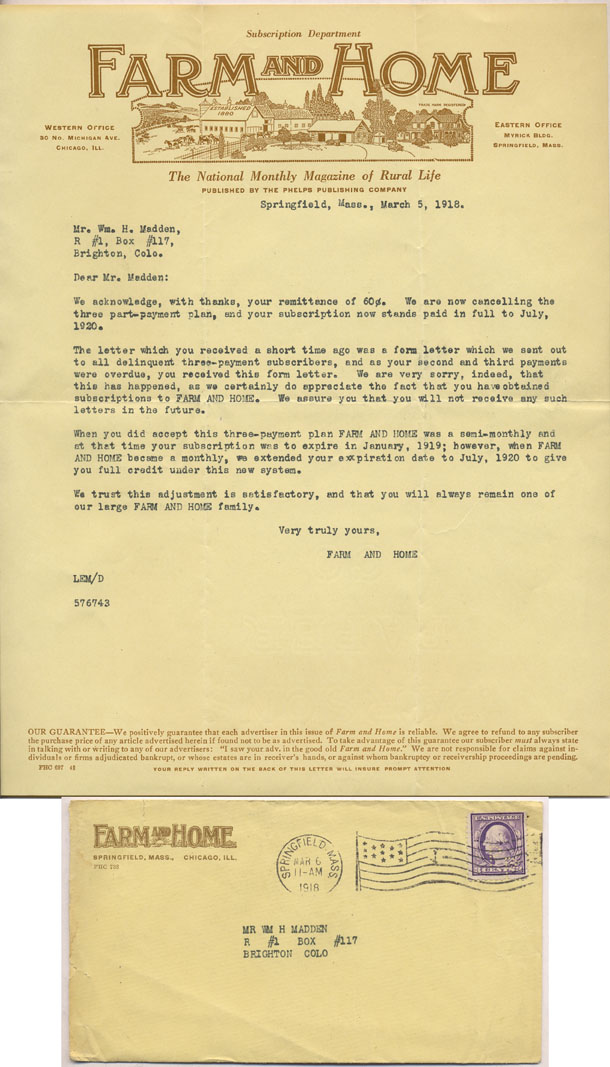
1918 - 1920 subscription to Farm and Home. |
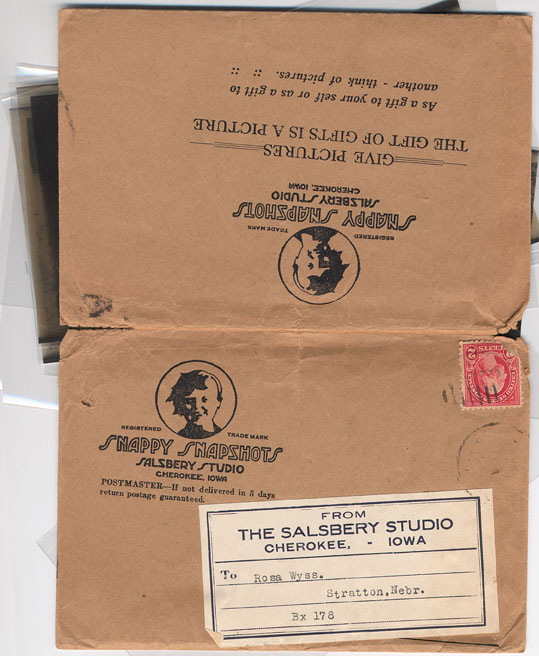
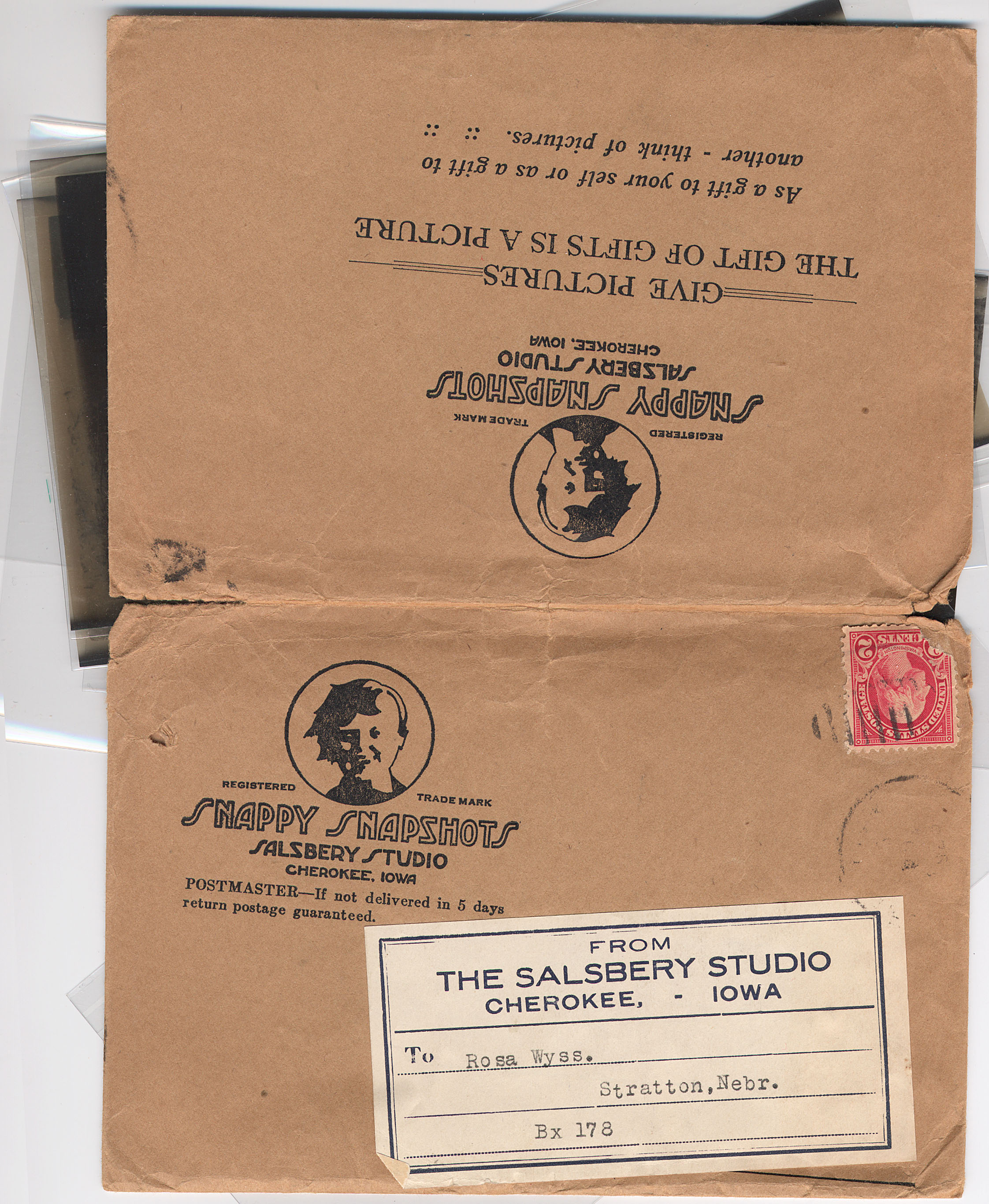
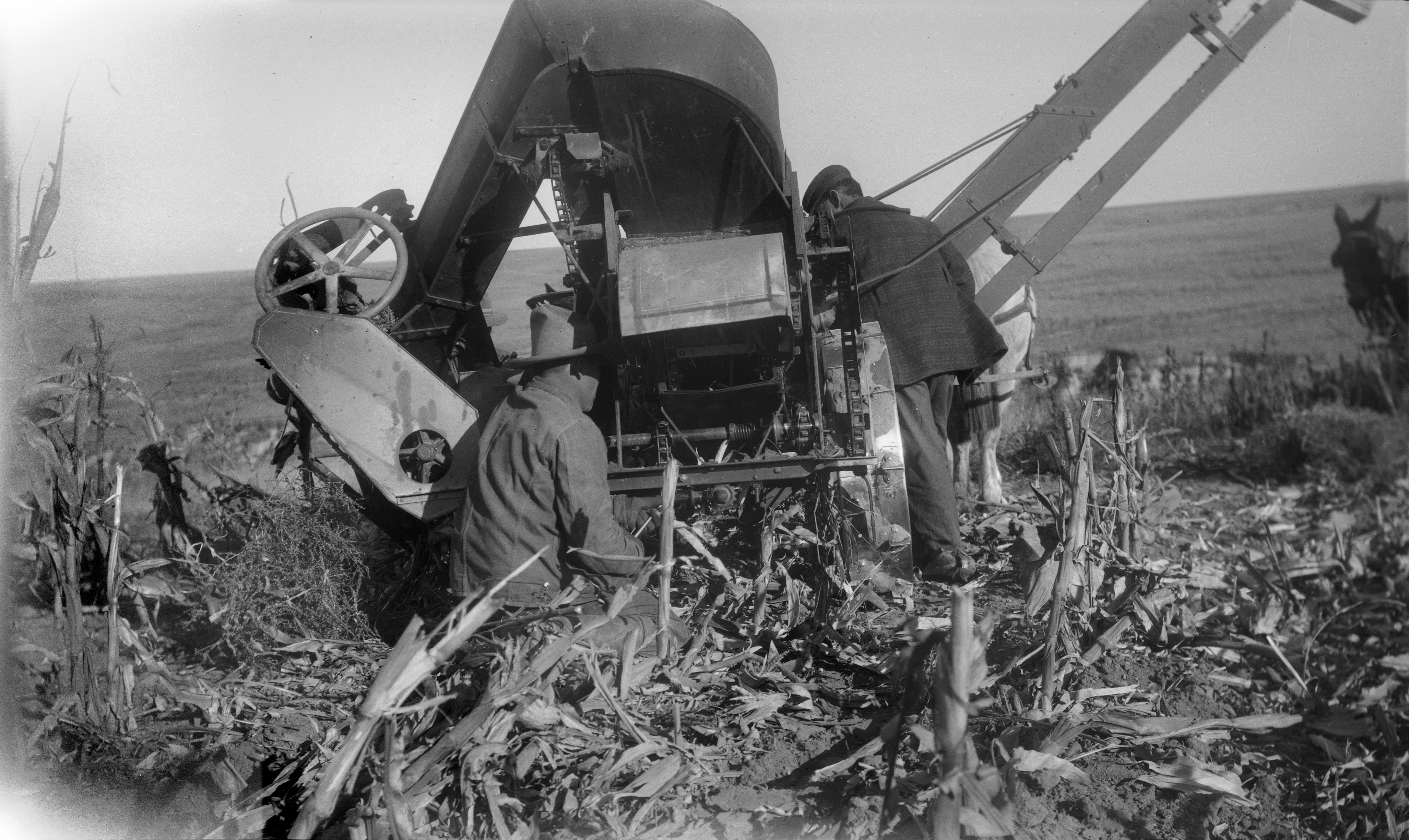
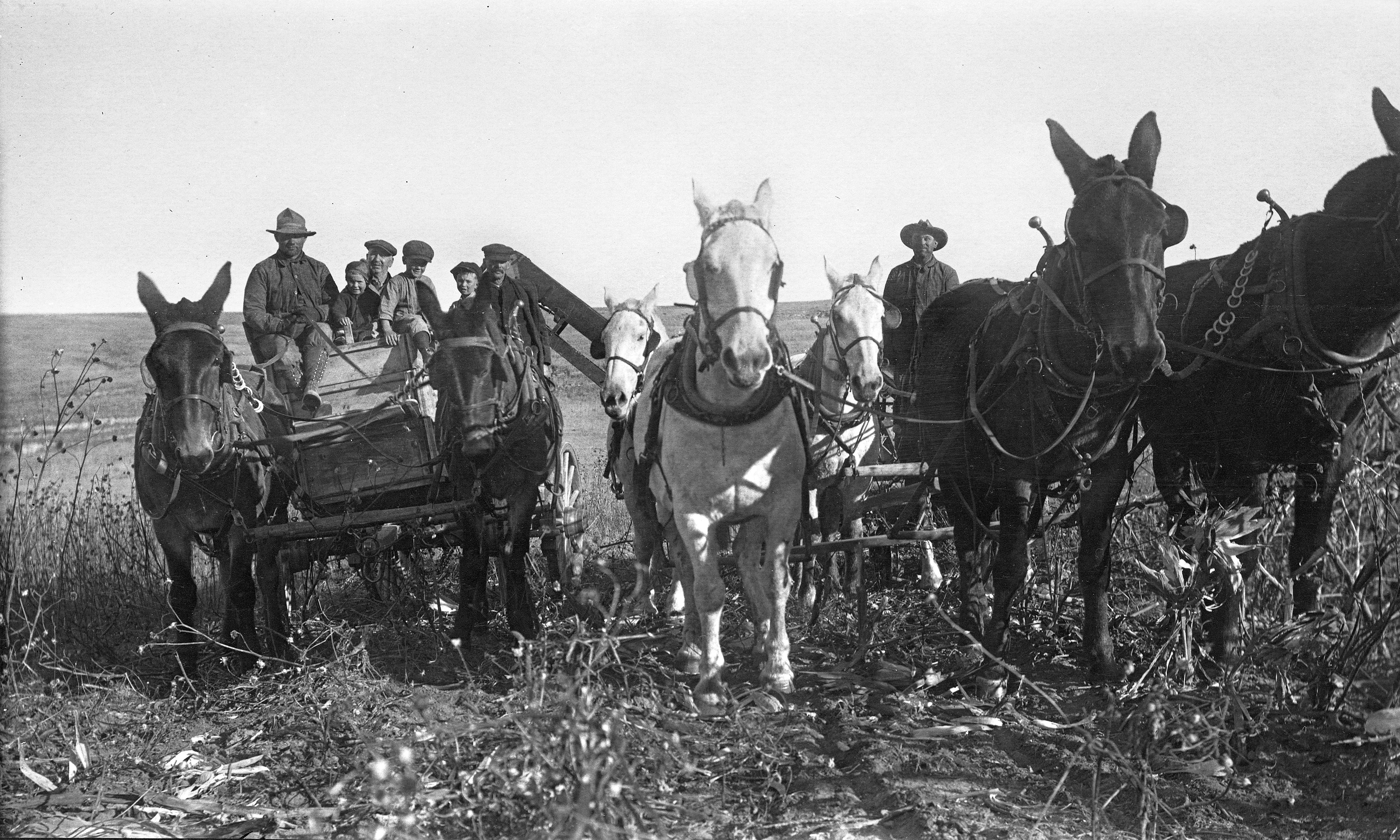
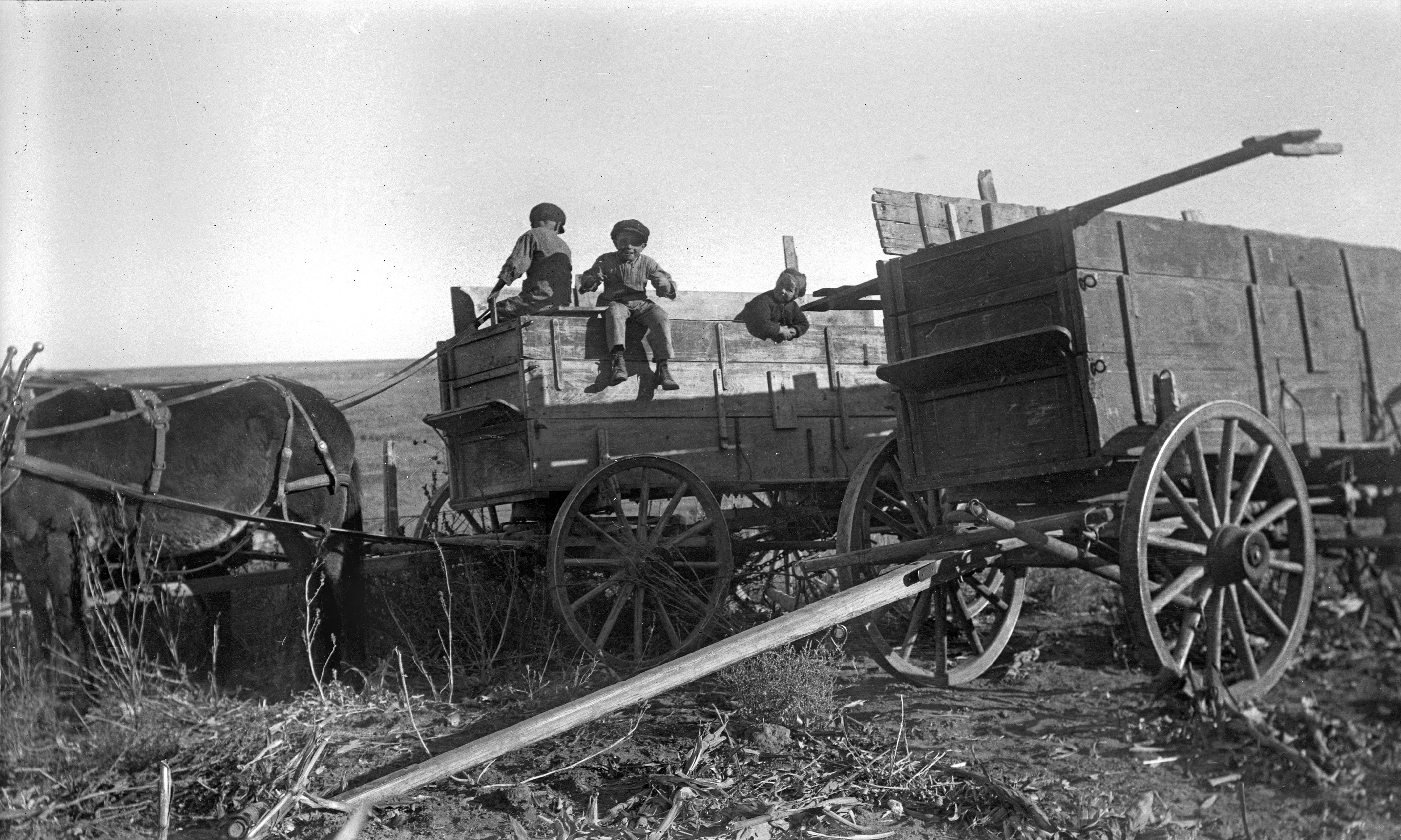
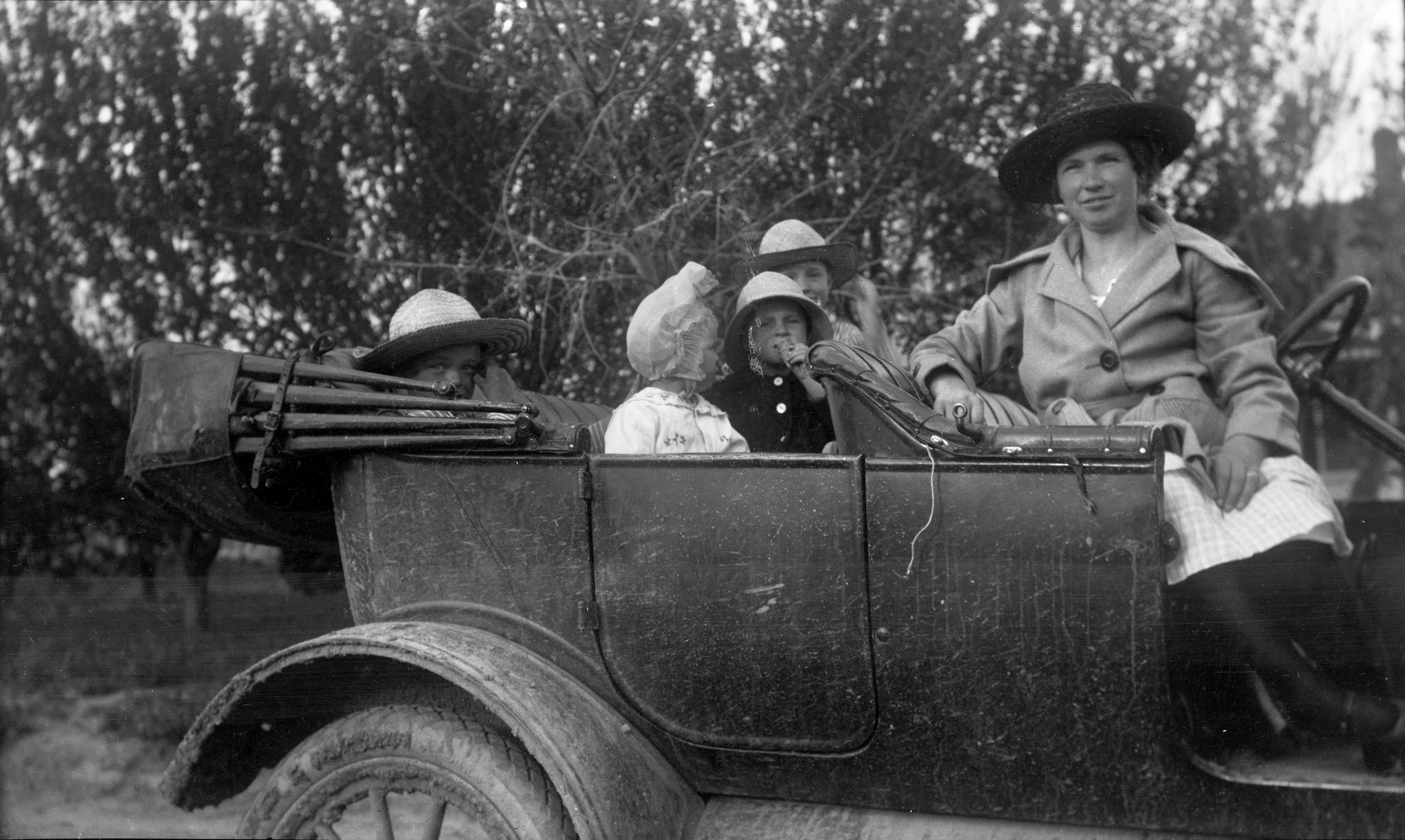
Found in an antique shop, negatives from photos were taken about 1913, southeast of Brighton and across state lines in Stratton, Nebraska. Another farmer documented harvesting with horse teams on his corn fields on the dry plains.
For all farmers including the Maddens, the process must have been a dry and dirty process and required constant fixes. |
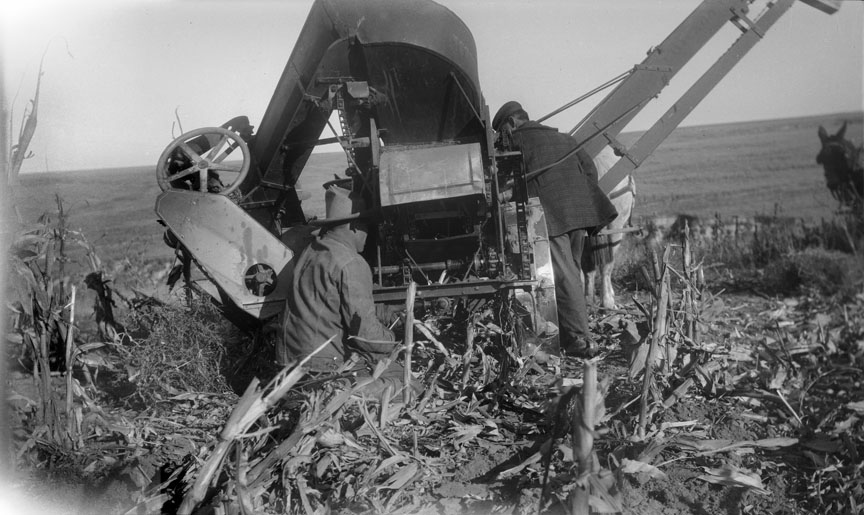
A team of hoses wait in the field for the corn harvester to be fixed. |

The Wyss family and crew in Nebraska work with multiple teams of mules and horses in the hilly fields. |
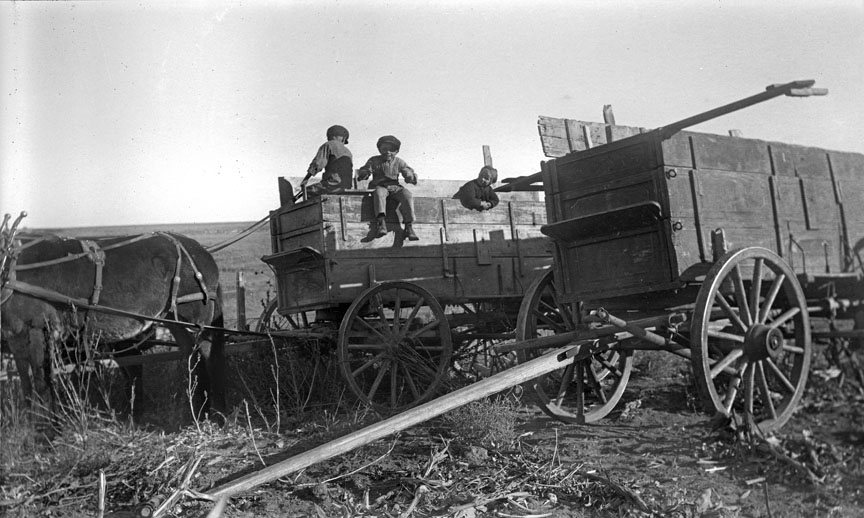
The kids play in the heavy duty wagons carrying the harvest. |
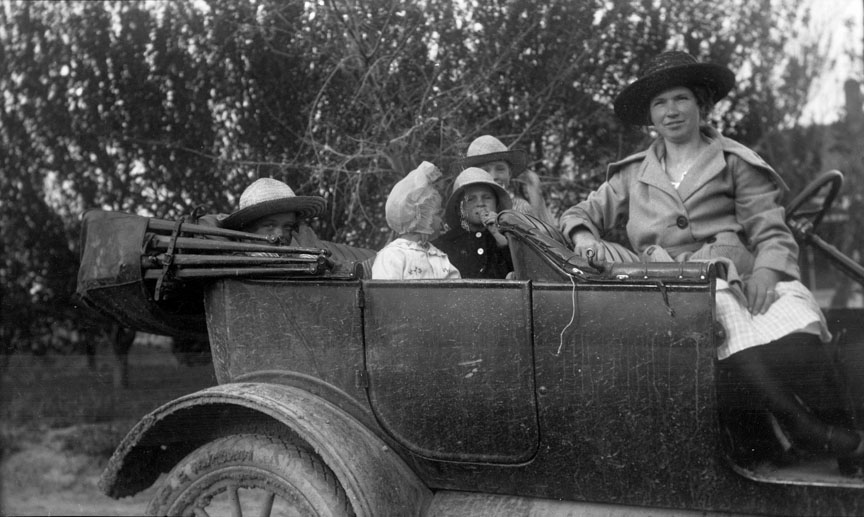
The family in the Ford, ready for a drive on the muddy farm roads. |

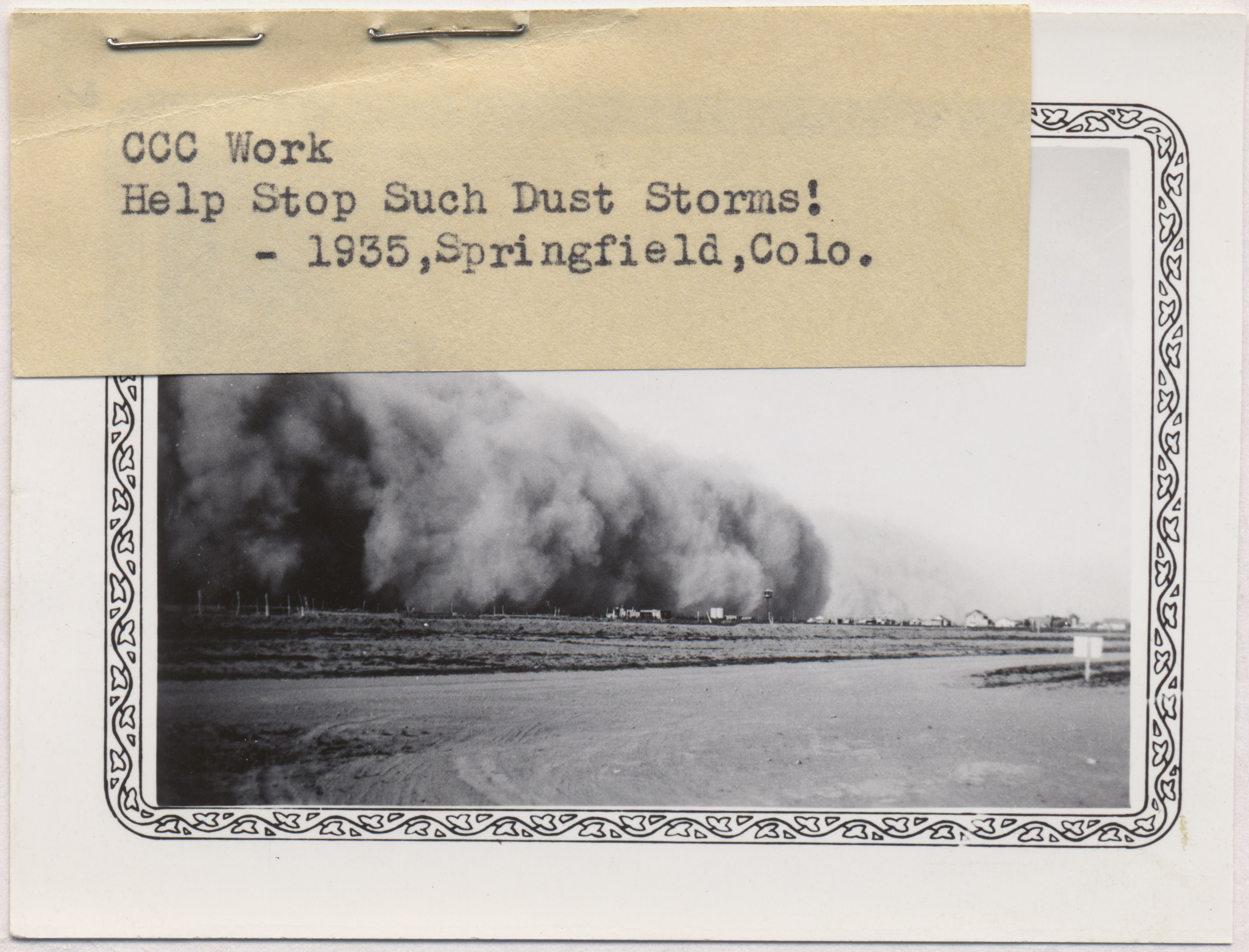
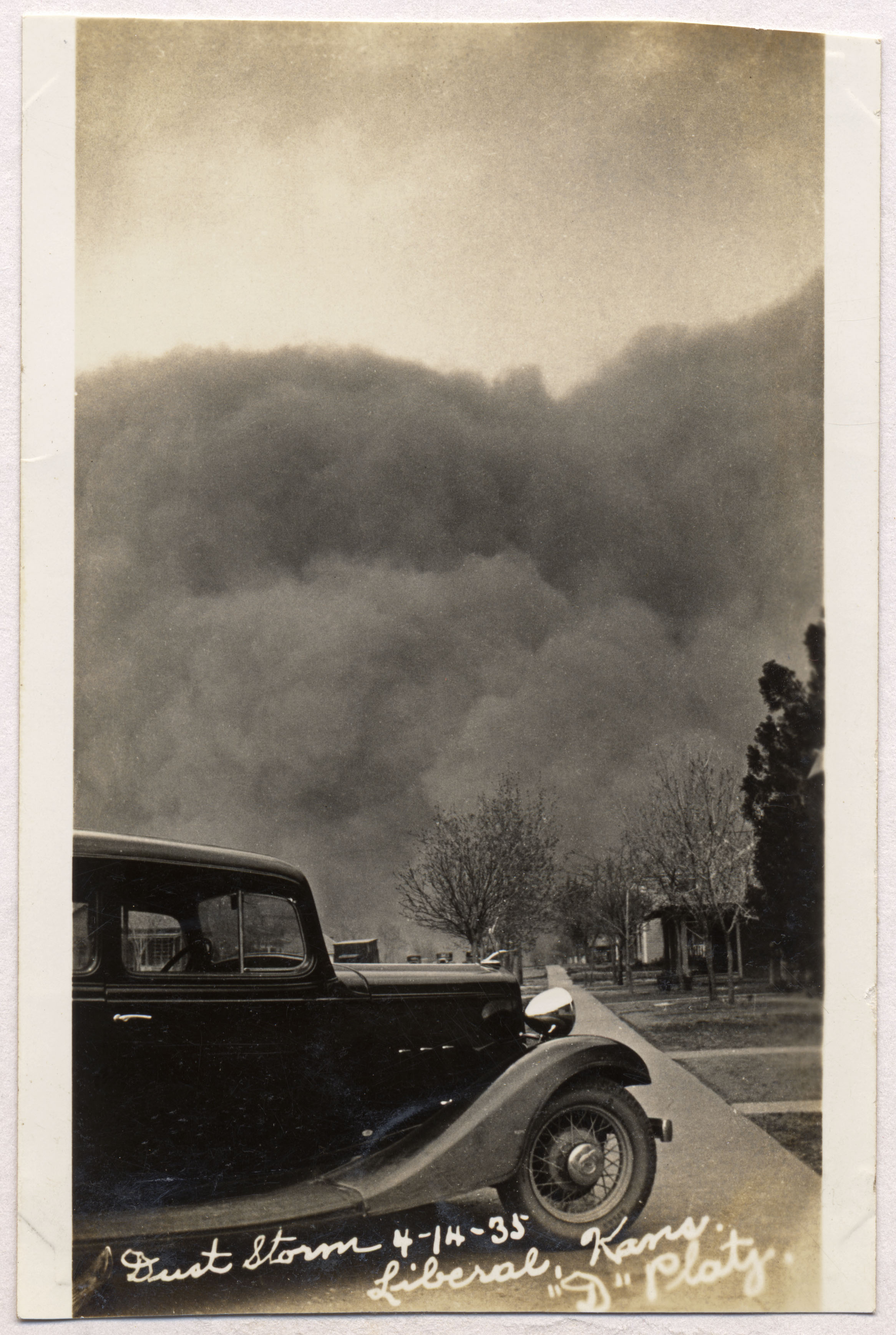
In the 1930s, farmers in Colorado and across the farm belt had to contend with extreme drought and high winds carrying away their top soil. Massive dust storms with walls of dirt picked up from over plowed prairies rolled through small towns and fields across the plains. This storm engulfed the small town of Springfield, southeast of Brighton in 1935. Dust storms would occur week after week for years darkening the skies and filling homes and farmers lungs with dust.
As crops failed in the Dust Bowl, the Civilian Conservation Corps (CCC), established in 1933 helped farmers with soil conservation and erosion control, like countour plowing and building terraces to prevent water drainage and soil erosion. These efforts were part of a broader response to the largest man made environmental crisis at the time, aimed at restoring the land and improving agricultural practices. |
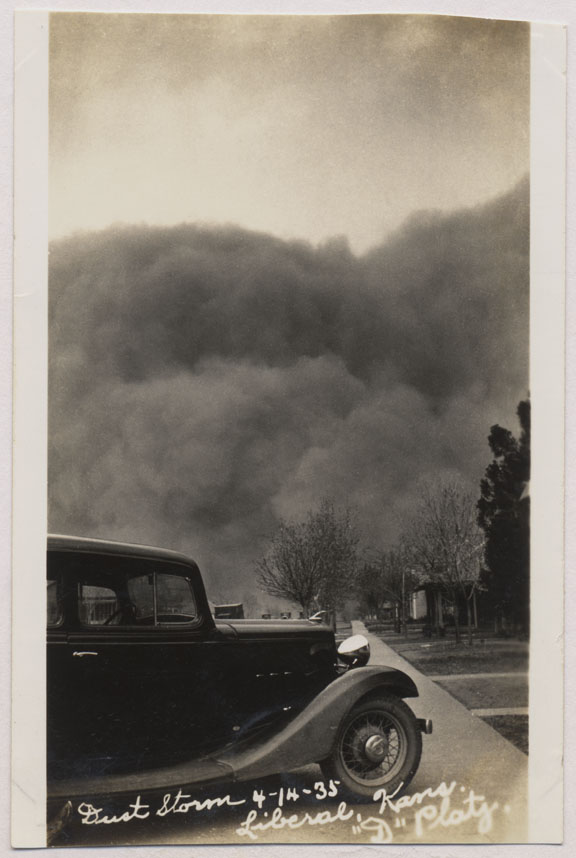
As massive dust storms turned day into night, small town residents would try and prevent dust from blowing in under the doors and windows by wetting cloth and jamming them into the cracks. In the kitchen, dishes would be turned over to keep them from filling up with dust. |
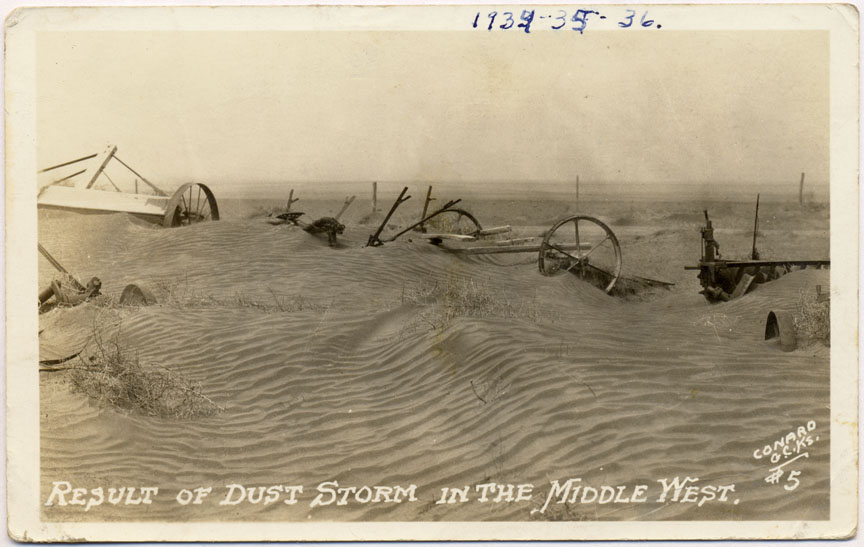
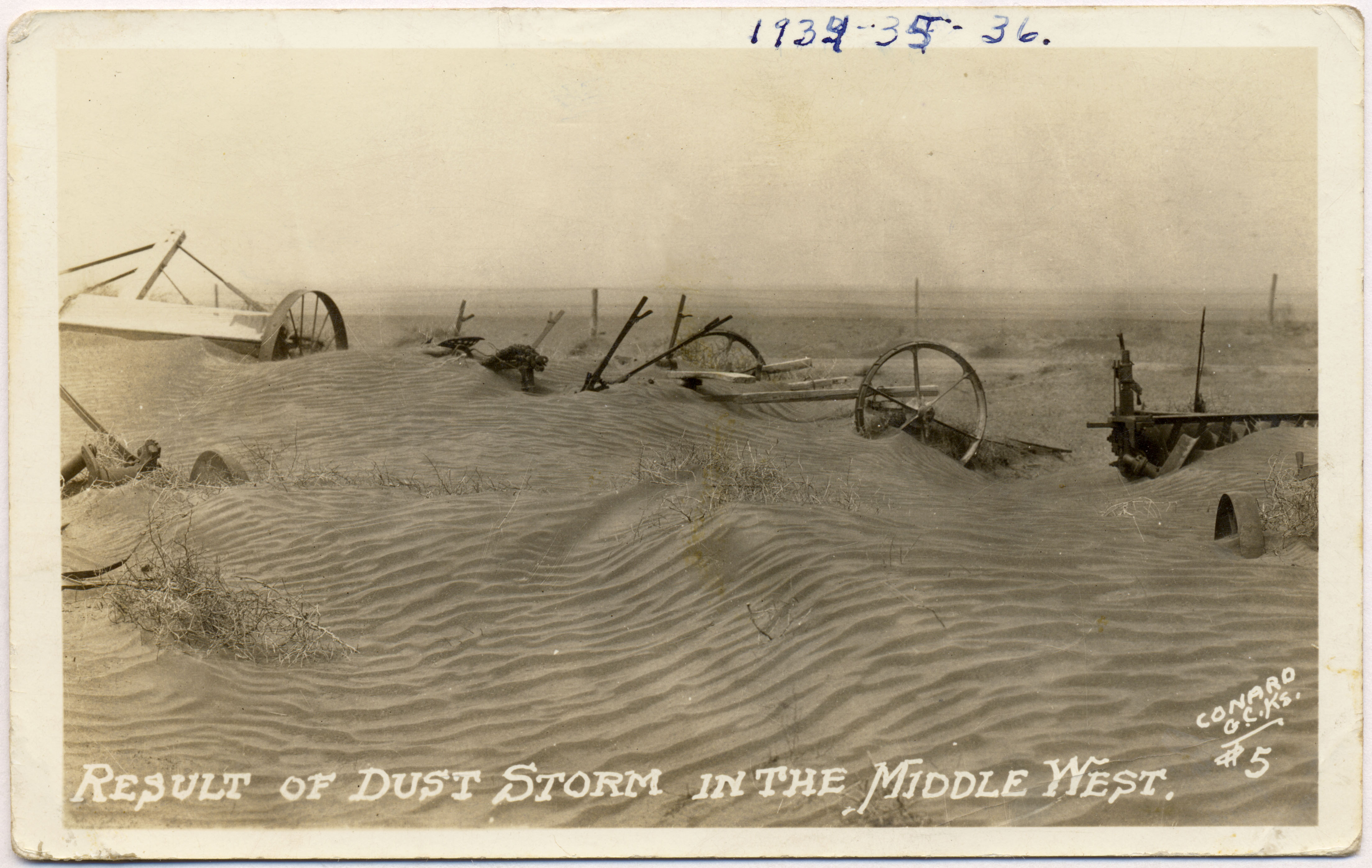
After a storm, many farmers would have to shovel out equipment from sand dunes in their fields and from drifts around their homes. If farming wasn't hard enough these storms pushed many into foreclosure and bankruptcy.
Just north of Brighton, the U.S. government began purchasing land in the mid-1930s to rehabilitate the soil and prevent further erosion. The Soil Conservation Bureau initiated efforts to restore the grasslands by replanting native grasses. In 1960, the Pawnee National Grasslands were established from degraded farmers fields as a response to the severe agricultural decline caused by the Dust Bowl and the harsh climate in northeastern Colorado.
William Madden and his family would have lived a hard life enduring harsh blizzards, devastating hail storms, crop killing dry summers, violent winds and repeated dust storms while trying to grow crops and raise animals. Farmers were and still are today, a determined and diehard breed all the while keeping the country fed despite the hardships. They certainly deserve our gratitude. |
DP Home | Feature | Gallery | About
|